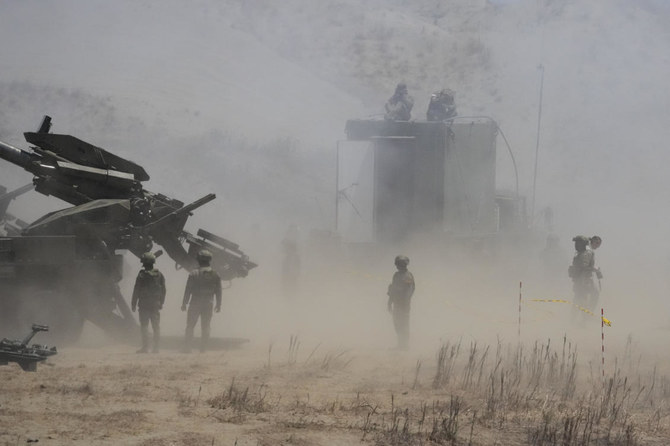
LAOAG, Philippines: Military force from the United States, Australian and the Philippines launched a barrage of high-precision rockets, artillery fire and airstrikes to sink a ship Wednesday as part of largescale war drills in waters facing the disputed South China Sea that have antagonized Beijing.
Military officials and diplomats from several countries, along with journalists, watched the display of firepower from a hilltop along a sandy coast in Laoag City on Wednesday in Ilocos Norte, Philippine President Ferdinand Marcos Jr.’s northern home province.
More than 16,000 military personnel from the United States and the Philippines, backed by a few hundred Australian troops and military observers from 14 countries were participating in annual combat-readiness drills called Balikatan, Tagalog for shoulder-to-shoulder, which started on April 22 and will end on Friday.
It’s the latest indication of how the United States and the Philippines have bolstered a defense treaty alliance that started in the 1950s.
Marcos has ordered his military to shift its focus to external defense from decades-long domestic anti-insurgency operations as China’s increasingly aggressive actions in the South China Sea become a top concern. That strategic shift dovetails with the efforts of President Joe Biden and his administration to reinforce an arc of alliances in the Indo-Pacific region to counter China.
China has angered the Philippines by repeatedly harassing its navy and coast guard ships with the use of powerful water cannons, a military-grade laser, blocking movements and other dangerous maneuvers in the high seas near two disputed South China Sea shoals that have led to minor collisions. Those have caused several injuries to Filipino navy personnel and damaged supply boats.
“We’re under the gun,” Philippine ambassador to Washington Jose Romualdez told The Associated Press in a telephone interview.
“We don’t have the wherewithal to be able to fight all of this bullying coming from China so where else will we go?” Romualdez asked. “We went to the right party which is the United States and those that believe in what the US is doing.”
China has accused the Philippines of setting off the hostilities in the disputed waters by encroaching into what it says are its offshore territories, demarcated by 10 dashes on a map. This has often prompted the Chinese coast guard and navy to take steps to expel Philippine coast guard and other vessels from that area. The Philippines, backed by the US and its allies and security partners, has repeatedly cited a 2016 international arbitration ruling based on the United Nations Convention of the Law of the Sea that invalidated China’s claim over virtually the entire South China Sea on historical grounds.
China did not participate in the arbitration complaint filed by the Philippines in 2013, rejected the ruling, and continues to defy it.
After an hour of the combat-readiness drills, black smoke started to billow from the stern of the mock enemy ship that was struck by missile fire and it started to sink ,as shown on a monitor watched by foreign military guests and journalists. US and Philippine warplanes later dropped bombs on the BRP Lake Caliraya, the target ship, which was made in China but decommissioned by the Philippine navy in 2020 due to mechanical and electrical issues, according to Philippine military officials.
Philippine military officials said the maneuvers would bolster the country’s coastal defense and disaster-response capabilities and claimed they were not aimed at any country. China has opposed military drills involving US forces in the region as well as increasing US military deployments, which it warned would ratchet up tensions and hamper regional stability and peace.
Washington and Beijing have been on a collision course over China’s increasingly assertive actions to defend its vast territorial claims in the South China Sea, and Beijing’s stated goal of annexing Taiwan, by force if necessary.
In February last year, Marcos approved a wider US military presence in the Philippines by allowing rotating groups of American military forces to stay in four more Philippine military camps. That was a sharp turnaround from his predecessor Rodrigo Duterte, who feared that a larger American military footprint could antagonize Beijing.
China strongly opposed the move, which would allow US forces to establish staging grounds and surveillance posts in the northern Philippines across the sea from Taiwan, and in western Philippine provinces facing the South China Sea.
China has warned that a deepening security alliance between Washington and Manila and their ongoing military drills should not harm its security and territorial interests or interfere in the territorial disputes. The Philippines countered that it has the right to defend its sovereignty and territorial interests.
“An alliance is very important to show China that you may have all the ships that you have, but we have a lot of firepower to sink all of them,” Romualdez said.


![]()

US, Philippine and Australian forces sink a ship during war drills in the disputed South China Sea
Short Url
https://arab.news/jhjue
US, Philippine and Australian forces sink a ship during war drills in the disputed South China Sea
- Philippine President Ferdinand Marcos Jr.has ordered his military to shift its focus to external defense from decades-long domestic anti-insurgency operations


Latest updates


© 2026 SAUDI RESEARCH & PUBLISHING COMPANY, All Rights Reserved And subject to Terms of Use Agreement.