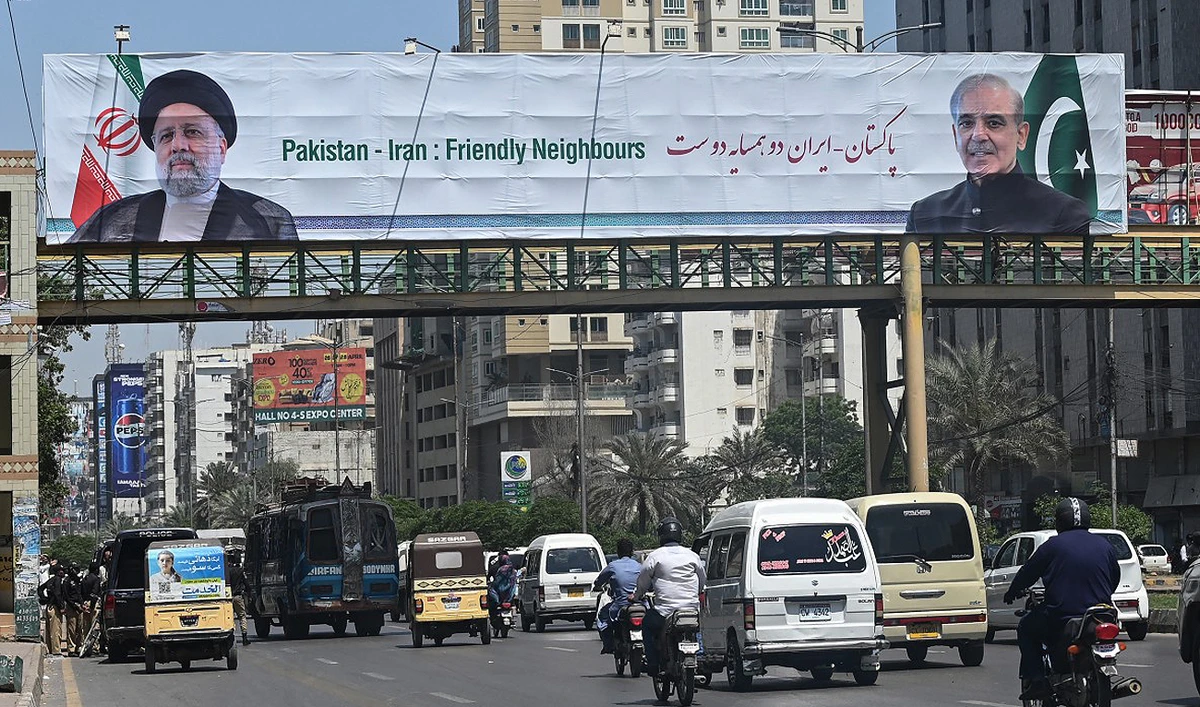
ISLAMABAD: Pakistan’s Deputy Prime Minister Ishaq Dar announced on Tuesday his country understood the sanctions risk involved in pursuing the Iran-Pakistan gas pipeline, though he said it would not take “dictation” from other states and follow its own interests.
Earlier this year in March, US Assistant Secretary of State for South and Central Asian Affairs Donald Lu told a Congressional hearing that President Joe Biden’s administration was trying to prevent the construction of the pipeline project that was agreed between the two countries in 2009.
His statement followed Pakistan’s decision to build an 80-kilometer pipeline segment from its border with Iran to the port city of Gwadar in the first phase.
Recent media reports also indicated the government was deliberating over engaging an international law firm to seek US sanctions waiver to implement the project.
“We are not concerned with what other countries say about the Iran-Pakistan gas pipeline project,” Dar said during a media talk in Islamabad. “We must prioritize our own interests, honor our commitments, and make decisions based on Pakistan’s interests.”
“We won’t be dictated to, nor will we allow anyone to veto our decisions,” he continued. “Pakistan is a sovereign nation, and we expect others to respect our sovereignty just as we respect theirs. The government will make the final decision on the IP gas pipeline.”
The deputy prime minister said the Iranian president visited Pakistan with sincerity, and the government conducted meetings and dialogues with him in a cordial environment.
“This project has long-standing complications, including sanctions from other countries, but we will prioritize Pakistan’s interests when making decisions about it,” he added.
The Iran-Pakistan gas pipeline, known as the Peace Pipeline, has faced significant delays in the past due to several reasons that include funding challenges.
Pakistan’s defense minister Khawaja Muhammad Asif also said last month his country had the right to buy gas at competitive rates from neighboring countries amid its ongoing economic problems.
Pakistan acknowledges sanctions risk for Iran gas pipeline, rejects foreign ‘dictation’
https://arab.news/gx3nn
Pakistan acknowledges sanctions risk for Iran gas pipeline, rejects foreign ‘dictation’
- Ishaq Dar says Pakistan will prioritize its own interest over the issue as a sovereign state
- The pipeline project has faced delays for several reasons including funding challenges
Pakistan marks Peshawar school attack anniversary with renewed vow against terrorism
- President recalls children killed in 2014 school massacre in Peshawar
- Attack remains one of the deadliest assaults on students globally
ISLAMABAD: Pakistan on Tuesday marked the 11th anniversary of the 2014 Army Public School (APS) terror attack in the northwestern city of Peshawar, with President Asif Ali Zardari reaffirming the country’s commitment to defeating terrorism and honoring the victims of one of the deadliest school massacres in modern history.
On December 16, 2014, gunmen affiliated with the Pakistani Taliban (TTP) stormed the APS campus in Peshawar, killing more than 150 people, including over 130 children, in an hours-long siege that shocked the country and drew international condemnation. The attack targeted students and staff and remains a defining moment in Pakistan’s fight against militancy.
The massacre prompted a nationwide crackdown on extremist groups, leading to the launch of major military operations and a series of counterterrorism measures, including the National Action Plan, aimed at dismantling militant networks and curbing violent extremism. While militant violence declined in subsequent years, Pakistan has seen a renewed surge in attacks since 2022, particularly in Khyber Pakhtunkhwa and Balochistan provinces.
“Today we remember the innocent children and staff of the Army Public School whose lives were taken in the brutal terrorist attack on 16 December 2014,” President Zardari said in a message issued on the anniversary. “Their sacrifice remains a solemn reminder of the heavy price our nation has paid in the fight against terrorism.”
He said Pakistan’s resolve against militancy remained unwavering, stressing that there could be “no soft corner for terrorists or those who support, finance, shelter or justify them,” and that there would be no negotiations with those who take up arms against the state or target civilians.
The president also condemned what he described as ongoing Indian-sponsored militancy in Pakistan, saying Islamabad would continue to expose hostile activities and defend its people, an allegation New Delhi has consistently denied.
Zardari paid tribute to the country’s security forces, law enforcement agencies and intelligence services, saying their efforts had prevented many attacks and would continue until all perpetrators and facilitators were brought to justice.
“The memory of the APS martyrs strengthens our resolve,” he said. “Pakistan will never allow the enemies of peace to succeed.”
The APS attack remains one of the world’s deadliest assaults on students and continues to shape Pakistan’s domestic security policies and public discourse on counterterrorism, education safety and extremism.


