

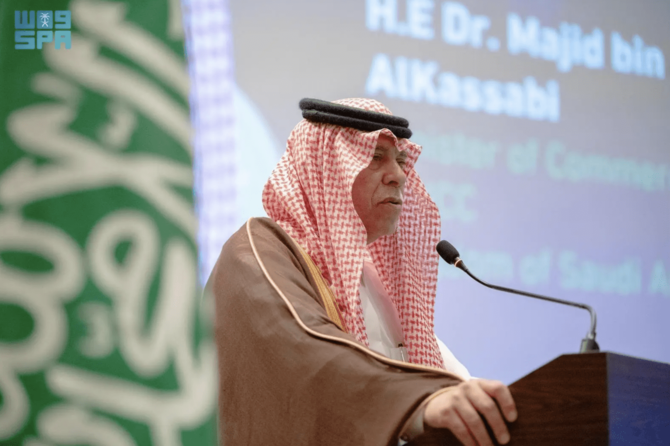

RIYADH: Economic ties between Saudi Arabia and Malaysia are set to soar with the launch of a business council aimed at catalyzing growth and collaboration across various sectors.
The council was inaugurated during the visit of Saudi Minister of Commerce Majed bin Abdullah Al-Qasabi, who led a delegation comprising 44 officials and leaders representing 20 government bodies and 24 private sector entities to the Southeast Asian country.
The minister announced the establishment of the business council, emphasizing its goal of enhancing economic relations between the two countries.
“We inaugurated today with the Minister of Investment, Trade and Industry, Tengku Zafrul Aziz the Saudi-Malaysian Business Council to contribute to strengthening economic and trade relations in the promising sectors in the two brotherly countries,” Al-Qasabi said in a post on his X account on May 6.
The Saudi minister further held a roundtable meeting with Aziz, attended by Sulaiman Mahbob, chairman of the Malaysian Investment Development Authority, and Dato Seri Reezal, chairman of the Malaysia External Trade Development Corp., along with Shaharul Sadri Alwi, director general of the Department of Standards Malaysia.
Al-Qasabi pointed out that the talks with Malaysian officials revolved around enhancing partnerships within the business sectors of both nations.
Concluding his visit to the Southeast Asian country, the commerce minister mentioned that he had also held meetings with Ewon Benedick, minister of entrepreneurship development; Mohamad Sabu, minister of agriculture and food industry; and Alexander Nanta Linggi, minister of works.
“We discussed cooperation in the areas of training, knowledge transfer, innovation, and sustainability, while also reviewing Malaysia’s experience in supporting small and medium-sized projects,” Al-Qasabi said.
During the meetings, efforts to encourage exports and enhance the capabilities of Saudi and Malaysian companies to access global markets were discussed, the Saudi Press Agency reported.
It added that collaboration in capacity building in innovation, emerging technologies, research programs, and e-commerce was emphasized.
Al-Qasabi affirmed that Saudi Arabia’s Vision 2030, launched by Crown Prince Mohammed bin Salman, has brought about significant transformations in the Saudi economy since its announcement in 2016.
He noted the close trade relations between Saudi Arabia and Malaysia, highlighting significant opportunities for expansion and diversification. The minister emphasized Saudi Arabia’s efforts to become a global hub for trade and logistics services.
In conjunction with the Saudi delegation’s visit to Malaysia, representatives from the Federation of Saudi Chambers, led by Secretary-General Waleed Al-Orainan, participated in the meeting aimed at exploring investment opportunities in both countries.
The meeting concluded with the signing of significant partnership and investment agreements between the two sides.
Al-Orainan and the President of the National Chamber of Commerce of Malaysia, Tan Datu, signed an agreement to enhance economic cooperation.
Moreover, private sector companies from both countries held bilateral meetings and signed trade and investment partnership agreements in multiple sectors.


