

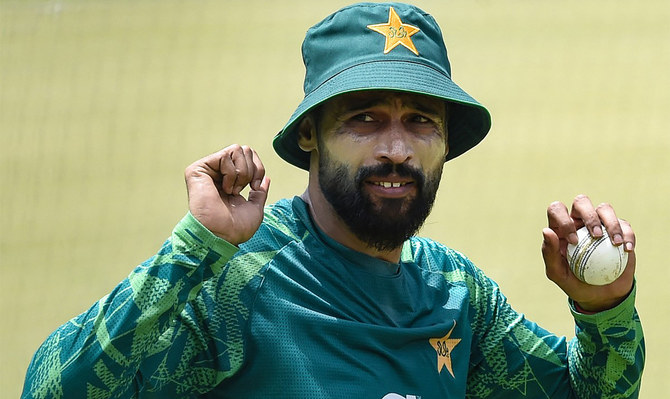

KARACHI: Rejuvenated fast bowler Mohammad Amir said he has “unfinished work” at next month’s T20 World Cup, 15 years after dazzling as a teenager when Pakistan last lifted the trophy.
The 32-year-old, who was jailed for spot-fixing in 2011, came out of retirement last month and is grateful to have another crack at the World Cup.
“It’s a great feeling to be playing for Pakistan again,” Amir told AFP by phone from Lahore this week ahead of the tournament in the United States and the West Indies beginning on June 2.
“I want to complete the unfinished work and, for me, the short-term goal is to win the World Cup.”
The young Amir impressed in all formats after breaking into the Pakistan side in 2009 and playing at the T20 World Cup.
Within a year he was one of the hottest young talents in cricket, but his precocious career then crashed to an infamous halt in 2010.
Amir was one of three Pakistan players banned from cricket for five years for spot-fixing during a Test match in England after being caught in a newspaper sting. He was later jailed in the UK for six months.
Pakistan captain Salman Butt, who was deemed the ringleader, and fellow quick bowler Mohammad Asif were also banned and the pair were jailed for 30 and 12 months respectively.
Amir returned after his ban to play for Pakistan in 2016 but announced a shock retirement in December 2020 after poor form kept him from being selected.
He will form a potent pace bowling attack with spearhead Shaheen Shah Afridi, Naseem Shah and Haris Rauf that sees Pakistan ranked among the World Cup favorites.
“The Pakistan Cricket Board and the team management have shown trust in me so I have to fulfil that trust,” said Amir.
“I have come back after four years and when you play for your country the feeling cannot be described.”
Amir played three of the four T20 home matches against New Zealand last month, taking three wickets in a 2-2 drawn series, and said he felt part of the attack again.
“To be honest I felt fitter than in 2019 and until you are fit you cannot express yourself, so I am ready to do better and better,” said Amir.
He will be in action when Pakistan travel to Ireland for three T20s in Dublin on May 10, 12 and 14.
Pakistan then move to England to play the defending T20 world champions in Leeds (May 22), Birmingham (May 25), Cardiff (May 28) and London (May 30).
Brought up in Changa Bangial village in Punjab province, some 60 kilometers from the capital Islamabad, Amir was determined to make his name in cricket after his five older brothers introduced him to playing.
He was picked out at the age of 15 by none other than great left-armer Wasim Akram at a fast-bowling camp and within two years grew in height and overcame a stress fracture of the back.
Amir said now he only wanted to remember the good events in his career.
“The 2009 Twenty20 World Cup winning memories are special and excite me to this day,” said Amir, who took six wickets in seven matches in the tournament.
They included the prize dismissal of Sri Lanka opener Tillakaratne Dilshan — the player of the tournament — in Pakistan’s eight-wicket final victory.
“I was selected for the first time and then became part of a champion team.
“When I landed (back) at Rawalpindi airport to go to my village there were so many cars and they were showering flowers on me,” he recalled.
“I am lucky that I am still playing. When I came, I was the youngest in the team, so here I am having another chance to win the World Cup and that is the target for me and my team.”


