

Advocacy group ‘alarmed’ as journalists shot at in West Bank

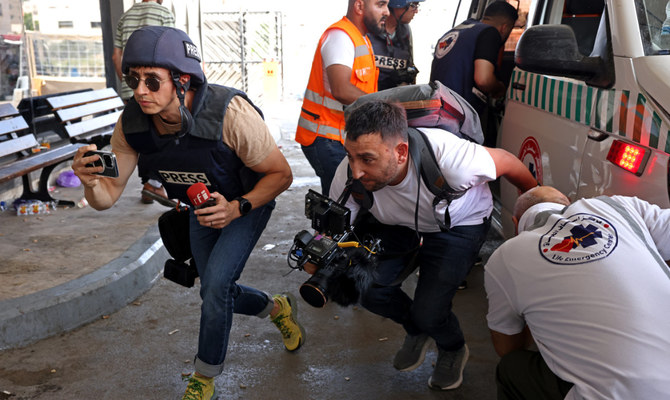
Journalists rush for cover inside a hospital in Jenin in the occupied West Bank amid an Israeli army raid. (AFP/File)
Short Url
Updated 06 May 2024
Follow

Advocacy group ‘alarmed’ as journalists shot at in West Bank

  • Al-Araby TV workers were not injured but their equipment was destroyed
  • Ameed Shehade, Rabih Al-Monayar were wearing ‘Press’ vests at time of attack

LONDON: American advocacy group the Committee to Protect Journalists says it is “extremely concerned” after hearing reports that two Al-Araby TV journalists were shot at by Israeli forces in the West Bank on Saturday.

Reporter Ameed Shehade and camera operator Rabih Al-Monayar came under fire while they were covering an Israeli raid on the village of Deir al-Ghusun in Tulkarm.

Neither of the men was injured in the attack but their equipment was destroyed.

The CPJ urged Israel to launch an investigation into whether the journalists were deliberately targeted.

“CPJ is alarmed by the Israeli soldiers’ shooting at two Al-Araby TV journalists, which hit their camera, while they were reporting in the West Bank,” the group’s Program Director Carlos Martinez de la Serna said.

Although he was “relieved” that the journalists had not been injured, he said he questioned whether the targeting was intentional as it was the second case of reporters being attacked while doing their jobs.

Al-Araby TV aired footage of the two men, who were wearing blue vests labeled “Press,” taking cover near their car.


Shehade said the shots were fired from a vehicle about 20 meters (22 yards) away and that they were clearly visible to the soldier.

Another journalist who was reporting on the raids confirmed that Shehade and Al-Monayar could be easily identified as members of the press.

According to The Guardian, Israeli forces killed five Palestinians in the overnight raid. Hamas confirmed that four of the men killed were from its al-Qassam armed wing.

Al-Monayar and Shehade suffered a similar attack in July last year while reporting on an Israeli operation against militants in the Jenin refugee camp in the West Bank. They again escaped personal injury but their video equipment was damaged.


Paris exhibition marks 200 years of Le Figaro and the enduring power of the press

Updated 17 January 2026
Follow

Paris exhibition marks 200 years of Le Figaro and the enduring power of the press

  • The exhibition celebrated the bicentennial of Le Figaro, offering visitors a rare opportunity to step inside the newspaper’s vast historical archive

PARIS: One of France’s most influential newspapers marked a major milestone this month with a landmark exhibition beneath the soaring glass nave of the Grand Palais, tracing two centuries of journalism, literature and political debate.
Titled 1826–2026: 200 years of freedom, the exhibition celebrated the bicentennial of Le Figaro, offering visitors a rare opportunity to step inside the newspaper’s vast historical archive. Held over three days in mid-January, the free exhibition drew large crowds eager to explore how the title has both chronicled and shaped modern French history.
More than 300 original items were displayed, including historic front pages, photographs, illustrations and handwritten manuscripts. Together, they charted Le Figaro’s evolution from a 19th-century satirical publication into a leading national daily, reflecting eras of revolution, war, cultural change and technological disruption.
The exhibition unfolded across a series of thematic spaces, guiding visitors through defining moments in the paper’s past — from its literary golden age to its role in political debate and its transition into the digital era. Particular attention was paid to the newspaper’s long association with prominent writers and intellectuals, underscoring the close relationship between journalism and cultural life in France.
Beyond the displays, the program extended into live journalism. Public editorial meetings, panel discussions and film screenings invited audiences to engage directly with editors, writers and media figures, turning the exhibition into a forum for debate about the future of the press and freedom of expression.
Hosted at the Grand Palais, the setting itself reinforced the exhibition’s ambition: to place journalism firmly within the country’s cultural heritage. While the exhibition has now concluded, the bicentennial celebrations continue through special publications and broadcasts, reaffirming Le Figaro’s place in France’s public life — and the enduring relevance of a free and questioning press in an age of rapid change.