

Pakistan’s deaf-staffed beauty salon provides economic opportunity, empowers hearing impaired

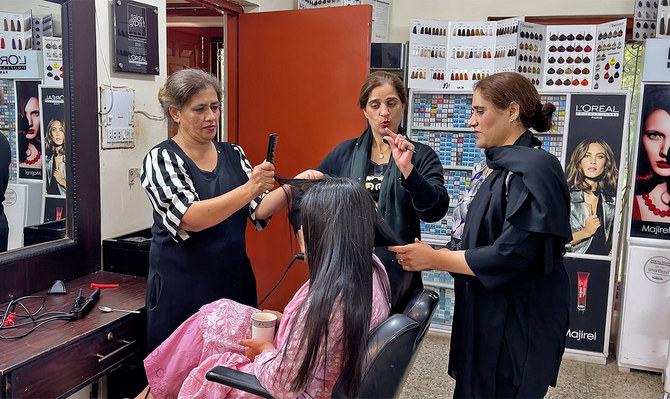
Staff at Options beauty salon interact with each other using sign language while styling a customer's hair on May 2, 2024, in Abbotabad, Pakistan. (AN Photo)
Short Url
Updated 07 May 2024
Follow

Pakistan’s deaf-staffed beauty salon provides economic opportunity, empowers hearing impaired

  • There are seven deaf beauticians out of a total of 12 employed at Options Salon in Abbottabad 
  • According to the World Health Organization, deaf population in Pakistan is around 10 million people

ABBOTTABAD: Eight years ago, while offering a training class at her Options beauty salon in the northwestern Pakistani city of Abbottabad, Nighat Aftab received an unlikely application: that from a deaf girl who wanted to attend the training and join her salon. 

“I didn’t have much experience working with such women and at first, I hesitated a little that how could I hire such a person whose language I don’t understand?” Aftab told Arab News in an interview earlier this month. “But then I said, ‘Come, join me’.”

Today, there are seven deaf beauticians out of a total of 12 employed at Options, which has since become a sanctuary for women with hearing and speech impairments, providing them economic opportunity, a chance to be financially independent and earn for their families, and a place where they can be part of a supportive, inclusive community.

According to the World Health Organization, the deaf population in Pakistan is around 10 million people. Pakistan has one of the lowest percentages of female labor force participation in South Asia and women with disabilities face even more impediments to employment.

“Previously, I used to work at a parlor in Islamabad where my salary wasn’t great, and I used to miss home a lot,” beautician Saima Mir told Arab News in sign language as Aftab translated for her. 

“Now I am very happy. I like working here. There are many here who cannot hear and speak, it makes me happy.”
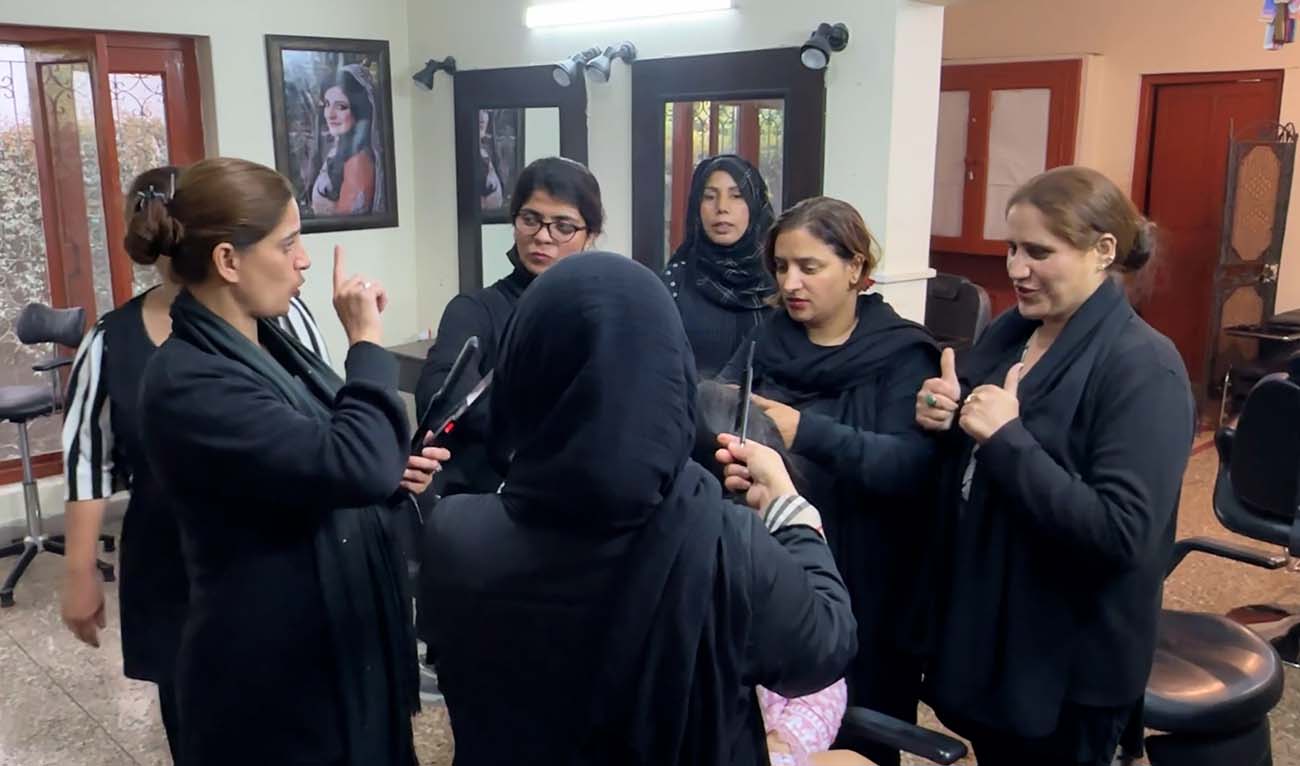


Staff at Options beauty salon interact with each other using sign language while styling a customer's hair on April 2, 2024, in Abbotabad, Pakistan. (AN Photo)

Others also said they felt a “sense of belonging” at the Options Salon.

“I have my mother and father. They are old. I feel frustrated at home as there is nobody with whom I can talk and share,” Isma Mushtaq told Arab News. “I come here and I spend time here happily.”

While many of the salon’s loyal customers are now used to communicating with the deaf staff members, that was not always the case, Aftab recalled, saying she faced criticism in the beginning by clients struggling to communicate with her workers. To bridge the gap, deaf workers were teamed up with those from the hearing community.

“The difficulties we faced [with communication] in the beginning got resolved over time,” said Sobia Khan, a beautician from the hearing community. 

And the troubles had been worth it, Aftab said.

“I might have closed down the salon by now because my daughters are now married and I want to enjoy my own life but I am committed because of these young women [deaf workers] and I am unable to quit because their employment is attached to me,” she said. 

“And because of them, Allah has blessed me with health. I am able to come to work daily, even though I am not that healthy, but I am happy here.”


Sindh assembly passes resolution rejecting move to separate Karachi

Updated 21 February 2026
Follow

Sindh assembly passes resolution rejecting move to separate Karachi

  • Chief Minister Shah cites constitutional safeguards against altering provincial boundaries
  • Calls to separate Karachi intensified amid governance concerns after a mall fire last month

ISLAMABAD: The provincial assembly of Pakistan’s southern Sindh province on Saturday passed a resolution rejecting any move to separate Karachi, declaring its territorial integrity “non-negotiable” amid political calls to carve the city out as a separate administrative unit.

The resolution comes after fresh demands by the Muttahida Qaumi Movement (MQM) and other voices to grant Karachi provincial or federal status following governance challenges highlighted by the deadly Gul Plaza fire earlier this year that killed 80 people.

Karachi, Pakistan’s largest and most densely populated city, is the country’s main commercial hub and contributes a significant share to the national economy.

Chief Minister Syed Murad Ali Shah tabled the resolution in the assembly, condemning what he described as “divisive statements” about breaking up Sindh or detaching Karachi.

“The province that played a foundational role in the creation of Pakistan cannot allow the fragmentation of its own historic homeland,” Shah told lawmakers, adding that any attempt to divide Sindh or separate Karachi was contrary to the constitution and democratic norms.

Citing Article 239 of Pakistan’s 1973 Constitution, which requires the consent of not less than two-thirds of a provincial assembly to alter provincial boundaries, Shah said any such move could not proceed without the assembly’s approval.

“If any such move is attempted, it is this Assembly — by a two-thirds majority — that will decide,” he said.

The resolution reaffirmed that Karachi would “forever remain” an integral part of Sindh and directed the provincial government to forward the motion to the president, prime minister and parliamentary leadership for record.

Shah said the resolution was not aimed at anyone but referred to the shifting stance of MQM in the debate while warning that opposing the resolution would amount to supporting the division of Sindh.

The party has been a major political force in Karachi with a significant vote bank in the city and has frequently criticized Shah’s provincial administration over its governance of Pakistan’s largest metropolis.

Taha Ahmed Khan, a senior MQM leader, acknowledged that his party had “presented its demand openly on television channels with clear and logical arguments” to separate Karachi from Sindh.

“It is a purely constitutional debate,” he told Arab News by phone. “We are aware that the Pakistan Peoples Party, which rules the province, holds a two-thirds majority and that a new province cannot be created at this stage. But that does not mean new provinces can never be formed.”

Calls to alter Karachi’s status have periodically surfaced amid longstanding complaints over governance, infrastructure and administrative control in the megacity, though no formal proposal to redraw provincial boundaries has been introduced at the federal level.