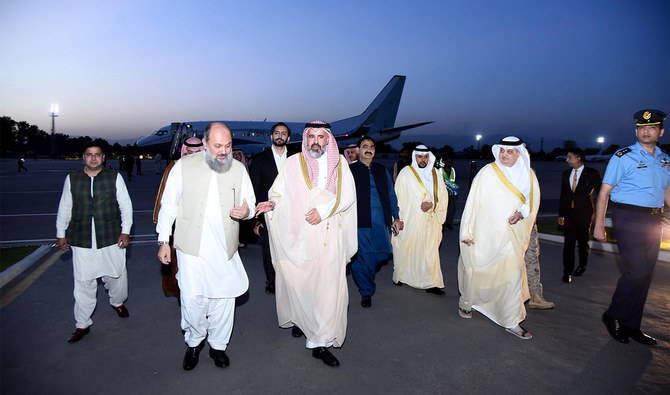

ISLAMABAD: A two-day Pakistan-Saudi investment conference is set to begin in Islamabad today, Monday, a day after a high-powered business delegation arrived in Pakistan from Riyadh to discuss trade and investments.
The 50-member Saudi delegation is led by Assistant Minister of Investment Ibrahim Al-Mubarak and comprises some 30 Saudi companies from the fields of information technology, telecoms, energy, aviation, construction, mining exploration, agriculture and human resource development.
“[Pakistani commerce] ministry had selected a large number of Pakistani companies in the respective sectors whose officials would have business-to-business meetings with their Saudi counterparts, and would hopefully enter into business and investment deals,” Pakistani news wire APP said.
“Pakistan would welcome and fully facilitate investments and partnerships from Saudi Arabia in IT, minerals, textiles, food security, engineering and energy sectors.”
During the first half of the current financial year, bilateral trade between Pakistan and Saudi Arabia was recorded at $2.482 billion, with Pakistan’s exports of $262.58 million and Saudi exports of $2.219 billion.
Pakistan and Saudi Arabia have been closely working in recent weeks to increase bilateral trade and investment deals, with Crown Prince Mohammed bin Salman also reaffirming the Kingdom’s commitment to expedite an investment package of $5 billion.
The business delegation’s visit comes on the heels of one by Sharif to Riyadh from Apr. 27-30 to attend a special two-day meeting of the World Economic Forum.
On the sidelines of the WEF conference, the Pakistani PM met and discussed bilateral investment and economic partnerships with the crown prince and the Saudi ministers of finance, industries, investment, energy, climate, and economy and planning, the adviser of the Saudi-Pakistan Supreme Coordination Council and the presidents of the Saudi central bank and Islamic Development Bank.
This was Sharif’s second meeting with the crown prince in a month. Before that he also met him when he traveled to the Kingdom on April 6-8. The Saudi foreign minister was also in Pakistan last month, during which Pakistan pitched projects worth at least $20 billion to Riyadh.
Pakistan and Saudi Arabia enjoy strong trade, defense and cultural ties. The Kingdom is home to over 2.7 million Pakistani expatriates and serves as a top source of remittances to the cash-strapped South Asian country.
Saudi Arabia has often come to Pakistan’s aid in the past, regularly providing it oil on deferred payments and offering direct financial support to help stabilize its economy and shore up forex reserves.
As things stand, Pakistan desperately needs to shore up its foreign reserves and is in talks with the International Monetary Fund (IMF) for a new bailout deal, for which it needs to signal that it can continue to meet requirements for foreign financing which has been a key demand in previous loan packages.
Last year Pakistan set up the Special Investment Facilitation Council, a body consisting of Pakistani civilian and military leaders and specially tasked to promote investment in Pakistan. The council is so far focusing on investments in the energy, agriculture, mining, information technology and aviation sectors and specifically targeting Gulf nations.