Global advocacy group says over 300 journalists faced state repression in Pakistan in one year

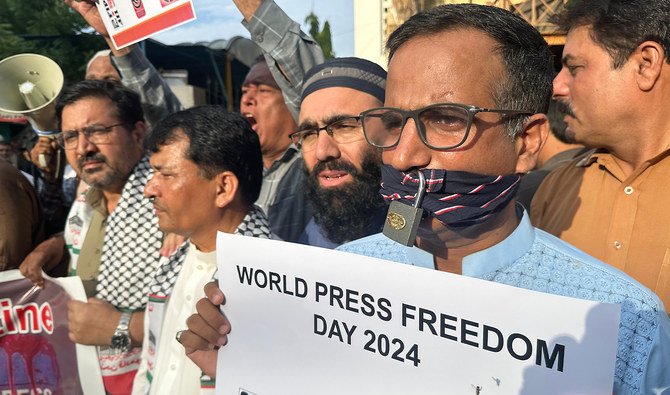
Pakistani journalists hold a protest demonstration in solidarity with Palestinian counterparts in Karachi, Pakistan on May 3, 2024. (AN photo)
Short Url
Updated 03 May 2024
Follow

Global advocacy group says over 300 journalists faced state repression in Pakistan in one year

  • International Federation of Journalists says 8 media workers were charged for sedition, terrorism, incitement to violence
  • It mentions the plight of Afghan journalists in exile, safety issues of Pakistani women journalists in online and offline spaces

ISLAMABAD: A leading global advocacy group for journalists’ rights on Friday highlighted alarming challenges faced by the media in Pakistan on Friday, saying that more than 300 people associated with the information industry faced repressive state tactics designed to quell dissent during the course of about a year.

The International Federation of Journalists (IFJ) released its country report on Pakistan on World Press Freedom Day that falls on May 3.

The report highlighted the persistent threats to freedom of expression, safety concerns, gender inequality, and the impact of disinformation on the local media industry.

“Over 300 journalists and bloggers this year were affected by state coercion and targeted, including dozens of journalists arrested for durations between several hours to four weeks and nearly 60 served legal notices or summons for their journalism work or personal dissent online,” the IFJ Pakistan country report for 2023-2024 said. “At least eight were charged for alleged sedition, terrorism and incitement to violence – all serious charges carrying lengthy sentences and even the death penalty.”

It maintained that most of these cases stemmed from the perceived or actual support of these journalists for former prime minister Imran Khan and his political party.

“In this sense, the principal threat actor behind crimes against journalists and free speech practitioners was undoubtedly the state and its functionaries, though some regional sects, non-state actors and gangsters were also involved in some cases,” the report added.

The IFJ described the judicial intervention in these matters as “the silver lining,” saying it thwarted the government’s attempts to entangle journalists “in legal proceedings as a tool of deterring dissent.”

The report noted four journalists were killed during the period under review while at least 59 journalists and bloggers were charged with sedition, terrorism, incitement to violence, defamation or contempt.

“Of these, 47 journalists were served legal summons to respond to allegations of targeted defamation and incitement against judges of the superior judiciary,” it continued.

The report also maintained the safety of women journalists in Pakistan’s online and offline spaces remained a persistent challenge.

“They continued to face gender-based discrimination, journalism work-related intimidation and under-representation in the industry,” it said.

The IFJ said this environment led to self-censorship among journalists and media outlets, especially while writing on topics concerning religion and law.

It also highlighted the plight of Afghan journalists, saying nearly 200 of them had fled to Pakistan after the Taliban takeover in August 2021.

“In October 2023, Pakistan’s government unilaterally demanded that Afghan refugees return to Afghanistan, setting a deadline of one month before authorities began forced deportations,” it recalled. “Amongst the refugees were 200 journalists who had fled to Pakistan to escape stifling restrictions on free speech in Afghanistan.”

The organization said it had called for financial and legal assistance for these journalists to support their sustenance and freedom to report.


Pakistan says responding to Afghan ‘offensive operations’ after border fire as tensions escalate

Updated 26 February 2026
Follow

Pakistan says responding to Afghan ‘offensive operations’ after border fire as tensions escalate

  • Afghan Taliban spokesperson says “large-scale offensive operations” launched against Pakistani military bases
  • Pakistan says Afghan forces opened “unprovoked” fire across multiple sectors along shared border

ISLAMABAD: Afghanistan’s Taliban authorities said on Thursday they had launched “large-scale offensive operations” against Pakistani military bases and installations, prompting Pakistan to say its forces were responding to what it described as unprovoked fire along the shared border.

The escalation follows Islamabad’s weekend airstrikes targeting what it said were Tehreek-e-Taliban Pakistan (TTP) and Daesh militant camps inside Afghanistan in response to a wave of recent bombings and attacks in Pakistan. Islamabad said the strikes killed over 100 militants, while Kabul said dozens of civilians were killed and condemned the attacks as a violation of its sovereignty.

In a post on social media platform X, Afghan government spokesperson Zabihullah Mujahid said Afghanistan had launched “large-scale offensive operations” in response to repeated violations by the Pakistani military.


Pakistan’s Ministry of Information said Afghan forces had initiated hostilities along multiple points of the frontier.

“Afghan Taliban regime unprovoked action along the Pakistan–Afghanistan border given an immediate, and effective response,” the ministry said in a statement.

The statement said Pakistani forces were targeting Taliban positions in the Chitral, Khyber, Mohmand, Kurram and Bajaur sectors, claiming heavy Afghan casualties and the destruction of multiple posts and equipment. It added that Pakistan would take all necessary measures to safeguard its territorial integrity and the security of its citizens.


Separately, security officials said Pakistani forces had carried out counterattacks in several border sectors.

“Pakistan’s security forces are giving a befitting reply to the unprovoked Afghan aggression with full force,” a security official said, declining to be named. 

“The Pakistani security forces’ counter-attack destroyed Taliban’s hideouts and the Khawarij fled,” they added, referring to TTP militants. 

The claims from both sides could not be independently verified.

Cross-border violence has intensified in recent weeks, with Pakistan blaming a surge in suicide bombings and militant attacks on militants it says are based in Afghanistan. Kabul denies providing safe havens to anti-Pakistan militant groups.

The clashes mark the third major escalation between the neighbors in less than a year. Similar Pakistani strikes last year triggered weeklong clashes before Qatar, Türkiye and other regional actors mediated a ceasefire in October.

The 2,600-kilometer (1,600-mile) frontier, a key trade and transit corridor linking Pakistan to landlocked Afghanistan and onward to Central Asia, has faced repeated closures amid tensions, disrupting commerce and humanitarian movement. Trade between the two nations has remained closed since October 2025.