Pakistani think tank reports significant surge in militant attacks with 70 killed in April

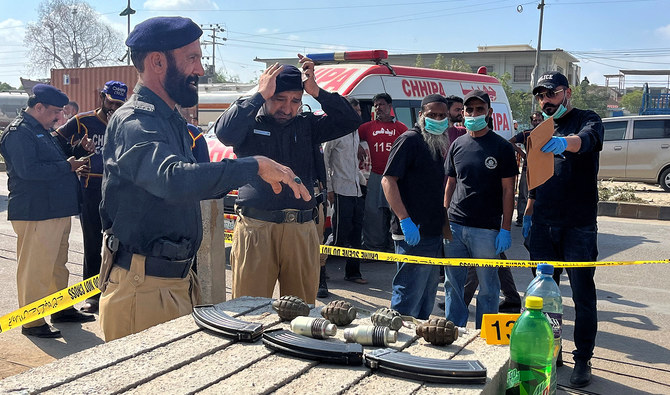
In this file photo, taken on April 19, 2024, police officers survey the site after a suicide blast in Karachi. (REUTERS/File)
Short Url
Updated 02 May 2024
Follow

Pakistani think tank reports significant surge in militant attacks with 70 killed in April

  • Pakistan Institute for Conflict and Security Studies says Khyber Pakhtunkhwa suffered maximum militant violence
  • Pakistan has endured 323 militant attacks during the first four months of the year, resulting in 324 fatalities

ISLAMABAD: A Pakistani think tank circulated a report on a significant increase in the number of militant attacks in the country on Wednesday, saying 70 people lost their lives in at least 77 verifiable episodes of extremist violence in the month of April.
Pakistan has witnessed a prolonged surge in militant attacks since the breakdown of a fragile ceasefire between the government and a proscribed armed network, Tehreek-e-Taliban Pakistan (TTP), in November 2022.
Apart from TTP fighters, other extremist and separatist groups have also targeted Pakistani security forces and civilians in recent months.
According to Pakistan Institute for Conflict and Security Studies (PICSS), there was a brief lull in March before militant groups resumed their activities last month, with the northwester Khyber Pakhtunkhwa province, particularly its southern districts, bearing the brunt.
“According to PICSS statistics, the country experienced at least 77 verifiable militant attacks during April, resulting in 70 fatalities, including 35 civilians and 31 security forces personnel, with four militants killed, and 67 individuals injured, among whom were 32 civilians and 35 security forces personnel,” the security report said.
“In comparison, March 2024 saw 56 militant attacks, resulting in 77 fatalities and 67 injuries,” it continued. “This indicates a 38 percent increase in the number of militant attacks, although there was a 9 percent decline in deaths, with no change in the number of injuries.”
The Islamabad-based think tank informed Balochistan witnessed 16 attacks, resulting in 21 fatalities, including 17 civilians and four security forces personnel, with 31 individuals injured.
Punjab also experienced a surge in militant activities, with four attacks reported in April compared to one in March, resulting in three fatalities.
“In the first four months of the year, Pakistan experienced a total of 323 militant attacks, resulting in 324 fatalities and 387 injuries,” the report added.


Pakistan welcomes Afghan scholars’ reported resolution against use of soil for cross-border attacks

Updated 5 sec ago
Follow

Pakistan welcomes Afghan scholars’ reported resolution against use of soil for cross-border attacks

  • Around 1,000 Afghan scholars passed a resolution this week prohibiting use of Afghan soil for cross-border attacks against another country, Afghan media reported
  • Development takes place as tensions persist between Pakistan and Afghanistan amid Islamabad’s allegations of Taliban supporting cross-border attacks against it 

ISLAMABAD: Pakistan’s foreign office spokesperson on Thursday welcomed a resolution reportedly passed by Afghan scholars against allowing the use of Afghan soil for attacks against any other country, but still demanded written assurances of the same from the Afghan leadership. 

According to a report published by Afghan news channel Tolo News, around 1,000 Afghan scholars gathered in Kabul on Wednesday to pass a resolution that, among other things, said no one will be allowed to use Afghanistan’s soil against other countries for attacks. The resolution also said that if anyone fails to comply with this decision, the Afghan government has the right to take action against them.

The development takes place as tensions persist between Afghanistan and Pakistan. Both countries have engaged in border clashes since October, with Islamabad accusing Kabul of harboring militants that launch attacks on Pakistan.

Afghanistan denies the allegation and says it cannot be held responsible for Pakistan’s security. 

Speaking to reporters during a weekly press briefing, Foreign Office spokesperson Tahir Andrabi said he had not seen the full text of the resolution. 

“Any developments with regards to the fact that Afghan leadership, the segment of Afghan society, realized the gravity of the situation that their soil is being used by not just TTP, but also by their own nationals to perpetrate terrorism in Pakistan — any realization to this effect is positive and one would certainly welcome it,” Andrabi said.

However, he said similar commitments by Kabul on preventing cross-border attacks have been made in the past but were not honored. 

Pakistan and Kabul engaged in a series of peace talks in Istanbul and Doha recently after their deadly border clashes in October. Andrabi pointed out that Islamabad had insisted on getting written assurances from the Afghan leadership that they would prevent Afghan soil from being used by the Pakistani Taliban and other militant groups. However, he said Islamabad had not received any. 

He said the resolution by Afghan scholars does not qualify as a proper written assurance from Kabul as it does not explicitly mention Pakistan or the Pakistani Taliban.

’NO FORMAL EXTRADITION TREATY’

Commenting on media reports of Islamabad seeking extradition of certain individuals from the UK, Andrabi confirmed that there exists no formal extradition treaty between Pakistan and the UK. However, he said cases can still be processed individually.

“In the absence of a formal treaty, the extradition cases can be processed on a case-to-case basis,” the FO spokesperson said. “And certain cases were submitted to the British High Commission in Islamabad for their consideration.”

Pakistan last week asked the UK to extradite two prominent pro-Imran Khan figures, former accountability aide Shehzad Akbar and YouTuber-commentator Adil Raja, saying they were wanted on charges of anti-state propaganda.

The issue had been brought up during Pakistan Interior Minister Mohsin Naqvi’s meeting with British High Commissioner Jane Marriott in Islamabad. The Interior Ministry said Naqvi had formally handed over Pakistan’s extradition documents, requesting that Raja and Akbar be returned to Pakistan without delay.