Pakistan reduces petrol and diesel prices amid favorable global energy market conditions

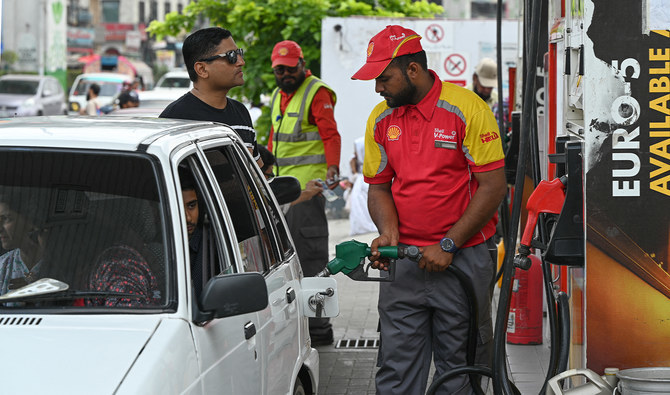
A worker pumps petrol in a car at a fuel station in Rawalpindi on July 16, 2023. (AFP/File)
Short Url
Updated 01 May 2024
Follow

Pakistan reduces petrol and diesel prices amid favorable global energy market conditions

  • The government has announced to bring down the petrol and diesel prices by Rs5.45 and Rs8.42 respectively
  • Rising fuel cost in Pakistan led to inflationary pressure in economy, though things are said to be improving

ISLAMABAD: The government announced a reduction in the petrol price in Pakistan by Rs5.45 per liter on Tuesday night, bringing the overall rate down to Rs288.49 for the next 15 days following a recommendation of the Oil and Gas Regulatory Authority (OGRA).
Pakistan typically adjusts petroleum prices on a fortnightly basis, taking into account fluctuations in the international energy market and the rupee-dollar exchange rate.
According to an official notification, the diesel price has also seen a downward revision of Rs8.42 per liter, setting it at Rs281.96.
“The prices of Petroleum products have seen a decreasing trend in the international market during the last fortnight,” the notification announced. “The Oil & Gas Regulatory Authority (OGRA) has worked out the consumer prices, based on the price variations in the international market. The prices of Motor Spirit [petrol] & HSD [high-speed diesel] for the next fortnight, starting from 1st May, 2024, are accordingly being lowered.”
Earlier, the government increased the petrol and diesel prices by Rs4.5 and Rs8.1 per liter, respectively, on April 15.
Pakistan significantly increased fuel prices after securing a short-term, $3 billion loan from the International Monetary Fund (IMF) last year.
The rising rates also led to spiraling inflation in the country, though the government started offering relief to the people by gradually bringing down the petroleum prices.
Pakistan is in the process of securing yet another IMF loan which is expected to be bigger in terms of size and duration.


Pakistan regulator says over 21,600 new companies registered in first half of FY26

Updated 5 sec ago
Follow

Pakistan regulator says over 21,600 new companies registered in first half of FY26

  • This reflects a 29 percent increase compared to the 16,839 companies that were registered during same period last year, says regulator
  • These incorporations contributed $109.5 billion in paid-up capital, says Securities and Exchange Commission of Pakistan report

ISLAMABAD: The Securities and Exchange Commission of Pakistan (SECP) said this week it registered over 21,600 new companies in the first half of the current fiscal year, reflecting rising investor confidence and positive economic outlook in the country. 

In a report issued on Jan. 6, the SECP said it registered 21,668 companies in the first six months of the current fiscal year, adding that these incorporations contributed Rs30.7 billion [$109.5 million] in paid-up capital. 

The report said this represented a 29 percent increase compared to the 16,839 companies registered during the same period last year.

“Pakistan’s business landscape continues to demonstrate strong momentum, reflecting rising investor confidence and a positive economic outlook,” the SECP report said. 

The SECP said the latest increase has brought the total number of registered companies in Pakistan to 279,724. It said the top ten sectors by incorporations were led by the IT & e-commerce, with 4,277 companies, followed by trading (2,997 companies), services (2,686 companies) and real estate (2,031 companies). 

“This sectoral diversity highlights expanding entrepreneurial activity, particularly in technology-driven and service-oriented industries,” the report said. 

The SECP said foreign investment also remained “robust” during the period, adding that 524 newly incorporated companies received foreign investment amounting to Rs1.26 billion [$4.5 million] with the participation from 731 foreign investors. 

“China emerged as the leading source, accounting for 71 percent of total inflows,” the SECP said. “It was followed by Afghanistan (8 percent), the United States (2 percent), and the United Kingdom, Germany, South
Africa, South Korea, Norway, Vietnam, Nigeria, and Bangladesh, each contributing 1 percent,” it added. 

The SECP said an additional 11 percent of the investment originated from other countries.