

Brazilian energy official from Riyadh: ‘We are on our way to join OPEC+’

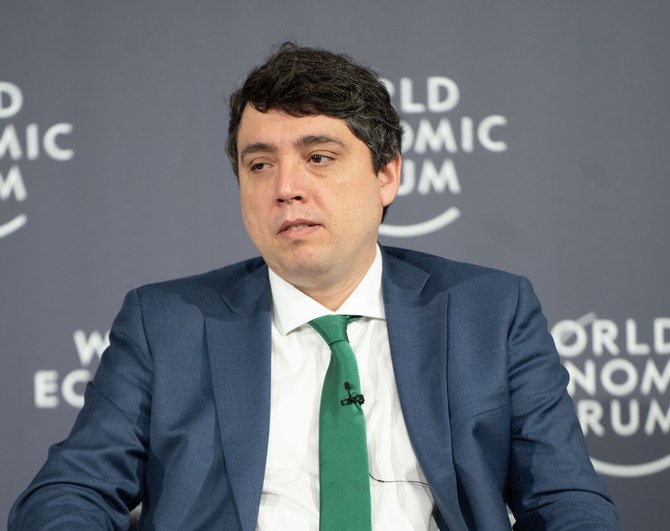
Secretary of Oil, Gas and Biofuels at Brazil’s Ministry of Mines and Energy Pietro Mendes attends a World Economic Forum special meeting in Riyadh. (WEF)
Short Url
Updated 29 April 2024
Follow

Brazilian energy official from Riyadh: ‘We are on our way to join OPEC+’

  • Mendes stressed the importance of South-South cooperation, noting his country’s relationship with Egypt and Saudi Arabia

RIYADH: Pietro Mendes, Secretary of Oil, Gas and Biofuels at Brazil’s Ministry of Mines and Energy, confirmed on Monday that his country is on its way to joining the OPEC+ alliance.

Mendes’ announcement came during his participation in a session titled “Energy Demand: Transforming Costs into Profits” during the special meeting of the World Economic Forum held in Riyadh.

Brazil ranks ninth in the world in oil production at 3.25 million barrels per day.

“Brazil is joining OPEC+. So, the idea is to create cooperation because there (are) differences between regions and we don’t have just one single solution that comes from us or a union; we need to recognize all the solutions,” the Brazilian official said, adding while his country continues to produce oil and gas, it is simultaneously increasing reliance on renewable energies and adopting solutions to reduce emissions.

Mendes stressed the importance of South-South cooperation, noting his country’s relationship with Egypt and Saudi Arabia, where several initiatives are being developed for cooperation in biofuels and technology, including artificial intelligence, is being adopted to reduce carbon emissions.


RLC Global Forum highlights role of Saudi youth in retail digital shift 

Updated 04 February 2026
Follow

RLC Global Forum highlights role of Saudi youth in retail digital shift 

RIYADH: Saudi Arabia’s young and highly digital population is reshaping how the Kingdom’s retail sector adopts new technologies and artificial intelligence, advancing faster than many global competitors, industry leaders told Arab News. 

Speaking on the sidelines of the RLC Global Forum in Riyadh, executives told Arab News that the intersection of a youthful population and strong investment in AI is driving a shift in the industry’s priorities. 

From understanding consumer behavior to leveraging the Kingdom’s growing status as a global AI leader, Saudi Arabia is becoming as a unique destination for the retail sector to thrive, learn, and evolve in the digital sphere. 

Abdullah Al-Tamimi, CEO of commercial real estate company Hamat Holding, told Arab News that the firm is keen to analyze and understand consumer behavior, with a particular focus on the younger generation as a key part of that insight. 

“Actually, it’s a big part of our day-to-day operation,” he said, adding that the company invests heavily in understanding customer needs and behavior and works to correct any missteps. 

Al-Tamimi emphasized paying close attention to small details, noting that younger consumers are especially sensitive to the overall experience and “deserve that we work around the clock in order to improve it.” 

He added that this focus “can be a competitive advantage for Saudi Arabia as well.” 

Al-Tamimi said that as the younger generation grows accustomed to new technology shaping retail customer experiences, Hamat Holding is leveraging AI to enhance them further. 

“We started a couple of initiatives improving digitalization,” he said, adding that the company sees digital tools as a way to enhance its work by automating day-to-day operations and allowing teams to focus on bigger-picture and more complex tasks. 

While the firm has expanded its use of technology, he stressed it has not replaced human workers, emphasizing the continued importance of human capital for creativity and interaction. “AI is a big part of our strategy,” Al-Tamimi added. 

Amit Keswani Manghnani, chief omnichannel and AI officer at luxury goods retailer and distributor Chalhoub Group, told Arab News that bridging a younger customer base with continuous digital development is key to advancing the Kingdom’s retail strategies. 

On Saudi Arabia’s demographics, he said: “We look at 2030 as really building products which serve especially the younger population, which is growing and very digitally savvy.” 

Manghnani underscored the unique characteristics of the Kingdom’s retail market as a tool for developing effective products and customer experiences. 

“So it’s very digitally savvy, much more than in other markets,” he said, noting that e-commerce penetration is rising not only through online purchases but also via digital catalogs that drive in-store visits. 

Manghnani said investment is focused on making products more digitally accessible and easier to use, while strengthening customer service to meet the expectations of what he described as a demanding but welcome consumer base. “Service excellence, digital — all these things together are how we are tapping into the younger population, which again is extremely savvy.” 

Manghnani reinforced Al-Tamimi’s point that the Kingdom holds a competitive advantage, citing the speed at which its retail and technology industries are aligning. 

“As a market, we’re tending to see the adoption of digital,” he said, referring to AI, data and other forms of digital interaction, adding that these tools are increasingly being combined. 

He noted that this market is moving “much quicker than the other markets.” 

The two-day RLC Global Forum brought together more than 2,000 global leaders, policymakers, and innovators from over 40 countries over the two-day event to define the next chapter of growth across retail, consumer, and lifestyle industries.