No peace in world without ceasefire in Gaza, Pakistani PM says at WEF 

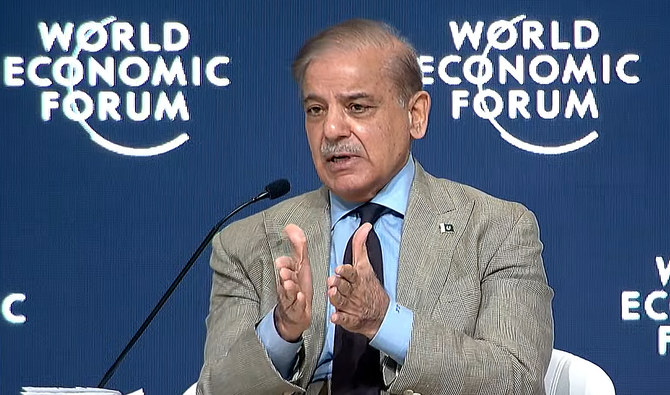
Pakistan Prime Minister Shehbaz Sharif address the closing plenary of a two-day World Economic Forum (WEF) summit in Riyadh, Saudi Arabia, on April 29, 2024. (Photo courtesy: World Economic Forum/YouTube)
Short Url
Updated 29 April 2024
Follow

No peace in world without ceasefire in Gaza, Pakistani PM says at WEF 

  • Pakistan does not recognize Israel and calls for an independent Palestinian state based on pre-1967 borders
  • Sharif is in Riyadh for two-day World Economic Forum summit on growth, has met top Saudi leaders on sidelines 

ISLAMABAD: Pakistan Prime Minister Shehbaz Sharif said on Monday there could be no peace in the world without a permanent ceasefire in Gaza, as Israel’s attacks on the besieged Palestinians territory continue. 

The statement came during the prime minister’s address at the closing plenary of a special two-day World Economic Forum (WEF) summit held in Riyadh, with a focus on global collaboration, growth and energy for development.

Israel’s air and ground assault on Gaza has killed about 34,500 Palestinians, according to Palestinian health authorities. The enclave is also in the grips of severe shortages of food, fuel and medicine since October 7 when the war started after attacks by Hamas on Israel.

“The world will not be in peace unless there is permanent peace in Gaza,” PM Sharif said.

Pakistan does not recognize the state of Israel and calls for an independent Palestinian state based on “internationally agreed parameters” and the pre-1967 borders with Al-Quds Al-Sharif as its capital.

Sharif said conflicts in Gaza, Ukraine and elsewhere had led to inflation globally, which was “breaking the back of developing countries.”

Sharif arrived in Riyadh on Saturday for the WEF special meeting on Global Collaboration, Growth and Energy for Development on April 28-29.

The conference has convened more than 700 participants, including key stakeholders from governments and international organizations, business leaders from the World Economic Forum’s partner companies, as well as Young Global Leaders, experts and innovators.

During his address, the Pakistan prime minister also thanked Saudi Arabia and other friendly countries for supporting Pakistan through difficult times.

“I have to acknowledge from the core of my heart the support we have been given and received from the Saudi leadership,” he said. “I think, a friend in need is a friend in deed and we will never be able to repay back to them what they have done to Pakistan in difficult times.”

Sharif said his government was going for “deep-rooted structural reforms” to put the country on the path to economic recovery.

“It will hit me as prime minister, obviously,” he said. “But ladies and gentlemen, without that nothing will happen.”

Pakistan is facing a chronic balance of payments crisis, with nearly $24 billion to repay in debt and interest over the next fiscal year, three-time more than its central bank’s foreign currency reserves.

The country is in talks with the International Monetary Fund (IMF) to secure a new loan program after its ongoing $3 billion program expires this month.


World Bank president in Pakistan to discuss development projects, policy issues

Updated 6 sec ago
Follow

World Bank president in Pakistan to discuss development projects, policy issues

  • Pakistan, World Bank are currently gearing up to implement a 10-year partnership framework to grant $20 billion loans to the cash-strapped nation
  • World Bank President Ajay Banga will hold meetings with Pakistan Prime Minister Shehbaz Sharif and other senior officials during the high-level visit

ISLAMABAD: World Bank President Ajay Banga has arrived in Pakistan to hold talks with senior government officials on development projects and key policy issues, Pakistani state media reported on Sunday, as Islamabad seeks multilateral support to stabilize economy and accelerate growth.

The visit comes at a time when Pakistan and the World Bank are gearing up to implement a 10-year Country Partnership Framework (CPF) to grant $20 billion in loans to the cash-strapped nation.

The World Bank’s lending for Pakistan, due to start this year, will focus on education quality, child stunting, climate resilience, energy efficiency, inclusive development and private investment.

"World Bank President Ajay Banga arrives in Pakistan for a high-level visit," the state-run Pakistan TV Digital reported on Sunday. "During his stay, he will meet Prime Minister Shehbaz Sharif and other senior officials to discuss economic reforms, development projects, and key policy issues."

Pakistan, which nearly defaulted on its foreign debt obligations in 2023, is currently making efforts to stabilize its economy under a $7 billion International Monetary Fund (IMF) program.

Besides efforts to boost trade and foreign investment, Islamabad has been seeking support from multilateral financial institutions to ensure economic recovery.

“This partnership fosters a unified and focused vision for your county around six outcomes with clear, tangible and ambitious 10-year targets,” Martin Raiser, the World Bank vice president for South Asia, had said at the launch of the CPF in Jan. last year.

“We hope that the CPF will serve as an anchor for this engagement to keep us on the right track. Partnerships will equally be critical. More resources will be needed to have the impact at the scale that we wish to achieve and this will require close collaboration with all the development partners.”

In Dec., the World Bank said it had approved $700 million in ​financing for Pakistan under a multi-year initiative aimed at supporting the country's macroeconomic stability and service delivery.

It ‍followed a $47.9 ‍million World Bank grant ‍in August last year to improve primary education in Pakistan's most populous Punjab province.