

Pakistani court rejects ‘malicious’ social media campaign against judge Babar Sattar

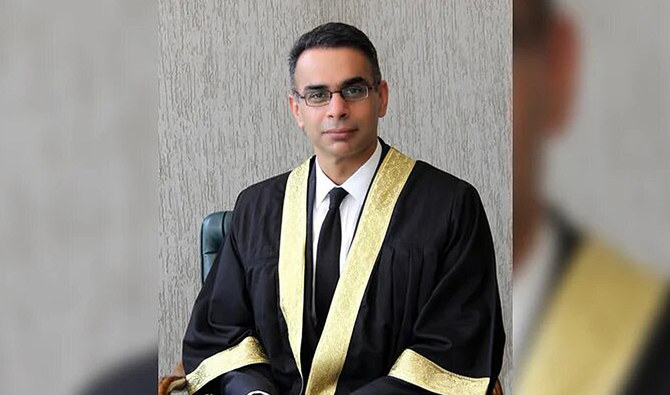
An undated file photo of Islamabad High Court's judge Justice Babar Sattar. (Photo courtesy: IHC website)
Short Url
Updated 28 April 2024
Follow

Pakistani court rejects ‘malicious’ social media campaign against judge Babar Sattar

  • Statement comes in response to allegations Justice Sattar is a dual national, minted assets after elevation as high court judge
  • Justice Sattar is one of six high court judges who spoke of alleged interference by intelligence agencies in judicial matters

ISLAMABAD: The Islamabad High Court (IHC) on Sunday rubbished a “malicious” social media campaign against one of its judges, Justice Babar Sattar, clarifying that he was not a dual national and that all his assets in Pakistan and the United States were legally owned. 

The press statement from the Pakistani court came in response to recent social media posts that targeted the judge and members of his family. Some social media users had shared pictures of Justice Sattar’s and his family’s travel documents, suggesting that he was a US national and that he had minted assets after his elevation to the post of high court judge. 

Justice Sattar is one of the six IHC judges who accused Pakistan’s premier spy agency, the Inter-Services Intelligence (ISI) of intimidating and coercing them over “politically consequential” cases in a letter written to the Supreme Judicial Council last month. 

The letter grabbed headlines following which Pakistan’s Supreme Court took notice of the matter and started hearing the case. 

The IHC said in its press release on Sunday that “untruthful” and “malignant” allegations against Justice Sattar were posted on social media along with details of his properties that were mentioned in his tax returns. 

“Justice Babar Sattar has never had any nationality other than that of Pakistan,” the high court said. “He studied law at Oxford University as a Rhodes Scholar and pursued graduate education at Harvard Law School.”

The IHC clarified that Justice Sattar worked as a lawyer with a New York law firm and was issued the Permanent Resident Card while he was there in the US. 

“He left his job in the US in 2005 and returned to Pakistan and has lived and worked in Pakistan since then,” the press release said. 

The court said Justice Sattar’s wife and children are citizens of Pakistan and the US, adding that they had been living in the US till 2021 but returned to Pakistan after he was appointed as a
high court judge. It said that they are now living in Islamabad. 

The high court said Justice Sattar’s mother is an educationist who established a school in Rawalpindi in 1992 as its sole proprietor. It added that the judge does not have any ownership interest in the school and is not involved with its management.

“Before being appointed a Judge, his law firm acted as legal adviser to the school and received retainer fee for its legal services,” the press release said. 

It said that the judge owns real estate assets in the US and Pakistan that are mentioned in his tax returns. The press release said these assets were scrutinized by the Judicial Commission of Pakistan prior to his elevation as a judge of the high court. 

“All real estate assets that he owns are either inherited or were acquired while he was a lawyer,” it said. “He has acquired no real estate assets since his appointment as a Judge. He is not
involved with the management of any business entity.”

The press release concluded by saying the IHC was committed to enforcing and upholding the code of conduct for high court judges, adding that it was accountable to the people as it was an institution that exercised public authority. 


Pakistan mulls enforcing remote work, online classes rules to conserve energy amid Mideast crisis

Updated 5 sec ago
Follow

Pakistan mulls enforcing remote work, online classes rules to conserve energy amid Mideast crisis

  • Government committee reviews contingency plans as Iran closes Strait of Hormuz, disrupting global oil supply
  • Petroleum Division official warns fuel costs may rise if Pakistan is forced to import oil from longer routes

ISLAMABAD: Pakistan is considering a range of options to conserve energy which include ordering corporate offices to ensure work-from-home facility for staff and directing universities to shift classes online, a senior official confirmed on Thursday as the ongoing Middle East conflict threatens to disrupt the global supply of petroleum products. 

These proposals were discussed by a cabinet committee constituted by Prime Minister Shehbaz Sharif to monitor petroleum prices on Wednesday. The committee meets daily to review the stock of petroleum products in Pakistan and assess the evolving regional situation.

Tensions in the Middle East have surged since Saturday after the US and Israel’s coordinated strikes against Iran and Tehran’s retaliatory attacks against both and Gulf nations. Iran has closed the crucial Strait of Hormuz waterway, through which roughly 20 percent of global oil and gas supply passes through. 

Pakistan relies heavily on Middle Eastern crude oil, with the majority of its energy imports typically transiting through the strait, making any disruption a major risk to domestic fuel supplies.

“Yes, proposals such as work-from-home for corporate offices and online classes for higher education institutions were discussed in the high-level committee,” a senior official of the finance ministry told Arab News on condition of anonymity, as he was not authorized to speak to the media.

“However, final decisions will be taken in a couple of days after the action plan is finalized based on priority areas.”

The official said the government may also advise the public to avoid unnecessary travel, adding that fuel supplies would be ensured for various industries and other critical sectors.

Meanwhile, Pakistani authorities have imposed a ban on the export of petroleum condensate, a chemical used by oil refineries, to secure its domestic supply in case the Middle East crisis worsens further.

A senior official from Pakistan’s Petroleum Division told a Senate committee on Wednesday that the country currently has petroleum reserves sufficient to last around one month.

“The country has around one month of refined petroleum products available, along with more than ten days’ worth of crude oil stocks,” the official said, also requesting anonymity. 

He added that the government is working on contingency planning to meet future energy requirements if the conflict continues.

“Pakistan is exploring options to import fuel from Saudi Arabia through the Red Sea to ensure uninterrupted supplies,” he said. 

Pakistan’s petroleum ministry confirmed the same in a statement on Wednesday, following Petroleum Minister Ali Pervaiz Malik’s meeting with Saudi Ambassador Nawaf bin Said Al-Malki. 

The official warned that petroleum product prices may rise in line with global market trends, particularly if supplies have to be transported through alternative, longer routes.

He added that in the event of a prolonged conflict, Pakistan may consider importing fuel from the US and other countries.