

155 killed in Tanzania as heavy rains lash East Africa

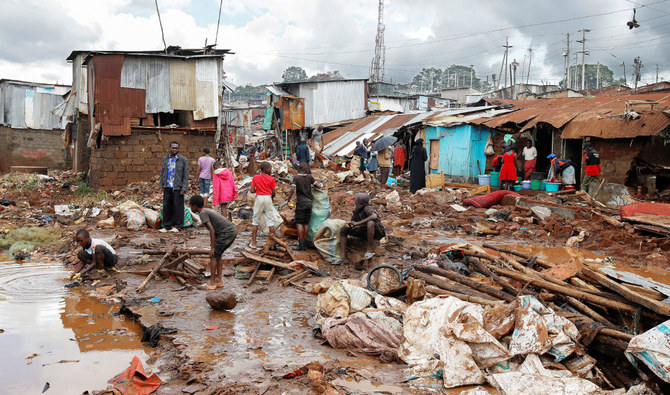
Residents sift through the rubble on Thursday as they recover their belongings after the Nairobi River burst its banks and destroyed their homes within the Mathare Valley settlement in Kenya. (Reuters)
Short Url
Updated 25 April 2024
Follow

155 killed in Tanzania as heavy rains lash East Africa

  • Kenyan president convenes emergency multi-agency meeting to respond to crisis after floods cause chaos

DAR ES SALAAM, Tanzania: At least 155 people have died in Tanzania as torrential rains linked to El Nino triggered flooding and landslides, Prime Minister Kassim Majaliwa said on Thursday.

Tanzania and other countries in East Africa — a region highly vulnerable to climate change — have been pounded by heavier than usual rainfall during the current rainy season, with dozens of deaths also reported in Kenya.

Majaliwa said the rains have affected more than 51,000 households and 200,000 people, with 155 fatalities and 236 injuries.

“The heavy El Nino rains, accompanied by strong winds, floods, and landslides in various parts of the country, have caused significant damage,” Majaliwa told parliament in Tanzania’s capital, Dodoma.

He added: “These include loss of life, destruction of crops, homes, citizens’ property, and infrastructure such as roads, bridges, and railways.”

El Nino is a naturally occurring climate pattern typically associated with increased heat worldwide, drought in some parts of the world, and heavy rains elsewhere. 

It can have a devastating impact on East Africa.

In Burundi, around 96,000 people have been displaced by months of relentless rains.

In addition, about 45 people have been killed in Kenya since the start of the rainy season in March, including 13 who lost their lives in flash floods in the capital, Nairobi, this week.

Kenyan President William Ruto convened an emergency multi-agency meeting on Thursday to respond to the crisis after torrential rains triggered floods that caused chaos across the city, blocking roads and bridges and engulfing homes in slum districts.

Kenyans have been warned to stay on alert, with more heavy rains forecast across the country. Officials said people living in the most vulnerable areas would be relocated.

“The government ... will do whatever it takes, apply all the required resources in terms of money and personnel to make sure that lives are not lost and the people of Kenya are protected from this disaster,” Deputy President Rigathi Gachagua told a press briefing.

Meanwhile, the UN humanitarian response agency OCHA said in an update this week that in Somalia, the Gu (April to June) rains are intensifying, with flash floods reported since April 19.

It said four people had been reportedly killed, and at least 134 families or more than 800 people were affected or displaced across the country.

Late last year, more than 300 people died in torrential rains and floods in Kenya, Somalia, and Ethiopia just as the region was trying to recover from its worst drought in four decades that left millions of people hungry.

From October 1997 to January 1998, massive floods caused more than 6,000 deaths in five countries in the region.

In March, the UN’s World Meteorological Organization said that El Nino, which peaked in December, was one of the five strongest ever recorded.

Though the weather pattern is gradually weakening, its impact will continue over the coming months by fueling the heat trapped in the atmosphere by greenhouse gases, it said.

Therefore, the WMO said in a quarterly update that “above normal temperatures are predicted over almost all land areas between March and May.”


Kyiv mayor calls for temporary evacuation over heating outages

Updated 4 sec ago
Follow

Kyiv mayor calls for temporary evacuation over heating outages

  • “Moscow is trying to use cold weather as a tool of terror,” Zelensky said
  • He said 20 residential buildings in Kyiv had been damaged, including the Qatari embassy

KYIV: Mass heating outages caused by Russian strikes on Kyiv are set to last into the weekend, as the capital’s mayor called on residents to temporarily leave the city with sub-zero temperatures expected to fall even lower.
A massive missile and drone attack on Kyiv killed four and ripped open apartment blocks. Moscow also fired its feared Oreshnik ballistic missile at western Ukraine, drawing condemnation from Europe.
The barrage came hours after Moscow rejected a plan by Kyiv and its Western allies to deploy peacekeeping forces to Ukraine should a ceasefire be reached.
AFP journalists in Kyiv saw residents running for shelter late Thursday night as the air raid siren echoed, and heard Russian drones exploding into residential buildings and missiles whistling over the capital.
“Moscow is trying to use cold weather as a tool of terror,” Ukrainian President Volodymyr Zelensky said at a meeting in Kyiv with British Defense Secretary John Healy.
He said 20 residential buildings in Kyiv had been damaged, including the Qatari embassy, in one of the largest attacks on the capital for months.
Qatar expressed “deep regret” over the embassy hit and said that none of its staff there had been harmed.

- ‘Very difficult’ situation -

The Russian barrage left around half of all apartment blocks in the capital, some 6,000 buildings, without heating, Mayor Vitaliy Klitschko said.
Temperatures are set to fall to -15C on Saturday.
Officials said they were hopeful some heating could be restored on Friday night.
“In some areas where the damage is more complex, additional time is needed,” Ukraine’s Restoration Minister Oleksiy Kuleba said.
Klitschko said the situation was “very difficult” and called on “residents of the capital who have the opportunity to temporarily leave the city for places with alternative sources of power and heat to do so.”
City authorities said they had set up 1,200 warming centers.

- Russia fires rarely-used missile -

A medic who died at a building that was struck in a repeat attack was among the four killed, officials said. Another 26 were wounded.
Nina, 70, who lives in one of the buildings hit, told AFP she was angry that the world was talking about a possible deal to end the conflict at a time when Russia was launching such deadly barrages.
“Where is Europe, where is America? It doesn’t hurt them the same way,” she said.
Her neighbor, 58-year-old Kostiantyn Kondratchenko fought the second-floor blaze from a drone hit with a hose used to water flowers, he told AFP.
The barrage is just the latest to batter Ukraine as diplomats wrangle for a breakthrough in what has been Europe’s deadliest conflict since World War II.
Russia has shown no sign of slowing down its ground offensive or aerial bombardments.
Moscow’s defense ministry said it had fired the Oreshnik ballistic missile on “strategic targets” — only the second time the new weapon, which the Kremlin says is impossible to stop, is known to have been used.

- ‘Escalatory and unacceptable’ -

Ukrainian authorities said a ballistic missile traveling “at about 13,000 kilometers (8,000 miles) per hour” had struck an “infrastructure facility” near the western city of Lviv.
It said Russia had attacked “civilian infrastructure,” without specifying the target or extent of any damage.
The Oreshnik is an intermediate-range ballistic missile that can be equipped with both nuclear and conventional warheads.
Lviv region officials said that radiation levels were within normal range after the attack.
France, Germany and Britain condemned Moscow’s “escalatory and unacceptable” use of Oreshnik, a UK government spokeswoman said after a call between leaders of the three countries.
Across the border in Russia’s Belgorod, the governor said more than half a million people were without power or heating after a Ukrainian attack targeted the region’s utilities.
Despite intense diplomatic efforts led by US President Donald Trump, a deal to end the fighting remains elusive.
Moscow baulked this week after European leaders and US envoys announced post-war guarantees for Ukraine would include a US-led monitoring mechanism and a multinational force.
Russia called the plan “dangerous” and “destructive.”
Key territorial issues are also unresolved as Russia insists on getting full control of Ukraine’s Donbas region, part of which is still controlled by Kyiv.
Russia occupies around 20 percent of Ukraine.
Tens of thousands have been killed since it invaded in February 2022, millions forced to flee their homes and much of eastern and southern Ukraine decimated.