

Investigation clears coalition on claims of rights violations at Yemen sites

1 / 2
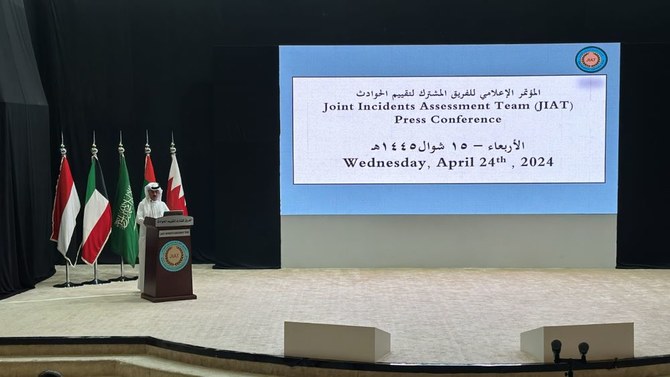
Mansour Al-Mansour announces the results of investigations into allegations against coalition forces in Yemen. (Supplied)
2 / 2
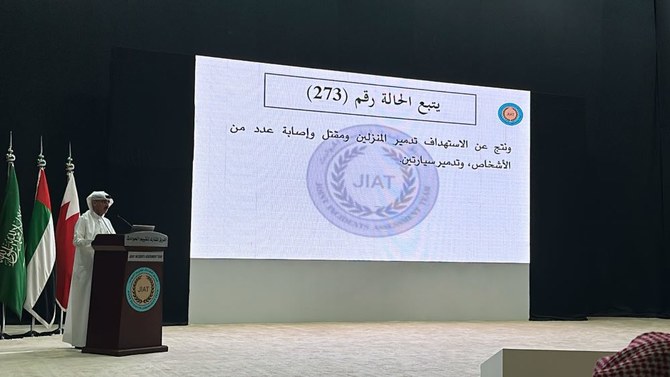
Mansour Al-Mansour announces the results of investigations into allegations against coalition forces in Yemen. (Supplied)
Short Url
Updated 25 April 2024
Follow

Investigation clears coalition on claims of rights violations at Yemen sites

  • Report details three incidents, including claims that coalition forces targeted two houses in the Sha’aban area, a civilian house in Al-Hudaydah governorate, and Al-Ghail Health Center
  • Investigation concluded that the coalition carried out an air mission on a military target, 4.5 km away from the coordinates of the claimed two houses, using one guided bomb that hit its target

RIYADH: The Joint Incident Assessment Team held a conference in Riyadh on Wednesday to announce the results of investigations into allegations against coalition forces in Yemen. 

The report details three incidents, including claims that coalition forces targeted two houses in the Sha’aban area, a civilian house in Al-Hudaydah governorate, and Al-Ghail Health Center in Al-Ghail. 

Team spokesman Mansour Al-Mansour said that “with regards to what was stated in the ninth periodic report on the works of the National Commission to Investigate Alleged violations to Human Rights in Yemen (NCIAVHR) on Dec 11, 2017, the Coalition Forces targeted G.J house and M.J. house in Sha’aban area in Razih directorate of Sa’ada governorate, the targeting resulted in the destruction of the two houses, killing and injuring number of people, and the destruction of two cars.” 

Al-Mansour, said that the investigation had concluded that the coalition forces carried out an air mission on a military target, 4.5 km away from the coordinates of the claimed two houses, using one guided bomb that hit its target. 

Regarding the allegation that the coalition targeted a civilian house in Al-Jirahi directorate of Al-Hudaydah governorate on Dec. 1, 2021, and that one man and two children were injured in the strike, JIAT found that the coalition did not carry out any air missions in the whole of the governorate. 

JIAT also exonerated the coalition over a report issued by Physicians for Human Rights which stated that on Feb. 24, 2016, coalition forces aircraft dropped three munitions on Al-Ghail Health Center in Al-Ghail directorate of Al-Jawf governorate.

At the time, Houthi militia were occupying the site and using it as a military center. The building was partially destroyed in the attack. 

In response to the allegation, JIAT found that coalition forces carried out an air mission on a military target, consisting of a gathering of fighter elements belonging to the Houthi militia, in a vacant area, 2.9 km away from Al-Ghail Health Center, using one guided bomb that hit its target.


Saudi wildlife center records rare sighting of critically endangered leatherback turtle in Red Sea

Updated 4 sec ago
Follow

Saudi wildlife center records rare sighting of critically endangered leatherback turtle in Red Sea

  • NCW says the leatherback traveled thousands of kilometers to reach the Red Sea
  • The closest known nesting grounds are located in India’s Andaman Islands, some 6,500 km distant

RIYADH: Saudi Arabia's National Center for Wildlife (NCW) has documented a rare sighting of a leatherback sea turtle in the Red Sea, marking a significant biological record for one of the planet's most critically endangered marine species.

The sighting occurred approximately 30 kilometers off the coast of Al-Qunfudhah within the Blue Holes Protected Area, a newly established marine reserve, according to the Saudi Press Agency.

The NCW confirmed that the presence of a leatherback in these waters is an exceptional event. Recognized as the largest turtle species on Earth, the leatherback can weigh up to 900 kilograms. It is easily identified by its unique leathery, black carapace—distinguished by five longitudinal ridges rather than a hard bony shell—and its ability to dive to depths exceeding 1,000 meters.

Shutterstock image

Noting the species' migratory nature, the center explained that leatherbacks travel thousands of kilometers foraging for jellyfish. The specimen likely navigated through the Bab el-Mandeb Strait in search of food. 

This is considered a remarkable journey, the NCW said, noting that the nearest known populations reside in the Indian Ocean, spanning waters from South Africa to Sri Lanka (roughly 7,000 to 8,000 kilometers away). The closest known nesting grounds are located in India’s Andaman Islands, approximately 6,500 kilometers distant. No nesting activity has been recorded in the Red Sea.

According to the IUCN Red List, the leatherback is Critically Endangered in the Indian Ocean. While data for the Red Sea and Arabian Gulf is scarce, recent isolated sightings include a juvenile recorded in Jordan in December 2025 and another off Djibouti in 2019.

The NCW emphasized that these rare appearances highlight the ecological importance of the Kingdom's marine conservation efforts in the Red Sea. The center pointed to the Farasan Islands Marine Protected Area, along with the new Blue Holes and Ras Hatiba reserves, as critical sanctuaries that could support the potential expansion of such endangered species' ranges.