



DUBAI: As it celebrates its 25th anniversary, L’Oreal Middle East has signed an agreement with the Himayah Organization in Saudi Arabia to support its “Safe Homes” initiative, which seeks to provide skills training for more than 600 women.
“The project aims to have a lasting long-term impact through psychological support and skill training,” said Laurent Duffier, CEO of L’Oreal Middle East, in an interview with Arab News en Francais.
Over the past 25 years, L’Oreal has assisted 25,000 women in the region.
L’Oreal launched its Hairdressing Academy in Riyadh and Dammam in 2023, to upskill and integrate women in the workforce, recording a 70 percent employment rate in this growing beauty segment in Saudi Arabia. The program is expected to create 15,000 jobs for Saudi women.
The flagship “L’Oreal for Women in Science” program invested over $925,000 in endowments to support 51 female Arab scientists over the past decade and advocate for gender equality in STEM, or science, technology, engineering and mathematics.
In addition, the firm’s “Stand Up Against Street Harassment” project trained more than 11,000 participants on countering gender-based violence.

Laurent Duffier, CEO of l'Oreal Middle East and Dr. Sameera Alghamdi, chairwomen of Himayah Organization announcing the MOU signature during the L'Oreal Middle East 25th anniversary event. (Supplied)
While the brand’s products have been distributed in the region since the 1960s, L’Oreal opened its first subsidiary in the Middle East in 1998, and currently serves 10 markets.
Today, the group is moving toward its 2030 sustainability, innovation and technology goals by engaging stakeholders across the supply chain, including consumers and startups, through strategic partnerships.
L’Oreal aims to foster innovation by investing in the startup ecosystem, the latest being the partnership with Astrolabs that launched the “L’Oreal Tech Quest Challenge” earlier in April 2024.
“The future is for beauty tech, tackling current industry challenges and augmenting the impact of L’Oreal’s solutions. ‘L’Oreal Tech Quest Challenge’ awarded a group of winners whose work will be incorporated in developing tools and best practices across the SAPMENA (South Asia Pacific - Middle East - North Africa) region,” said Duffier.
The region is home to a growing startup ecosystem. “LEAP in Saudi Arabia held in March reflects the growing entrepreneurial and creative energy in the Kingdom,” he added.
This is particularly important in the Middle East, where the beauty industry is recording one of the highest growth rates globally.
The GCC market ranks among the top 10 beauty markets worldwide, valued at $11.7 billion in 2024. Since the COVID-19 pandemic, the market has grown by 10 percent, fueled by underlying macroeconomic trends.
“Non-oil GDP in the GCC is growing at 4 to 5 percent while growing at less than 1 percent in Europe. The inflow of high-net-worth individuals had a positive impact on the luxury market in the UAE. While demand for beauty, particularly in Saudi Arabia, tripled during the last three years with the rise in women’s access to the workforce, and increase in disposable income,” said Duffier.
“The quality of retail execution, and the growth of new beauty concepts in the Kingdom, are factors boosting the market in the region, further enhanced by the growth in e-commerce,” he added.
According to a Boston Consulting Group report, in 2020 the Kingdom’s e-commerce share of total retail was 6 percent. This was far behind mature e-commerce markets and the worldwide average of 18 percent, but was 60 percent higher than the Kingdom’s 2019 share. It has been forecast that there will be double-digit growth post-COVID-19, with market value expected to exceed $13.3 billion by 2025.
“Saudi Arabia displays accelerated growth across segments. Efforts to diversify the economy are clear. It is the biggest economy in the region, with the highest potential, and it is a priority market for L’Oreal,” said Duffier.
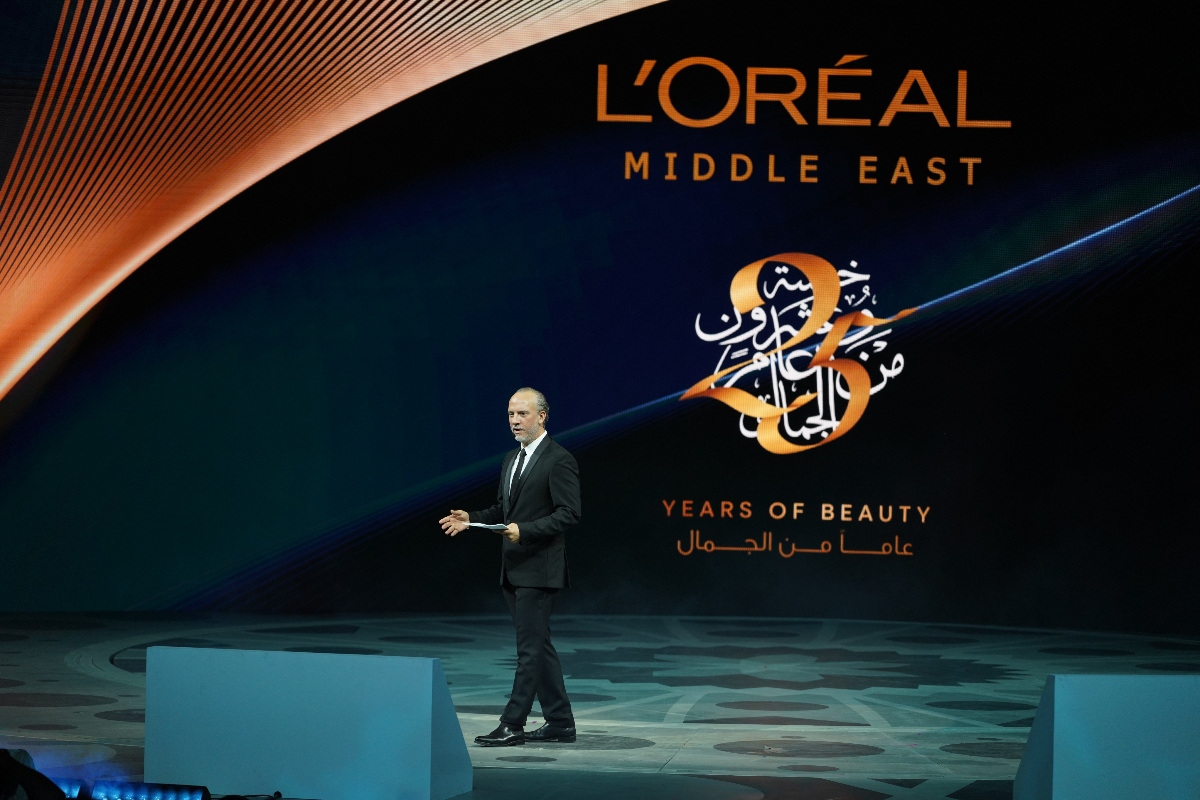
This is particularly important in the Middle East, where the beauty industry is recording one of the highest growth rates globally. (Supplied)
The offer-driven beauty and personal care market is expected to continue to be led by product innovation and beauty technology, for better end-user results, he said.
“We are launching Melasyl, after 18 years of R&D. A breakthrough ingredient for skin care treatments, among other applications,” said Duffier.
With lipstick used 5,000 years ago in Mesopotamia, Duffier describes the Middle East as the “cradle of beauty and a region that defines beauty trends.” The region has a diverse customer base, covering the full spectrum of skin and hair colors, is shifting toward digital platforms, and more sustainable consumption.
“We are working with startups to offer sustainable innovative products, with 70 percent of consumers opting for sustainable products,” said Duffier.
“We are no longer a beauty company, but a beauty tech company. Anchored in innovation and sustainability, the objective remains beauty for all. The future of beauty will be increasingly personalized to create beauty that moves the world, and most importantly to create beauty that moves the Middle East,” he said.
The quest for sustainability is also a byproduct of the reconciliation between beauty and tech, developed and implemented across the various segments: hair care (Airlight pro), derma cosmetics, the latest being La Roche-Posay’s diagnostic virtual reality tools, and make-up applications in collaboration with Microsoft.
“By applying green science, 95 percent of products’ ingredients will be bio-based and traceable to natural green-science formulations by 2030,” he said.
Advancing toward its sustainability targets, the “L’Oreal for the Future” program aims to reduce carbon dioxide emissions at all sites, and move to renewables, waste management and water treatment by 2030.
L’Oreal Middle East expects a 50 percent reduction in distribution-related carbon dioxide emissions, and a 70 percent reduction in water consumption with the introduction of Gjosa shower heads in hair salons.
Set to launch in the region this year, the latter is expected to target 500 salons per year, for a total yearly saving of 35 million gallons of water.
This is in addition to the recycling of 340 tonnes of waste over the past two years in Saudi Arabia, which is a Garnier initiative in collaboration with Panda and Naqaa Solutions.




