

Malala Yousafzai vows support for Gaza after backlash

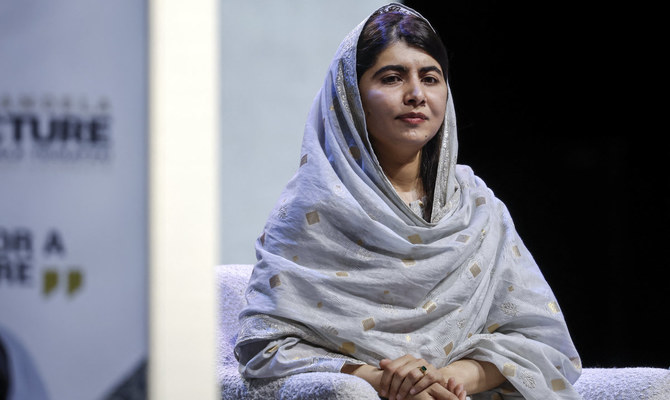
Nobel Peace Prize laureate Malala Yousafzai has publically condemned the civilian casualties and called for a ceasefire in Gaza. (AFP)
Short Url
Updated 25 April 2024
Follow

Malala Yousafzai vows support for Gaza after backlash

  • Pakistan has seen many fiercely emotional pro-Palestinian protests since the war in Gaza began last October

LAHORE, Pakistan: Nobel laureate Malala Yousafzai on Thursday condemned Israel and reaffirmed her support for Palestinians in Gaza, after a backlash in her native Pakistan over a Broadway musical she co-produced with former US Secretary of State Hillary Clinton.

Yousafzai, who was awarded the Nobel Peace Prize in 2014, has been condemned by some for partnering with Clinton, an outspoken supporter of Israel's war against Hamas.

The musical, titled "Suffs," depicts the American women's suffrage campaign for the right to vote in the 20th century and has been playing in New York since last week.

"I want there to be no confusion about my support for the people of Gaza," Yousafzai wrote on X, the former Twitter. "We do not need to see more dead bodies, bombed schools and starving children to understand that a ceasefire is urgent and necessary."

She added: "I have and will continue to condemn the Israeli government for its violations of international law and war crimes."

Pakistan has seen many fiercely emotional pro-Palestinian protests since the war in Gaza began last October.

Yusafzai's "theatre collaboration with Hillary Clinton -- who stands for America's unequivocal support for genocide of Palestinians -- is a huge blow to her credibility as a human rights activist," popular Pakistani columnist Mehr Tarar wrote on social media platform X on Wednesday.

"I consider it utterly tragic."

Whilst Clinton has backed a military campaign to remove Hamas and rejected demands for a ceasefire, she has also explicitly called for protections for Palestinian civilians.

Yousafzai has publically condemned the civilian casualties and called for a ceasefire in Gaza.

The New York Times reported the 26-year-old wore a red-and-black pin to the "Suffs" premier last Thursday, signifying her support for a ceasefire.

But author and academic Nida Kirmani said on X that Yousafzai's decision to partner with Clinton was "maddening and heartbreaking at the same time. What an utter disappointment."

The war began with an unprecedented Hamas attack on Israel on October 7 that resulted in the deaths of around 1,170 people, according to an AFP tally of Israeli official figures. Hamas militants also abducted 250 people and Israel estimates 129 of them remain in Gaza, including 34 who the military says are dead.

Clinton served as America's top diplomat during former president Barack Obama's administration, which oversaw a campaign of drone strikes targeting Taliban militants in Pakistan and Afghanistan's borderlands.

Yousafzai earned her Nobel Peace Prize after being shot in the head by the Pakistani Taliban as she pushed for girls' education as a teenager in 2012.

However, the drone war killed and maimed scores of civilians in Yousafzai's home region, spurring more online criticism of the youngest Nobel Laureate, who earned the prize at 17.

Yousafzai is often viewed with suspicion in Pakistan, where critics accuse her of pushing a Western feminist and liberal political agenda on the conservative country.


94 million need cataract surgery, but access lacking: WHO

A Somali patient undergoes free cataract surgery at Al Nuur eye Hospital in Mogadishu, on February 16, 2015. (AFP)
Updated 11 February 2026
Follow

94 million need cataract surgery, but access lacking: WHO

  • Of the 94 million affected, fewer than 20 percent are blind, while the rest suffer from impaired vision

GENEVA: More than 94 million people suffer from cataracts, but half of them do not have access to the surgery needed to fix it, the World Health Organization said Wednesday.
Cataracts — the clouding of the eye’s lens that causes blurred vision and can lead to blindness — are on the rise as populations get older, with age being the main risk factor.
“Cataract surgery — a simple, 15-minute procedure — is one of the most cost-effective medical procedures, providing immediate and lasting restoration of sight,” the WHO said.
It is one of the most frequently performed surgeries undertaken in high-income countries.
However, “half of the world’s population in need of cataract surgery don’t have access to it,” said Stuart Keel, the UN health agency’s technical lead for eye care.
The situation is worst in the WHO’s Africa region, where three in four people needing cataract surgery remain untreated.
In Kenya, at the current rate, 77 percent of people needing cataract surgery are likely to die with their cataract blindness or vision impairment, said Keel.
Across all regions, women consistently experience lower access to care than men.
Of the 94 million affected, fewer than 20 percent are blind, while the rest suffer from impaired vision.

- 2030 vision -

The WHO said that over the past two decades, global cataract surgery coverage had increased by 15 percent.

In 2021, WHO member states set a target of a 30-percent increase by 2030.
However, current modelling predicts that cataract surgery coverage will rise by only about 8.4 percent this decade.
To close the gap, the WHO urged countries to integrate eye examinations into primary health care and invest in the required surgical equipment.
States should also expand the eye-care workforce, training surgeons in a standardised manner and then distributing them throughout the country, notably outside major cities.
The WHO was on Wednesday launching new guidance for countries on how to provide quality cataract surgery services.
It will also issue guidance to help support workforce development.
Keel said the main issue was capacity and financing.
“We do need money invested to get rid of this backlog, which is nearly 100 million people,” he told a press conference.
While age is the primary risk factor for cataracts, others include prolonged UV-B light exposure, tobacco use, prolonged corticosteroid use and diabetes.
Keel urged people to keep up regular eye checks as they get older, with most problems able to be either prevented or diagnosed and treated.
The cost of the new lens that goes inside the eye can be under $100.
However, out-of-pocket costs can be higher when not covered by health insurance.
“Cataract surgery is one of the most powerful tools we have to restore vision and transform lives,” said Devora Kestel, head of the WHO’s noncommunicable diseases and mental health department.
“When people regain their sight, they regain independence, dignity, and opportunity.”
