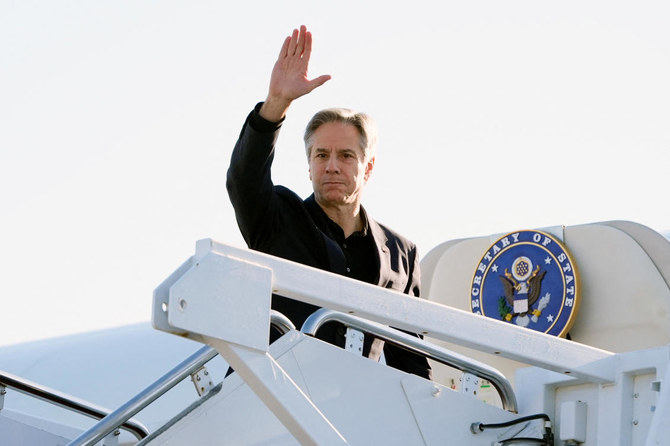
Shanghai: US Secretary of State Antony Blinken was due in China on Wednesday, as the United States ramps up pressure on its rival over its support for Russia while also seeking to manage tensions with Beijing.
The US diplomat will meet China's top brass on Friday in Beijing, where he is also expected to plead for restraint as Taiwan inaugurates a new leader, and to raise US concerns on Chinese trade practices -- a vital issue for President Joe Biden in an election year.
But Blinken is also seeking to stabilise ties, with tensions between the world's two largest economies palpably easing since his last visit in June.
At the time, he was the highest-ranking US official to visit China in five years, and the trip was followed by a meeting between the countries' presidents in November.
At that summit in California, Chinese President Xi Jinping agreed to a US wish list including restoring contact between militaries and cracking down on precursor chemicals to fentanyl, the powerful painkiller behind an addiction epidemic in the United States.
Blinken will start his visit on Wednesday in Shanghai.
While in the city, he will meet students and business leaders in what an aide called a bid to highlight warm ties between the American and Chinese peoples.
The friendly side trip -- the first visit by a US secretary of state to the bustling metropolis since Hillary Clinton in 2010 -- would have been unthinkable until recently, with hawks on both sides previously speaking of a new Cold War between the two powers.
Treasury Secretary Janet Yellen similarly toured the manufacturing hub of Guangzhou before visiting Beijing earlier this month.
A senior US official previewing Blinken's trip said that the United States and China were at a "different place than we were a year ago, when the bilateral relationship was at an historic low point".
"We also believe, and we have also clearly demonstrated, that responsibly managing competition does not mean we will pull back from measures to protect US national interests," he said.
The Biden administration's eagerness to engage China stands in stark contrast to its efforts to isolate Russia since its invasion of Ukraine in February 2022.
After initially being pleased that Beijing has not directly supplied weapons to Russia, the United States in recent weeks has accused China of lavishing industrial material and technology on Moscow.
Washington has encouraged European leaders, including German Chancellor Olaf Scholz, who recently visited Beijing, to stand firm on China not backing Russia, believing that it wants stable ties with the West as it focuses on addressing economic headwinds at home.
"If China purports on the one hand to want good relations with Europe and other countries, it can't on the other hand be fuelling what is the biggest threat to European security since the end of the Cold War," Blinken said Friday after Group of Seven talks in Capri, Italy.
The Biden administration has trumpeted the agreement with Xi on fentanyl as a success.
A State Department official said that since the November summit, China appears to have taken its first law enforcement measures on the matter since 2017.
Blinken will ask for further implementation, the official said.
"More regular PRC law enforcement action against PRC-based chemical companies and pill press manufacturers involved in illicit fentanyl supply chains would send a strong signal of China's commitment to address this issue," the official said, referring to the People's Republic of China.
One source of friction between the two countries is new legislation that cleared the US Congress on Tuesday -- and which Biden intends to sign -- requiring the wildly popular social media app TikTok to be divested from its Chinese parent company ByteDance, or be shut out of the American market.
Biden faces a rematch in November against former president Donald Trump, who has vowed a more confrontational approach against China.
Yun Sun, a senior fellow at the Washington-based Stimson Center, said that China's leaders, eager to focus on their economy, were in a wait-and-see mode ahead of the US election.
"The Chinese understand that the Biden administration is unlikely to deliver any good news on trade because that simply does not support the election agenda," she said.
For Chinese leaders this year, "their priority is to keep the relationship stable".
"Until there is clarity on who the next administration will be, I don't think they see a better strategy," she said.

Blinken due in China seeking pressure but also stability
Short Url
https://arab.news/v98ch
Blinken due in China seeking pressure but also stability
UK’s Starmer urges ‘sleeping giant’ Europe to curb dependence on US
MUNICH, Germany: British leader Keir Starmer will tell the Munich Security Conference that Europe is “a sleeping giant” and must rely less on the United States for its defense, his office said Friday.
In a speech on Saturday at the summit, the UK prime minister will argue that the continent must shift from overdependence on the United States toward a more European NATO.
“I’m talking about a vision of European security and greater European autonomy that does not herald US withdrawal but answers the call for more burden sharing in full and remakes the ties that have served us so well,” Starmer is expected to say.
The gathering comes as European leaders remain concerned that a United States led by President Donald Trump can no longer be relied upon to be the guarantor of their security.
Since returning to the White House last year, Trump has frequently criticized European countries for not sharing enough of the burden on common defense, and raised questions about the future of NATO.
European members of the transatlantic military alliance are rushing to build up their defenses in the face of an increasingly belligerent Moscow, whose war in Ukraine is set to enter its fifth year this month.
“As I see it — Europe is a sleeping giant. Our economies dwarf Russia’s, 10 times over,” Starmer will tell allies, according to excerpts released ahead of his address.
“We have huge defense capabilities. Yet, too often, all of this has added up to less than the sum of its parts,” he was to say, citing fragmented planning and procurement problems.
Late last year, talks on Britain joining the bloc’s new 150-billion-euro (£130 billion) rearmament fund broke down, reportedly because London baulked at the price for entry.
Downing Street said Starmer would use his speech to call for closer UK-EU defense cooperation.
“There is no British security without Europe, and no European security without Britain. That is the lesson of history — and it is today’s reality too,” Starmer was to say.
The UK government announced on Friday that Britain will spend more than £400 million this financial year on hypersonic and long-range weapons, including through joint projects with France, Germany and Italy.
Starmer, whose center-left Labour party is being squeezed on opposite ends of the political spectrum by the anti-immigrant Reform UK group and the more leftwing Greens, was to say leaders “must level with the public” about the defense costs they face.
He was due to hit out at “peddlers of easy answers on the extreme left and the extreme right,” according to the excerpts.
“The future they offer is one of division and then capitulation. The lamps would go out across Europe once again. But we will not let that happen,” Starmer was expected to say.
In a speech on Saturday at the summit, the UK prime minister will argue that the continent must shift from overdependence on the United States toward a more European NATO.
“I’m talking about a vision of European security and greater European autonomy that does not herald US withdrawal but answers the call for more burden sharing in full and remakes the ties that have served us so well,” Starmer is expected to say.
The gathering comes as European leaders remain concerned that a United States led by President Donald Trump can no longer be relied upon to be the guarantor of their security.
Since returning to the White House last year, Trump has frequently criticized European countries for not sharing enough of the burden on common defense, and raised questions about the future of NATO.
European members of the transatlantic military alliance are rushing to build up their defenses in the face of an increasingly belligerent Moscow, whose war in Ukraine is set to enter its fifth year this month.
“As I see it — Europe is a sleeping giant. Our economies dwarf Russia’s, 10 times over,” Starmer will tell allies, according to excerpts released ahead of his address.
“We have huge defense capabilities. Yet, too often, all of this has added up to less than the sum of its parts,” he was to say, citing fragmented planning and procurement problems.
Late last year, talks on Britain joining the bloc’s new 150-billion-euro (£130 billion) rearmament fund broke down, reportedly because London baulked at the price for entry.
Downing Street said Starmer would use his speech to call for closer UK-EU defense cooperation.
“There is no British security without Europe, and no European security without Britain. That is the lesson of history — and it is today’s reality too,” Starmer was to say.
The UK government announced on Friday that Britain will spend more than £400 million this financial year on hypersonic and long-range weapons, including through joint projects with France, Germany and Italy.
Starmer, whose center-left Labour party is being squeezed on opposite ends of the political spectrum by the anti-immigrant Reform UK group and the more leftwing Greens, was to say leaders “must level with the public” about the defense costs they face.
He was due to hit out at “peddlers of easy answers on the extreme left and the extreme right,” according to the excerpts.
“The future they offer is one of division and then capitulation. The lamps would go out across Europe once again. But we will not let that happen,” Starmer was expected to say.
© 2026 SAUDI RESEARCH & PUBLISHING COMPANY, All Rights Reserved And subject to Terms of Use Agreement.


