NASA chief asks nations to work together on climate change

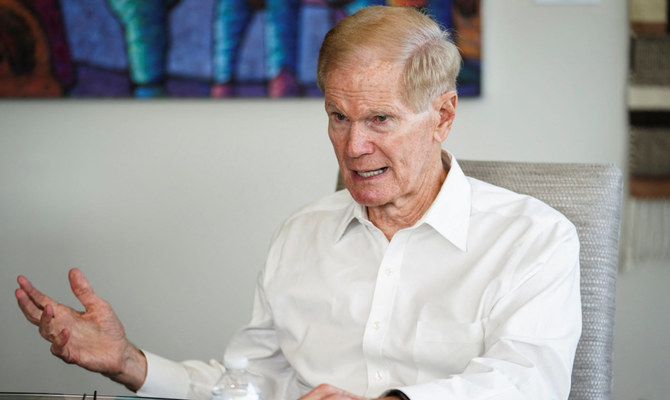
NASA Administrator Bill Nelson answers questions from reporters about U.S.-Mexico science collaborations, in Mexico City, Mexico, April 23, 2024. (Reuters)
Short Url
Updated 24 April 2024
Follow

NASA chief asks nations to work together on climate change

  • Solutions to mitigate greenhouse gas emissions that rapidly warm the planet and drive the climate crisis already exist, but require unprecedented changes at a new scale and pace

MEXICO CITY: NASA is hoping that nations will work together more closely in the future on topics such as climate change, including greenhouse gas emissions, the space agency’s head, Bill Nelson, said on Tuesday.
Solutions to mitigate greenhouse gas emissions that rapidly warm the planet and drive the climate crisis already exist, but require unprecedented changes at a new scale and pace.
“This is something that nations can work on together because the information is there,” Nelson said in Mexico City when asked about how to address greenhouse gas emissions. “It’s important that we act on it.”
Satellites have emerged as powerful tools for scientists around the world to study climate change but also, increasingly, pinpoint the origin of greenhouse gas emissions, such as methane leaks, that would otherwise have gone undetected.
Nelson added that satellites were constantly collecting data about climate and NASA was looking to make this data accessible, and educate people on how to use it.
Methane, the main component of natural gas, is the second-largest contributor to global warming after carbon dioxide. Scientists can now pinpoint the origin of large methane leaks using data gathered by satellites.
It is a much more potent driver of global warming in the short term than carbon dioxide because it traps more heat in the atmosphere, ton for ton.
“The types of concerns that we have are global,” said NASA Deputy Administrator Pam Melroy. “It’s very important to recognize that not any one country can solve that problem alone.”
Earlier in the day, Nelson and Melroy, who are both astronauts, met with Mexican President Andres Manuel Lopez Obrador and lawmakers to discuss how the countries can work together.


US abstains in UN vote voicing support for Ukraine

Updated 3 sec ago
Follow

US abstains in UN vote voicing support for Ukraine

  • The resolution also called for an immediate and unconditional ceasefire and “comprehensive, just and lasting peace“
  • The US delegation had pressed for a separate vote on paragraphs involving Ukraine’s territorial integrity and international law but this idea was rejected

UNITED NATIONS: The UN General Assembly voiced support for Ukraine Tuesday on the fourth anniversary of Russia’s invasion, with the United States among countries abstaining from the vote.
The assembly passed a resolution saying it was committed to “the sovereignty, independence, unity and territorial integrity of Ukraine within its internationally recognized borders.”
It passed by a tally of 107 countries in favor, 12 against and 51 abstentions, which included the United States.
The resolution also called for an immediate and unconditional ceasefire and “comprehensive, just and lasting peace.”
The US delegation had pressed for a separate vote on paragraphs involving Ukraine’s territorial integrity and international law but this idea was rejected.
The transition from Joe Biden to Donald Trump in the White House last year has seen firm, unconditional US support for Ukraine cool dramatically.
Trump has brought Russian leader Vladimir Putin back in from the diplomatic cold and Washington has repeatedly refused to condemn the Russian invasion of 2022.
US deputy ambassador Tammy Bruce said she welcomed the UN appeal for a ceasefire.
But she said the resolution includes “language that is likely to distract” from diplomatic efforts to end the war rather than support them. She did not identify these words.
Still, leaders of the G7 global powers, including Trump, on Tuesday reaffirmed their “unwavering support for Ukraine” in a statement on the fourth anniversary of the invasion.
A month after Trump returned to power in January 2025, the United States voted against a UN General Assembly resolution calling for a “just and lasting peace” to end the war.
The US delegation later won Security Council passage of a Russian-backed resolution that called for peace but made no mention of Ukraine’s territorial integrity, frustrating Ukraine’s European allies.
Until then, the council had failed to speak out on the war because Russia consistently used its veto power.
“Despite peace efforts led by the US and supported by Europe, Russia continues to demonstrate no genuine willingness to stop this aggression,” Ukraine’s Deputy Foreign Minister Mariana Betsa said.
Russia’s deputy ambassador Anna Evstigneeva answered, saying Ukraine should focus on diplomacy to end the war “rather than initiating yet another politicized vote.”
In Washington, Ukraine’s Ambassador to the US Olga Stefanishyna urged the Trump administration to intensify pressure on Russia.
“We hope that the US government this particular day... will get to the understanding that the language which is understood by Russians is not the dialog or diplomatic effort, it’s the pressure,” Stefanishyna told reporters.
She expressed hope that US lawmakers would soon pass a bill imposing tariffs and secondary sanctions on countries doing business with Russia in order to choke its economy and ability to finance the war.
Stefanishyna added that Ukraine is in desperate need of air defenses at a time when Russia has been intensifying its attacks on civilians and critical infrastructure during a brutal winter.
While acknowledging that “it’s too premature to speak about any settlement in the nearest period of time,” she said that any deal to end the war must include powerful US and EU Security guarantees.