Pakistan, Saudi Arabia and Uzbekistan ink ‘landmark’ agreement to promote trade, investment

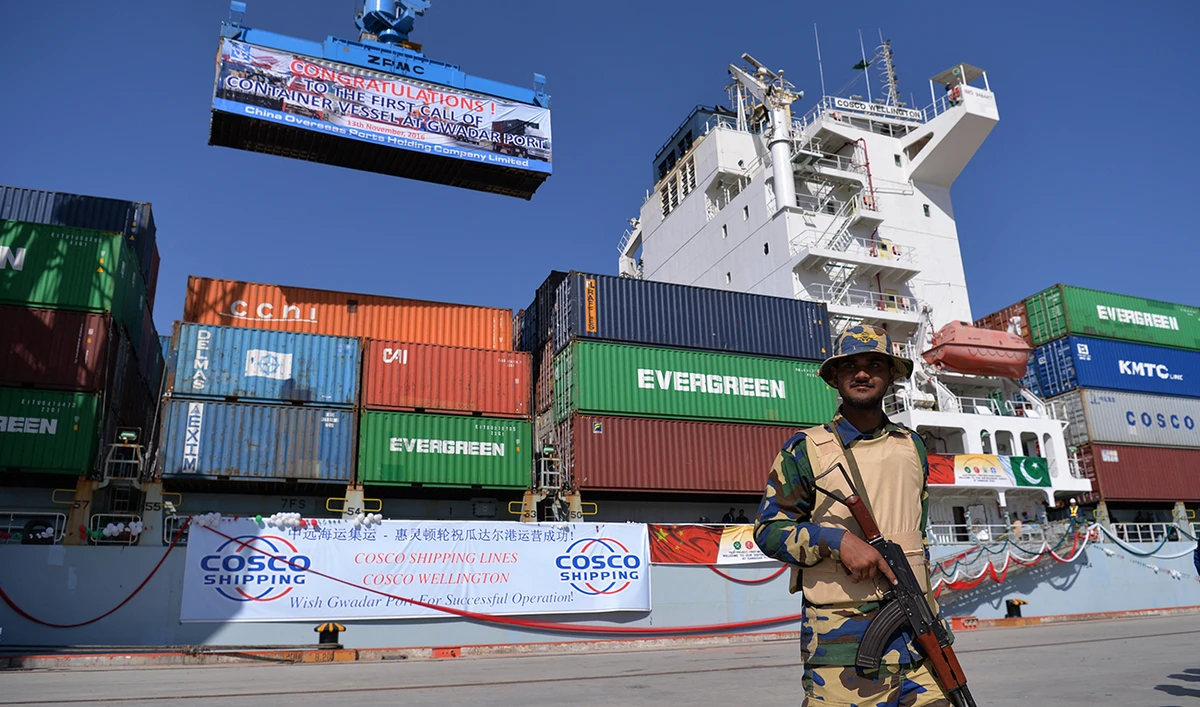
A Pakistani Naval personnel stands guard beside a ship carrying containers during the opening of a trade project in Gwadar port, some 700 kms west of Karachi on November 13, 2016. (AFP/File)
Short Url
Updated 23 April 2024
Follow

Pakistan, Saudi Arabia and Uzbekistan ink ‘landmark’ agreement to promote trade, investment

  • As per agreement, Uzbekistan’s largest bank and a Pakistani firm will support investors in all three countries
  • Partnership to attract foreign investment particularly in key sectors of energy, infrastructure and agriculture

ISLAMABAD: Pakistan, Saudi Arabia and Uzbekistan have signed a “landmark” partnership agreement to boost economic cooperation and create new opportunities for investors in the region, Pakistan’s state-run television reported on Tuesday.

As per the terms of the agreement, Uzbekistan’s largest bank Ansher Capital will work closely with KASB Securities Limited (KASB), a leading Pakistani stock and commodity brokerage firm, to provide financial advisory and corporate finance services to investors in all three countries, the state media said. 

Both firms will support investors and traders in Pakistan, Uzbekistan and Saudi Arabia by providing expert guidance on navigating financial markets, the Pakistan Television (PTV) said. 

“In a significant development, Uzbekistan, Pakistan, and Saudi Arabia have signed a landmark partnership agreement aimed at promoting investment and trade between the three countries,” PTV said. 

“The partnership is expected to expand the market and attract foreign investment, particularly in key sectors such as energy, infrastructure, and agriculture.”

The report said that the agreement is also expected to strengthen trade ties between the three countries, with a focus on increasing trade volumes and promoting economic integration. 

“The partnership will enable businesses to tap into new markets and access new investment opportunities, creating jobs and driving economic growth,” PTV said.

Pakistan and Saudi Arabia enjoy strong trade, defense and cultural ties. The Kingdom is home to over 2.7 million Pakistani expatriates and serves as the top destination for remittances to the cash-strapped South Asian country.

Saudi Foreign Minister Prince Faisal bin Farhan arrived in Pakistan last week for a two-day visit aimed at strengthening bilateral economic cooperation and pushing forward previously agreed investment deals. Pakistan has said it pitched investment projects worth $30 billion to Riyadh during Prince Faisal’s visit.

Islamabad has sought trade and economic partnerships with bilateral partners and allies as it seeks to navigate a macroeconomic crisis that has seen its reserves plummet to historic lows and its currency weaken significantly. 

Pakistan, Afghanistan trade heavy casualty claims, battlefield losses as cross-border fighting escalates

Updated 4 sec ago
Follow

Pakistan, Afghanistan trade heavy casualty claims, battlefield losses as cross-border fighting escalates

  • Pakistan says 133 Afghan Taliban killed in counter-strikes, Kabul says 55 Pakistani soldiers dead
  • Both sides report destruction, capture of military posts as escalation deepens, signaling widening conflict

Islamabad/Karachi: Pakistan and Afghanistan traded claims of heavy battlefield losses early Friday as cross-border fighting intensified along their shared frontier, marking the most serious escalation in hostilities between the bitter neighbors in recent months.

The fighting follows Pakistani airstrikes earlier this week targeting what Islamabad said were Tehreek-e-Taliban Pakistan (TTP) and Daesh militant camps inside Afghanistan. Pakistan said those strikes killed more than 100 militants, while Kabul said women and children were killed and condemned the attacks as violations of Afghan sovereignty.

With both governments now announcing retaliatory operations and publishing sharply conflicting casualty figures, the confrontation signals a rapid deterioration in relations between the two countries.

Pakistani officials said the latest strikes were in response to what they described as unprovoked firing by Afghan forces along multiple sectors of the border late Thursday. The Pakistani prime minister’s spokesman Mosharraf Zaidi said at 0345 hours Friday counter-strikes were continuing.

“A total of 133 Afghan Taliban are confirmed killed, more than 200 wounded,” Zaidi said in an X update. “Twenty seven (27) Afghan Taliban posts have been destroyed, and nine (9) have been captured.”

He added that strikes had targeted military positions in Kabul, Paktia and Kandahar, and that corps headquarters, brigade headquarters, ammunition depots, logistics bases and other installations had been destroyed.

Pakistan’s Information Minister Attaullah Tarar described the military action as “Operation Wrath for the Sake of Truth,” saying Pakistan’s “effective counter operations are ongoing.”

Defense Minister Khawaja Asif adopted sharply escalatory language on X, declaring: “Now it is open war between us and you.”

On the Afghan side, Taliban government spokesperson Zabihullah Mujahid accused Pakistan of bombing major cities. 

“The cowardly Pakistani army has bombed some places in Kabul, Kandahar, and Paktia. Praise be to God, no one was harmed,” Mujahid said on X.

In a separate statement, Afghanistan’s Ministry of National Defense said its forces had conducted retaliatory operations along the shared border. 

The ministry claimed 55 Pakistani soldiers were killed, two garrisons and 19 posts captured and military equipment seized. It said eight Afghan fighters were killed and 11 wounded in the clashes, and alleged that 13 civilians were injured in Nangarhar.

Pakistani officials said no Pakistani posts had been damaged or captured. 

None of the casualty figures or battlefield claims from either side could be independently verified.

Cross-border violence has intensified in recent weeks, with Pakistan blaming a surge in suicide bombings and militant attacks on insurgents it says are based in Afghanistan. Kabul denies providing safe havens to anti-Pakistan militant groups.

The latest clashes mark the third major escalation between the neighbors in less than a year. Similar Pakistani strikes last year triggered weeklong fighting before Qatar, Türkiye and other regional actors mediated a ceasefire in October.

The 2,600-kilometer (1,600-mile) frontier, a key trade and transit corridor linking Pakistan to landlocked Afghanistan and onward to Central Asia, has faced repeated closures amid tensions, disrupting commerce and humanitarian movement. Trade and movement of people between the two nations has remained closed since October 2025.

The confrontation also unfolds against a backdrop of growing friction over Afghanistan’s regional alignments. Pakistan has repeatedly accused the Taliban authorities of allowing Indian influence to expand in Afghanistan, an allegation Kabul has rejected.

Pakistan’s defense minister Asif renewed that accusation on Friday, saying the Taliban government had turned Afghanistan into “a colony of India.”

Islamabad has long accused India of using Afghan territory to support anti-Pakistan militant groups, a charge New Delhi denies.