

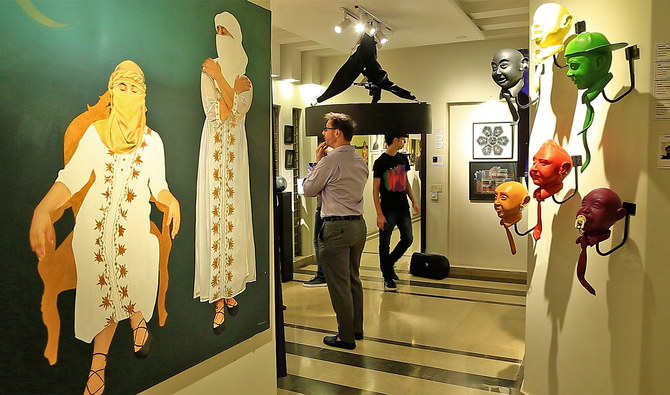

LAHORE: When Imtisal Zafar launched the Pakistan Art Forum, a gallery and what has become the country’s largest digital space for contemporary art, he envisioned a platform that would bring the work of Pakistani artists to collectors and enthusiasts around the world.
Last week’s ‘Stars of Tomorrow’ show hosted by PAF in Lahore did just this and more: it brought to Lahore – the country's cultural and art hub – the work of 28 up-and-coming artists, many of them from remote parts of the country and a number belonging to religious minorities.
One of these artists was Ghaffar Mesih, who worked as a painter and truck artist for years until he realized he needed formal training to hone his craft.
“I got a 100% scholarship at BNU [Beaconhouse National University in Lahore] where I graduated on the Dean’s Honour List,” Mesih, a Christian from the southern city of Hyderabad, told Arab News at the PAF exhibition on Saturday.
Mesih, whose work invokes Christian stained-glass art found in churches, uses oil on canvas and had already sold a few paintings before the show opened, something Zafar, 38, is extremely proud of.
“The focus this year has been putting together artists from smaller cities and far-flung areas,” Zafar told Arab News at the third annual Stars of Tomorrow show. “We have artists from Vehari, Chitral, Sargodha, Sialkot… and also religious minorities.
“We want to give them visibility. I prefer artists who are from lesser-known art institutes because they get less visibility and exposure.”
Zafar, who set up PAF in 2014, said a lot of established galleries didn’t give newer artists solo shows, but PAF had been consistently doing that for years.
“We pride ourselves on discovering new artists,” he said. “In the last two years, we have launched several lesser-known artists and given them solo shows, they’ve all gone on to make a name for themselves.”
The show has definitely done that for Sheva Ram Jogi, a Hindu artist from the remote desert region of Tharparker in Sindh, who said Stars of Tomorrow was the biggest art collective he had attended to date.
“Basically, I am from Umerkot,” Jogi told Arab News. “I have had offers for my pieces. They are based on optical illusions which is a bit different to everyone else here. But this has been great to get people from other cities to see my work.”
Tahir Zaman from Chitral, paints the idyllic northern regions of Pakistan with their pastoral beauty, valleys and quietude, and said his work had been well-received by the audience.
“I know nature is not that much in fashion in contemporary art, but this is what I grew up with, what I know best,” he said.
Half the works displayed during the show were already sold by Saturday evening and more orders were coming in, Zafar said.
Two of the artists, including Zarnab Baloch, had sold their entire collection.
“These are the biggest platforms my work has ever had,” said Baloch, who has also exhibited her work in past Stars of Tomorrow collections.
Nadia Batool, who teaches at the National College of Arts (NCA) Rawalpindi, said it was difficult for aspiring artists from regions like Gilgit-Baltistan, Khyber-Pakhtunkhwa and northern Punjab to get into art shows, but Stars of Tomorrow was a “step in the right direction.”
“When you're not from one of the bigger schools in the country, NCA, BNU, IVS (Indus Valley School), then you have a harder time [getting exposure] unless you're connected to somebody within the market,” she told Arab News.
“Platforms like Pakistan Art Forum giving people from lesser-known institutes a chance is great for the art world. We could do with many more of these shows.”


