

Health-harming heat stress rising in Europe, scientists say

1 / 3
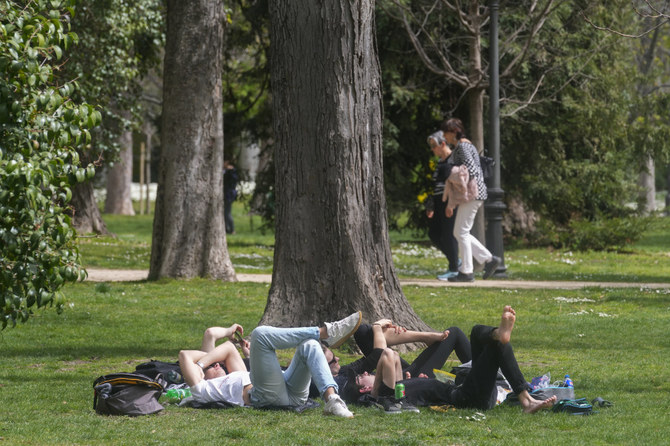
People relax in the Retiro park in Madrid, Spain, on March 20, 2024. Europe is the fastest-warming continent and its temperatures are rising at roughly twice the global average, climate monitoring organizations say. (AP Photo/File)
2 / 3
A lake of meltwater has formed on the tongue of the Rhone Glacier near Goms, Switzerland, on June 13, 2023, an effect of temperatures rising in Europe at roughly twice the global average. (AP Photo/File)
3 / 3
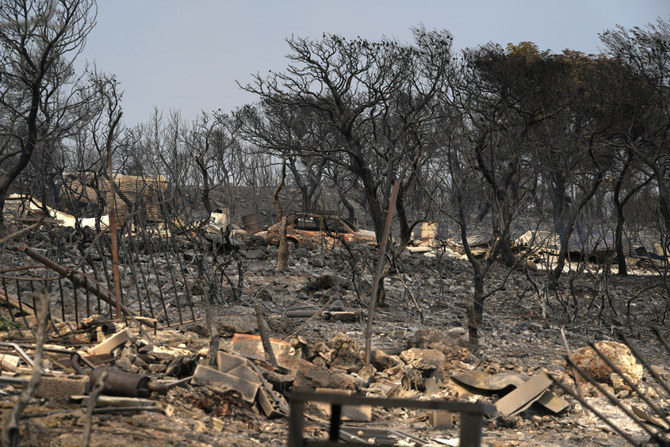
This photo taken on July 19, 2023, shows burnt trees and a car in Mandra, west of Athens, Greece, an effect of temperatures rising in Europe at roughly twice the global average. (AP Photo/File)
Short Url
Updated 22 April 2024
Follow

Health-harming heat stress rising in Europe, scientists say

  • Temperatures in Europe are rising at roughly twice the global average, Copernicus and WMO reported
  • Deaths related to heat have increased by around 30 percent in Europe in the last 20 years, the report said

BRUSSELS: Europe is increasingly facing bouts of heat so intense that the human body cannot cope, as climate change continues to raise temperatures, the EU’s Copernicus climate monitoring service and the World Meteorological Organization said on Monday.
In a report on Europe’s climate, Copernicus and the WMO noted last year’s extreme conditions, including a July heatwave which pushed 41 percent of southern Europe into strong, very strong or extreme heat stress — the biggest area of Europe under such conditions in any day on record.
Extreme heat poses particular health risks to outdoor workers, the elderly, and people with existing conditions like cardiovascular diseases and diabetes.
Parts of Italy recorded 7 percent more deaths than normal last July, with victims including a 44-year-old man painting road markings in the northern town of Lodi who collapsed and died.
Heat stress measures the impact that the environment has on the human body, combining factors like temperature, humidity and the body’s response, to establish a “feels like” temperature.

Parts of Spain, France, Italy and Greece experienced up to ten days of extreme heat stress in 2023, defined as a “feels like” temperature of more than 46 degrees Celsius, at which point immediate action must be taken to avoid heat stroke and other health issues.
Deaths related to heat have increased by around 30 percent in Europe in the last 20 years, the report said.
The EU’s environment agency urged governments last month to prepare health care systems for climate change and called for EU rules to protect outdoor workers from extreme heat.
Last year was the world’s hottest since records began. Europe is the world’s fastest-warming continent.
Greenhouse gas emissions were the biggest cause of last year’s exceptional heat, the report said. Factors including the El Nino weather pattern also played a role.
The heat fueled extreme weather including flooding, since the warmer atmosphere can hold more moisture, causing heavier downpours when it is released.
Floods in Slovenia last year affected 1.5 million people. Greece suffered the EU’s biggest wildfire on record which, at 960 square km, was twice the size of Athens. Alpine glaciers lost 10 percent of their remaining volume during 2022 and 2023.
“Some of the events of 2023 took the scientific community by surprise because of their intensity, their speed of onset, extent and duration,” said Carlo Buontempo, director of the Copernicus Climate Change Service.


US Treasury chief says retaliatory EU tariffs over Greenland ‘unwise’

Updated 4 sec ago
Follow

US Treasury chief says retaliatory EU tariffs over Greenland ‘unwise’

  • He said Trump wanted control of the autonomous Danish territory because he considers it a “strategic asset” and “we are not going to outsource our hemispheric security to anyone else.”

Davos: US Treasury Secretary Scott Bessent warned European nations on Monday against retaliatory tariffs over President Donald Trump’s threatened levies to obtain control of Greenland.
“I think it would be very unwise,” Bessent told reporters on the sidelines of the World Economic Forum in the Swiss ski resort of Davos.
He said Trump wanted control of the autonomous Danish territory because he considers it a “strategic asset” and “we are not going to outsource our hemispheric security to anyone else.”
Asked about Trump’s message to Norway’s prime minister, in which he appeared to link his Greenland push to not winning the Nobel Peace Prize, Bessent said: “I don’t know anything about the president’s letter to Norway.”
He added, however, that “I think it’s a complete canard that the president will be doing this because of the Nobel Prize.”
Trump said at the weekend that, from February 1, Britain, Denmark, Finland, France, Germany, the Netherlands, Norway and Sweden would be subject to a 10-percent tariff on all goods sent to the United States until Denmark agrees to cede Greenland.
The announcement has drawn angry charges of “blackmail” from the US allies, and Germany’s vice chancellor Lars Klingbeil said Monday that Europe was preparing countermeasures.
Asked later Monday on the chances for a deal that would not involve acquiring Greenland, Bessent said “I would just take President Trump at his word for now.”
“How did the US get the Panama Canal? We bought it from the French,” he told a small group of journalists including AFP.
“How did the US get the US Virgin Islands? We bought it from the Danes.”
Bessent reiterated in particular the island’s strategic importance as a source of rare earth minerals that are critical for a range of cutting-edge technologies.
Referring to Denmark, he said: “What if one day they were worried about antagonizing the Chinese? They’ve already allowed Chinese mining in Greenland, right?“