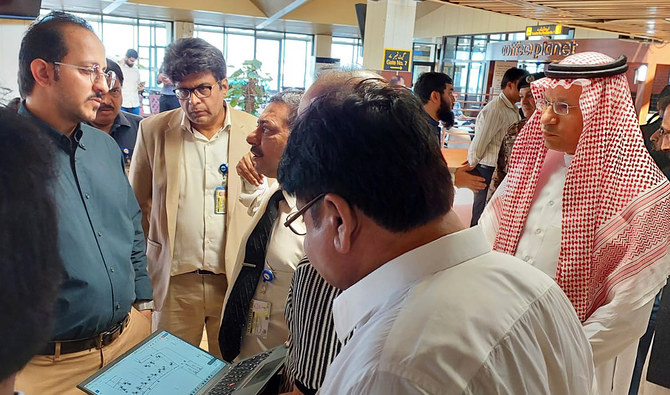
KARACHI: A two-member delegation from Saudi Arabia on Sunday visited the Jinnah International Airport in Karachi to inspect facilities there for the Makkah Route initiative aimed at facilitating local Hajj pilgrims, the Pakistan Civil Aviation Authority (PCAA) said.
Launched in 2019, the initiative allows for the completion of immigration procedures at the pilgrims’ country of departure. This makes it possible to bypass long immigration and customs checks upon reaching Saudi Arabia, which significantly reduces the waiting time and makes the entry process smoother and faster.
Pakistani pilgrims performing Hajj under the government scheme have been availing this facility at the airport in Islamabad for the last couple of years. But the government wants the initiative to be extended to other cities as well.
The two-member delegation, which was accompanied by officials of the Saudi consulate, was warmly welcomed by PCAA officials upon arrival at the Karachi airport.
“The purpose of their visit was to inspect the airport’s facilities and discuss the arrangements for the Route to Makkah project,” the PCAA said in a statement. “During their visit, APM (airport manager) provided the delegation with a comprehensive tour of the airport’s facilities.”
The delegation showed particular interest in the entry process for intending pilgrims and the allocation of immigration space, according to the PCAA. Other key points discussed were related to the allocation of an immigration hall, and differentiating between government and private scheme pilgrims.
Pakistan’s religious affairs ministry last month announced completion of a survey for the Makkah Route initiative at the Karachi airport ahead of the Hajj season.
The South Asian country expects more than 60 percent of pilgrims performing Hajj this year to benefit from the initiative. People opting for the private Hajj scheme can also avail the facility, given the tour operators providing them services have contacted the Pakistani religious ministry for the purpose.
Saudi Arabia last year restored Pakistan’s pre-pandemic Hajj quota of 179,210 pilgrims and abolished the upper age limit of 65 years. More than 81,000 Pakistani pilgrims performed Hajj under the government scheme in 2023, while the rest used private tour operators.
This year’s pilgrimage is expected to run from June 14 till June 19.

Saudi delegation inspects facilities at Karachi airport for Makkah Route initiative
https://arab.news/rck6d
Saudi delegation inspects facilities at Karachi airport for Makkah Route initiative
- The initiative allows for the completion of immigration procedures at the pilgrims’ country of departure
- More than 60% of Pakistani pilgrims on government program are likely to benefit from the initiative this year
Pakistan Army’s logistics firm to run national shipping corporation, confirm officials
- Government to transfer 30 percent shares in Pakistan National Shipping Corporation, management control to NLC firm, say officials
- Officials say the move will increase PNSC’s shipping fleet from 10 to 54, save $6 billion Islamabad pays in foreign freight annually
KARACHI: The government has decided to transfer the state-run Pakistan National Shipping Corporation’s (PNSC) management to the military-run National Logistics Corporation (NLC), officials confirmed on Thursday, saying the move is expected to save $6 billion that Islamabad currently pays in foreign freight annually.
A week earlier, Prime Minister Shehbaz Sharif’s government sold 75 percent of its shareholding in the national flag carrier Pakistan International Airlines (PIA) to a business consortium led by Arif Habib Group for Rs135 billion ($482 million).
The government’s current drive to privatize state-owned enterprises (SOEs) is a key requirement of the International Monetary Fund’s (IMF) $7 billion loan program. The global lender wants Islamabad to privatize its loss-making state assets to save valuable revenue.
PNSC reported a 34 percent decline in its profit, which reduced to Rs3.71 billion ($13.2 million) in the July-September quarter this year. Its revenues from shipping business fell by 2 percent to Rs9.32 billion ($33 million) in the same period, according to the company’s filing to the Pakistan Stock Exchange (PSX) seen by Arab News. The PNSC’s profits remained almost stagnant at Rs20 billion ($73 million) in FY25 while its shipping income shrank 18 percent to Rs33.7 billion ($120.3 million).
“We received a letter about one month ago in which the government asked us to sort out things before Dec. 30,” a PNSC official told Arab News on condition of anonymity as he was not authorized to speak to media. “The management control will go to the NLC.”
An NLC official confirmed the same.
“Yes, this is happening,” an NLC official told Arab News on condition of anonymity. He said details will be shared in due course.
Muhammad Arshad, a spokesman at Pakistan’s Maritime Affairs Ministry, and PNSC Spokesperson Muhammad Farooq Nizami both declined to comment on the matter.
“We can’t say anything about this development until we get an official notification,” Nizami told Arab News.
Officials said that as per the PNSC Revitalization and Improvement Plan, the government would sell about 30 percent of its PNSC shareholding to NLC, which would then have a controlling share in the corporation’s management.
As of Jun. 30, the government holds 87.56 percent shares in PNSC, whose 198.1 million shares are listed on the PSX with a market capital of Rs109 billion ($389 million).
The NLC will be required to increase the PNSC’s shipping fleet, which currently comprises only 10 ships, to 54 over the next five years, the shipping company’s official said.
This would help Pakistan’s government save about $6 billion in freight costs as the PNSC’s current 10 ships are only able to handle 11 percent of the country’s commercial cargo, he added.
“As a result, Pakistan has to pay approximately $6 billion annually in foreign exchange to foreign shipping companies as freight charges,” he said.
Among other objectives, the military-led company is also expected to rid PNSC of its aging fleet, as many vessels are nearing the end of their operational life and won’t be able to sail profitably beyond 2030.
“This initiative will ensure 100 percent replacement of all old PNSC vessels along with the induction of new ships,” the PNSC official said.
News reports of the transfer of management have led to a rise in the PNSC’s shares at the PSX, which gained by around 21 percent in the last two trading sessions. The stocks traded at Rs548.89 ($1.9) per share on Thursday morning, taking its year-to-date gains to 17 percent.
Pakistan’s government has been cautious in spending its $16 billion foreign exchange reserves as it aims to keep its current account balance in check.
Pakistan’s current account reported a $812 million deficit in the July-November period from a $503 million surplus last year, according to data shared by the central bank.
The PNSC official said the increase in the company’s shipping fleet will enhance its share in global maritime freight from $162 million to $1.79 billion.
“Despite significant growth potential in the shipping industry, the absence of private operators is hindering market dynamism and efficiency,” he said.
“World-class financial and legal advisers will be appointed for institutional restructuring, transforming PNSC into a modern, agile, and professionally managed organization.”


