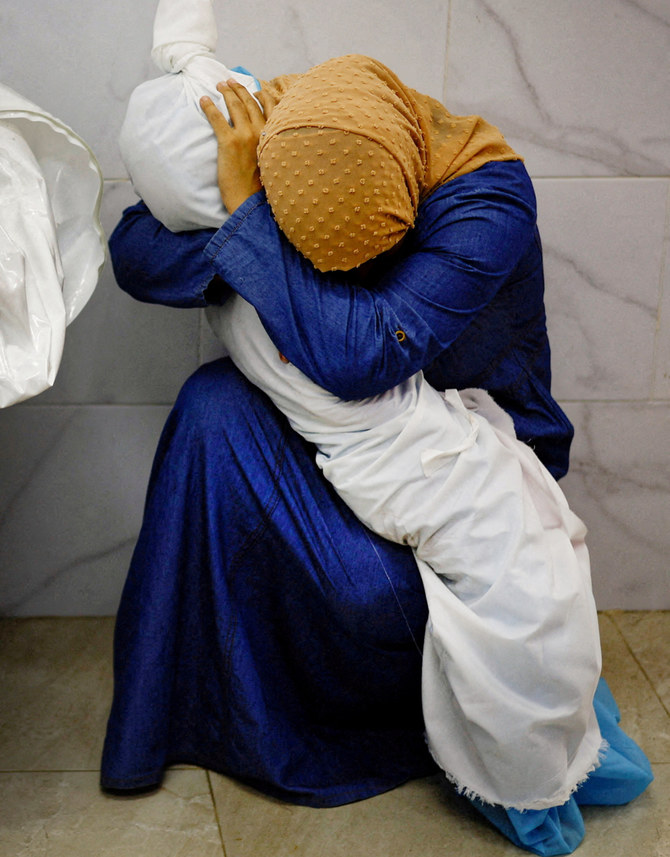

GENEVA: The UN has decried the intentional destruction of complex and hard-to-obtain medical equipment in Gaza’s beleaguered hospitals and maternity wards, further deepening risks to women already giving birth in “inhumane, unimaginable conditions.”
Recent UN-led missions to 10 Gaza hospitals found many “in ruins” and just a couple capable of providing any level of maternal health services, said Dominic Allen, the UN Population Fund or UNFPA representative for the state of Palestine.
He said that what the teams found at the Nasser Hospital complex, long besieged by Israeli forces during their operations in the southern city of Khan Younis, “breaks my heart.”
BACKGROUND
The World Health Organization has described the difficulty of bringing complex medical equipment into Gaza even before the current war erupted in October.
Speaking to journalists in Geneva via video link from Jerusalem, he described seeing “medical equipment purposefully broken, ultrasounds — which you will know, is a very important tool for helping ensure safe births — with cables that have been cut.”

Palestinian forensic experts inspect the body of a dead person uncovered in the vicinity of Al-Shifa Hospital in Gaza City on April 17, 2024 after the recent Israeli military operation there amid the ongoing fighting in the Palestinian territory between Israel and the militant group Hamas. (AFP)
“Screens of complex medical equipment, like ultrasounds and others with the screens smashed,” he added.
The World Health Organization has described the difficulty of bringing such equipment into Gaza even before the current war erupted following Hamas’s Oct. 7 attack inside Israel.
Allen warned that this “purposeful, wanton destruction in the maternity ward,” coupled with other damage and lacking water, sanitation, and electricity, was complicating efforts to get what was previously the second-most important hospital in the Palestinian territory up and running again “to provide a lifeline.”
Meanwhile, at Al-Khair, another specialized maternity hospital in Khan Younis, “it didn’t seem as if there was any piece of working medical equipment,” he said, lamenting that the birthing rooms “stand silent.”
“They should be places that give life, but they just have an eerie sense of death.”
Only 10 of Gaza’s 36 hospitals are currently even partially functioning.
And Allen said that only three of those were now capable of assisting the estimated 180 women giving birth across Gaza every single day — around 15 percent of whom suffer complications requiring significant care.
The hospitals that can provide such care are thus facing significant capacity constraints.
The Emirati Hospital in the south, the main maternity hospital in Gaza currently, is, for instance, supporting up to 60 births every day, including as many as 12 Caesarian sections, he said.
Given the heavy pressure on the facility, women are discharged just hours after giving birth, “and after C-sections, it is less than a day,” Allen said, stressing “that increases risks.”
He said there was a risk in the number of complicated procedures linked to “malnutrition, dehydration, and fear, which impact the pregnant woman’s ability to give birth safely and carry their baby to full term safely.”
A doctor at the Emirati hospital had told Allen that “he no longer sees normal-size babies.”
Amid a “completely crippled” health system in Gaza, the UNFPA is “deeply concerned about the ability to provide postnatal care,” he said.
He said the agency was deploying midwives and midwifery kits to makeshift school centers to help fill the gap.
The current war started after Hamas launched its unprecedented attack on Oct. 7.
Israel’s retaliatory offensive has killed more than 34,000 people in Gaza, mostly women and children. according to the territory’s Health Ministry.