TEHRAN: Iran has dismissed as akin to child’s play Israel’s reported retaliation for an unprecedented Iranian strike, as both sides on Saturday appeared to step back from wider conflict stemming from the war in Gaza.
However, a deadly blast at an Iraqi military base emphasized the high tensions which persist in the region, as did more deadly Israeli strikes in Gaza and intensifying clashes in the West Bank.
Fears have soared this month that escalating tit-for-tat attacks between Israel and Iran could tip over into a broader war in the Middle East.
Israel had warned it would hit back after Iran launched more than 300 missiles and drones a week ago in its first-ever direct attack on its arch enemy’s territory.
The Iran attack was itself in retaliation for an air strike — widely blamed on Israel — that levelled the Iranian consulate in Damascus and killed seven Revolutionary Guards on April 1.
The Israeli retaliation appeared to come on Friday, when Iranian media reported blasts in the central province of Isfahan.
Fars news agency reported “three explosions” close to Qahjavarestan, near Isfahan airport and the 8th Shekari army air base.
“What happened last night was no attack,” Iranian Foreign Minister Hossein Amir-Abdollahian told NBC News.
“It was the flight of two or three quadcopters, which are at the level of toys that our children use in Iran,” he added.
“As long as there is no new adventure on behalf of the Israeli regime against Iran’s interests, we will have no response.”
Israeli officials have made no public comment on what — according to a senior US congressional source who spoke to AFP — were retaliatory Israeli strikes against Iran.
Sanam Vakil, director of the Middle East and North Africa program at Britain’s Chatham House think tank, said the reported Israeli strike had been “calibrated to avoid damage and further Iranian aggression.”
Iranian political expert Hamid Gholamzadeh said the incident in Isfahan, while “insignificant,” needs to be seen in the context of the “fight for balance of power” between the two countries.
“The region is on fire and an all-out war can be ignited any moment,” he said.
While tensions rose after the attack on Iran’s consulate, violence involving Iran-backed groups had already been surging across the Middle East since the outbreak of the Gaza war.
Officials in Iraq said one person was killed and eight wounded in an explosion at a military base south of Baghdad housing a coalition of pro-Iranian armed groups.
There was no immediate claim of responsibility.
Since the Gaza war began, violence has also flared in the other occupied Palestinian territory, the West Bank.
The Israeli army said Saturday that its forces killed 10 militants and arrested eight other people during a 40-hour raid on a refugee camp in the northern West Bank.
The Palestinian health ministry said 11 people were wounded in the Israeli raid, including a paramedic who was shot trying to get to the wounded.
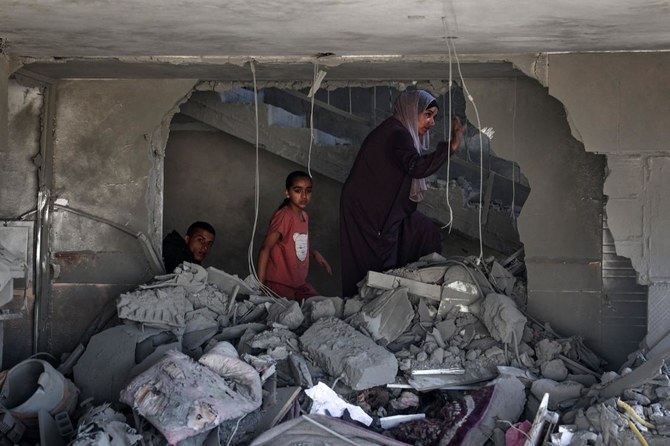
Israel has faced growing global opposition over its military offensive in Gaza, which has reduced vast areas of the besieged Palestinian territory to rubble, while aids groups have warned the north is on the brink of famine.
Israeli Prime Minister Benjamin Netanyahu, who is under pressure over the rising civilian toll, needs “further escalation and another war to distract the world attention” away from suffering in Gaza, Iranian analyst Gholamzadeh said.
There have been particular fears about Israel’s intention to send troops into the southernmost city of Rafah, where most of the population is now sheltering having fled violence elsewhere.
Foreign ministers of the G7 group of developed economies, meeting in Italy on Friday, said they opposed a “full-scale military operation in Rafah” because it would have “catastrophic consequences” for civilians.
But even without a full operation, the city has been under regular bombardment.
On Saturday, Gaza’s Civil Defense agency said an overnight Israeli strike in Rafah killed nine members of a family including six children.
Agency spokesman Mahmud Bassal said the Israeli army had also hit several other areas of Rafah overnight, adding: “It has been a very hard night.”
The war was triggered by an attack on Israel by Hamas on October 7 that resulted in the deaths of 1,170 people, mostly civilians, according to an AFP tally based on Israeli official figures.
Israel has responded with a retaliatory offensive that has killed at least 34,049 people in Gaza, mostly women and children, according to the latest toll from the health ministry in the Hamas-run territory.
Israel’s military said it struck dozens of militant targets over the past day, including the site in north Gaza from which a rocket was fired into the Israeli city of Sderot.
Witnesses in the central Nuseirat refugee camp said the Israeli army told them to evacuate one home, then several were destroyed.
“They instruct us to evacuate and return later, but where do we go back? To ruins?” asked resident Abu Ibrahim.
“How long will this farce continue?“
A UN report on Friday said “multiple obstacles” continue to impede delivery of urgently needed aid.
Despite some recent aid convoys being able to reach Gaza, the WFP cited “the real possibility of famine” in the north.
Efforts to seal a long sought-after truce have stalled, according to mediator Qatar.
Turkish President Recep Tayyip Erdogan, a staunch critic of Israel’s war in Gaza, met with Qatar-based Hamas leader Ismail Haniyeh on Saturday, calling for unity among Palestinians.
After Washington vetoed a Palestinian bid to become a full UN member state earlier this week, president Mahmud Abbas said his West Bank-based Palestinian Authority would “reconsider” its relationship with the US.


![]()

Iran, Israel appear to pull back from brink as Gaza bombed again
Short Url
https://arab.news/9rmr9
Iran, Israel appear to pull back from brink as Gaza bombed again
- Israel had warned it would hit back after Iran launched more than 300 missiles and drones a week ago
- The Iran attack was itself in retaliation for an air strike widely blamed on Israel


Latest updates


Recommended


© 2026 SAUDI RESEARCH & PUBLISHING COMPANY, All Rights Reserved And subject to Terms of Use Agreement.