

Pakistani pacer Mohammad Amir sets sights on T20 World Cup after comeback

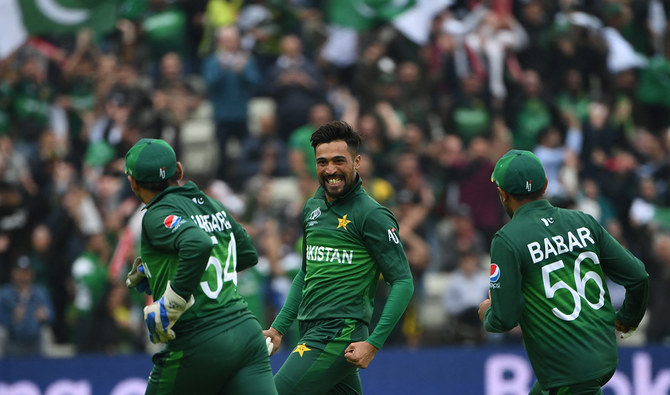
Pakistan's Mohammad Amir (C) celebrates with teammates after the dismissal of New Zealand's Martin Guptill during the 2019 Cricket World Cup group stage match between New Zealand and Pakistan at Edgbaston in Birmingham, central England, on June 26, 2019. (AFP/File)
Short Url
Updated 20 April 2024
Follow

Pakistani pacer Mohammad Amir sets sights on T20 World Cup after comeback

  • Amir played his first T20 international match for Pakistan on Thursday after a nearly four-year hiatus
  • Pacer says he feels his body is fitter compared to 2019 when he last played for Pakistan in a World Cup 

ISLAMABAD: Pakistani fast bowler Mohammad Amir said this week he has set his sights on the upcoming T20 World Cup 2024, as he gears up to mark his return to international cricket after a nearly four-year hiatus. 

The 32-year-old pacer played his first match on Thursday against New Zealand in Rawalpindi but did not bowl a single delivery as rain suspended play during the first over of the match. 

Amir, one of Pakistan’s most prolific fast bowlers, retired in December 2020 after being dropped from the side. He changed his mind last month and decided to restart his career, which had also been stalled by a spot-fixing ban in 2010.

“The way the Pakistan Cricket Board (PCB) management brought me back, it is for a short-term goal, the [T20] World Cup,” Amir told PCB Digital in an interview on Friday. “And that is the biggest goal.”

The left-arm pacer pointed out that Pakistan had played in the semifinal of the T20 World Cup 2021 and competed in the final of the T20 World Cup in 2022. However, it had failed to “cross the line” and become world champions on both occasions. 

“If that happens [Pakistan win the World Cup] it would be a huge achievement for me, to be a part of that team,” he said. 

Amir said he feels he is much fitter compared to 2019 when he last represented Pakistan in a World Cup tournament.

“See, you cannot express yourself properly in the ground until you’re fit,” he said. “So I feel the way my body feels fresh right now, I can chip in more and prove beneficial to the team via my performance.”

The pacer credited his wife and children for helping him stay positive. 

“She makes sure that all my focus is on cricket,” he said. “I think that always gives me energy and helps me to face whatever I have to.”

Pakistan face New Zealand in the second T20 fixture of the five-match series in Rawalpindi today, Saturday. The two sides will lock horns in Rawalpindi on April 21 before meeting for the remaining two fixtures in Lahore on April 25 and 27. 

Teams:

Pakistan: Babar Azam (captain), Usman Khan, Abrar Ahmed, Iftikhar Ahmed, Mohammad Rizwan, Mohammad Amir, Muhammad Irfan Khan, Naseem Shah, Saim Ayub, Shadab Khan, Shaheen Shah Afridi

New Zealand: Michael Bracewell (captain), Mark Chapman, Josh Clarkson, Jacob Duffy, Dean Foxcroft, Ben Lister, Jimmy Neesham, Tim Robinson, Ben Sears, Tim Seifert, Ish Sodhi


Punjab expands Pakistan-India Wagah border arena with museum, partition-themed park

Updated 4 sec ago
Follow

Punjab expands Pakistan-India Wagah border arena with museum, partition-themed park

  • The border crossing, near eastern city of Lahore, is the primary land route between Pakistan and India and one of the most recognizable symbols of their often-tense relations
  • The site is best known for its daily flag-lowering ceremony, a choreographed military ritual performed by border forces from both countries that draws thousands of spectators

ISLAMABAD: Maryam Nawaz, chief minister of Pakistan’s Punjab province, on Thursday inaugurated the newly constructed arena at Wagah border cross between Pakistan and India, which includes a museum and a partition themed park.

The Wagah border crossing, located near the eastern city of Lahore, is the primary land route between Pakistan and India and one of the most recognizable symbols of the often-tense relationship between the two neighbors. It serves as a key point for prisoner exchanges and limited movement of travelers, while remaining tightly regulated due to security considerations.

The site is best known for its daily flag-lowering ceremony, a choreographed military ritual performed by border forces from both countries that draws thousands of spectators. Over the years, the ceremony has evolved into a popular tourist attraction, blending displays of nationalism with public spectacle and making it one of Pakistan’s most visited landmarks, which connects with India’s Attari.

Flanked by military officials, CM Nawaz visited the crossing and inaugurated the new arena, with its seating capacity increased from 7,500 to 25,000 spectators, the state-run Radio Pakistan broadcaster reported. The chief minister also visited the martyrs’ monument and offered her respects.

“In addition to the arena’s expansion, several new constructions have been added at the Joint Check Post Wagah. These new developments include a theme park depicting the partition of the Subcontinent, featuring models of a railway station, military equipment and a Martyrs’ Memorial,” the broadcaster reported.

“A Pakistan Museum has also been established within the arena, showcasing the country’s history and culture from the Freedom Movement to the present day.”

In August 1947, Britain divided the Indian Sub-continent, its former colony, into two countries — Hindu-majority India and Muslim-majority Pakistan.

Excitement over independence was quickly overshadowed by some of the worst bloodletting that left up to 1 million people dead as gangs of Hindus and Muslims slaughtered each other.

Creating two independent nations also tore apart millions of Hindu and Muslim families in one of the world’s largest peacetime migrations, which displaced at least 15 million people.

The fate of Kashmir, then a princely state, was left undecided. The Himalayan territory continues to remain a flashpoint in relations between the neighbors, who have fought multiple wars over it.