

Saudi deputy defense minister discusses security cooperation proposals with Pakistan army chief

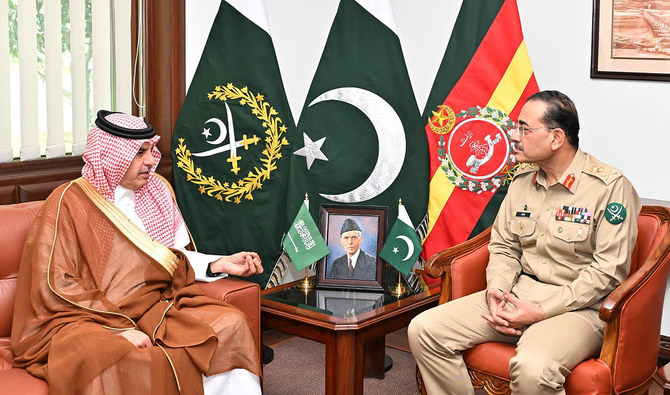
In this handout photo, taken and released by Pakistan’s Inter-Service Public Relations on April 19, 2024, Chief of Army Staff of Pakistan Asim Munir (right) meets Saudi Assistant Defense Minister Talal Bin Abdullah Bin Turki Al-Otaibi during his visit to the General Headquarters in Rawalpindi. (Photo courtesy: ISPR)
Short Url
Updated 19 April 2024
Follow

Saudi deputy defense minister discusses security cooperation proposals with Pakistan army chief

  • Al-Otaibi arrived in Pakistan earlier this week to finalize defense-related bilateral projects
  • Saudi official participates in the Fifth Meeting of Pakistan-KSA Defense Collaboration

ISLAMABAD: Saudi Assistant Defense Minister Talal Bin Abdullah Bin Turki Al-Otaibi called on Pakistani Chief of Army Staff Gen Syed Asim Munir on Friday and discussed defense collaboration projects, the Pakistani military said on Friday. 
Al-Otaibi arrived in Pakistan earlier this week to finalize defense-related bilateral projects, according to the Pakistani defense ministry. His visit follows on the heels of a two-day visit to Islamabad by Saudi Foreign Minister Faisal bin Farhan Al Saud, aimed at enhancing bilateral economic cooperation and pushing forward previously agreed investment deals. Pakistan has said it pitched investment projects worth$30 billion to Riyadh during Prince Faisal’s visit.
“During the meeting, matters of mutual interest and measures to further enhance bilateral defense collaboration including defense production and military training were discussed,” the Pakistan army statement said. 
“COAS affirmed Pakistan Army’s continuing support toward capacity building of Royal Saudi Land Forces.
“Both sides reiterated their resolve to solidify the efforts in defense collaboration with focused approach to target specific capabilities in land, air and sea domains. In this context, concrete proposals were deliberated by the forum to meet tangible objectives within specific timelines.”
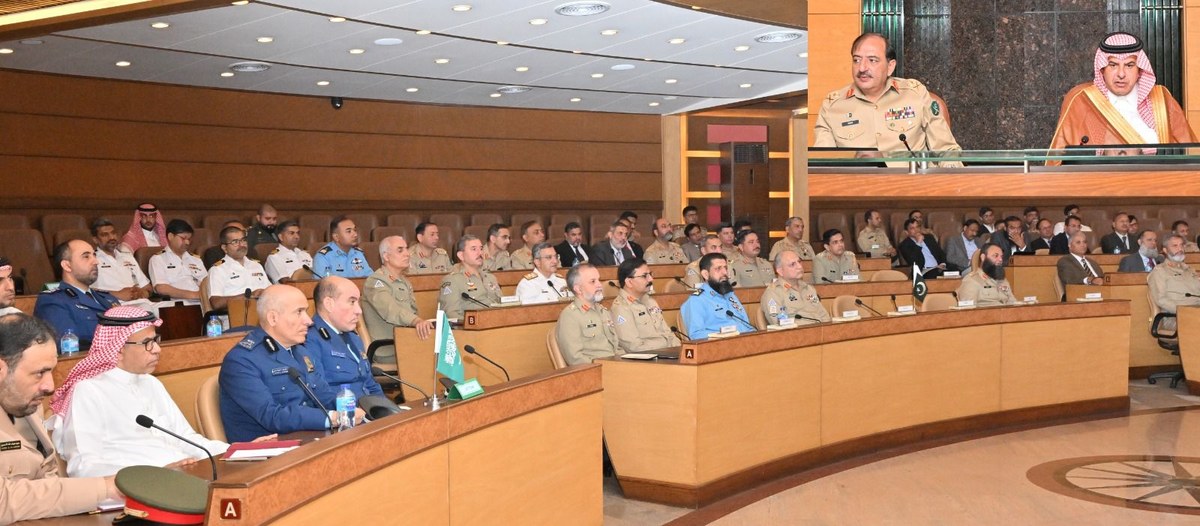


In this handout photo, taken and released by Pakistan’s Inter-Service Public Relations on April 19, 2024, Saudi Assistant Defense Minister Talal Bin Abdullah Bin Turki Al-Otaibi attends Pakistan-KSA Defense Collaboration meeting, co-chaired by Chief of General Staff Pakistan Army, during his visit to the General Headquarters in Rawalpindi. (Photo courtesy: ISPR)

Al-Otaibi also participated in the Fifth Meeting of Pakistan-KSA Defense Collaboration at the Pakistan army’s headquarters in Rawalpindi. 
The forum discussed challenges to global and regional security and noted that rapid advancements in modern technologies “necessitated defense industrial cooperation in critical capabilities between the two brotherly countries.”
“The visiting dignitary acknowledged Pakistan Army’s achievements and sacrifices in war against terrorism and Army’s valuable contributions toward regional peace and stability,” the army’s statement said. 
Pakistan maintains close military ties with Saudi Arabia, providing extensive support, arms, and training to the Saudi armed forces. 
Since the 1970s, Pakistani soldiers have been stationed in Saudi Arabia to protect the Kingdom and Pakistan has also been providing training to Saudi soldiers and pilots. The two nations also regularly carry out multidimensional joint ventures and defense exercises.


Pakistan says defense pact with Saudi Arabia elevated brotherly ties to ‘new heights’

Updated 25 February 2026
Follow

Pakistan says defense pact with Saudi Arabia elevated brotherly ties to ‘new heights’

  • Pakistan, Saudi Arabia signed strategic defense pact last year pledging aggression against one will be treated as attack on both
  • Deputy PM Ishaq Dar says enduring bonds with Islamic and Arab nations form vital pillar of Pakistan’s foreign policy 

ISLAMABAD: Deputy Prime Minister Ishaq Dar said on Wednesday that Pakistan’s defense pact with Saudi Arabia elevated its brotherly ties with the Kingdom to “new heights,” stressing that close ties with Arab and Islamic nations form a key pillar of Islamabad’s foreign policy. 

Pakistan and Saudi Arabia signed a Strategic Mutual Defense Agreement on Sept. 17 last year, pledging that aggression against one country would be treated as an attack on both, enhancing joint deterrence and formalizing decades of military and security cooperation.

Both nations agreed in October 2025 to launch an economic cooperation framework to strengthen trade and investment ties. 

“In the Middle East, our landmark Strategic Mutual Defense Agreement with Saudi Arabia has elevated our brotherly ties to new heights,” Dar said while speaking at the Pakistan Governance Forum 2026 event in Islamabad. 

The Pakistani deputy prime minister was speaking on the topic “Navigating International Relations Amidst Changing Geo-Politics.”

Dar noted that Pakistan has reinforced partnerships with other Middle Eastern nations such as the UAE, Qatar, Jordan, Oman, Egypt and Bahrain. He said these partnerships have yielded “concrete agreements” in investment, agriculture, infrastructure, and energy sectors. 

“Our enduring bonds with Islamic and Arab nations form a vital pillar of our foreign policy, and we will continue to expand our partnerships across Asia, Latin America, and Africa,” he said. 

Dar pointed out that the presidents of Kazakhstan, Uzbekistan and Kyrgyzstan have undertaken visits to Pakistan in recent months, reflecting Central Asian nations’ desire to boost cooperation with Islamabad.

On South Asia, the Pakistani deputy PM said Pakistan has successfully transformed its fraternal ties with Bangladesh into “a substantive partnership.”

“Similarly, the trilateral mechanism involving China, Pakistan, and Bangladesh has been launched with a view to expanding and deepening regional cooperation and synergy,” the Pakistani minister said. 

He said Islamabad has strengthened its “all-weather” partnership with China via the second phase of the multi-billion-dollar China-Pakistan Economic Corridor agreement and “unwavering support” from both sides for each other’s core interests. 

Dar said Pakistan had also reinvigorated its partnership with the US, advancing cooperation in trade, technology, investment, and regional stability. 

“This calibrated approach has enhanced our ability to navigate complexity with skill and confidence, ensuring that our national interests are served without compromising our core foreign policy principles,” he said.