Pakistan seeks to engage with Global Gateway Strategy through European Investment Bank

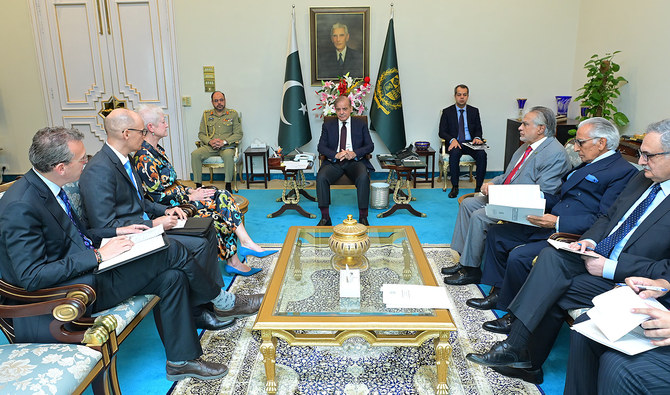
Pakistan Prime Minister Shehbaz Sharif (C) meets with Ambassador of the European Union, Riina Kionka (3L), in Islamabad on April 18, 2024. (Photo courtesy: PMO)
Short Url
Updated 19 April 2024
Follow

Pakistan seeks to engage with Global Gateway Strategy through European Investment Bank

  • EU to invest in infrastructure projects worldwide under Global Gateway Initiative 
  • Over the period 2021–2027, the European Union seeks to invest €300 billion

ISLAMABAD: Prime Minister Shehbaz Sharif on Thursday met Ambassador of the European Union, Riina Kionka, and sought the EU’s support to help Pakistan carry out important reforms in various sectors and engage with the Global Gateway Strategy through the European Investment Bank.
The EU is Pakistan’s second most important trading partner, accounting for over 14 percent of Pakistan’s total trade and absorbing 28 percent of Pakistan’s total exports. Pakistani exports to the EU are dominated by textiles and clothing.
“The Prime Minister appreciated the continuous support of the European Union to Pakistan regarding the GSP Plus scheme,” a statement from the PM’s office said about his meeting with Kionka. 
“The Prime Minister said that the European Union can play an important role in providing consultation and expertise for important reforms in various sectors in Pakistan.”
Pakistan’s GSP+ status is a special trade arrangement offered by the EU to developing economies in return for their commitment to implement 27 international conventions on human rights, environmental protection and governance. 
The current GSP framework came to an end in December 2023 but Members of EU Parliament (MEPs) voted in October to extend the current rules on the scheme for another four years for developing countries, including Pakistan.
During his meeting Kionka, Sharif expressed satisfaction over existing institutional mechanisms “meeting regularly to exchange views on further strengthening cooperation” and indicated Pakistan’s interest in engaging constructively with the EU’s Global Gateway Strategy through the European Investment Bank.
The Global Gateway Initiative is a worldwide strategy by the European Union to invest in infrastructure projects worldwide. The project was initiated by the EU Commission under the leadership of Ursula von der Leyen. Over the period 2021–2027, the EU will invest €300 billion.
The EU Ambassador briefed the PM on various cooperation initiatives, including an ongoing dialogue on migration and mobility issues between the two sides, as well as facilitating European businesses operating in Pakistan. Progress on the resumption of flights from Pakistan to EU countries was also discussed.


Pakistan army chief says future warfare will rely on technology over battlefield maneuvers

Updated 8 sec ago
Follow

Pakistan army chief says future warfare will rely on technology over battlefield maneuvers

  • Asim Munir cites drones, electronic warfare and surveillance as central to future war operations
  • Remarks follow Pakistan’s 2025 military conflict with India that highlighted role of technology

ISLAMABAD: Pakistan’s army chief said on Thursday future conflicts would be shaped more by technology than traditional battlefield maneuvers, as the military accelerates its shift toward drone warfare, electronic systems and networked command structures, according to a statement issued by the Pakistan military.

Field Marshal Syed Asim Munir, who also serves as Chief of Defense Forces, made the remarks while visiting the Bahawalpur Garrison in southern Punjab, where he observed a high-intensity field exercise focused on integrating new technologies into conventional military operations, the Inter-Services Public Relations (ISPR) said.

The exercise, titled Steadfast Resolve, involved unmanned aerial systems, advanced surveillance assets, electronic warfare capabilities and modern command-and-control mechanisms, reflecting what the military described as a move toward “technology-enabled multi-domain operations.”

“Character of war has evolved massively, with technological advancements driving the evolution, dictating huge mental transformation at all tiers,” Munir said while addressing troops, according to the ISPR statement.

“In future, technological maneuvers will replace physical maneuvers and will fundamentally alter the way offensive and defensive operations are undertaken,” he added.

Militaries worldwide are reassessing combat doctrine as drones, electronic warfare and real-time data increasingly shape outcomes on modern battlefields. In South Asia, those shifts gained renewed attention following military exchanges between Pakistan and India in May 2025, when both sides employed surveillance, electronic countermeasures and precision capabilities alongside conventional forces, underscoring the growing role of non-kinetic domains.

Munir said the Pakistan army was “embracing and absorbing technology at a rapid pace,” adding that “innovation, indigenization and adaptation shall remain fundamental” as the military prepares for future battlefield and security challenges.

The army chief also reiterated that Pakistan’s armed forces remained prepared to defend the country’s sovereignty and territorial integrity, while emphasizing the need to maintain readiness as warfare increasingly expands across physical, cyber and electronic domains.