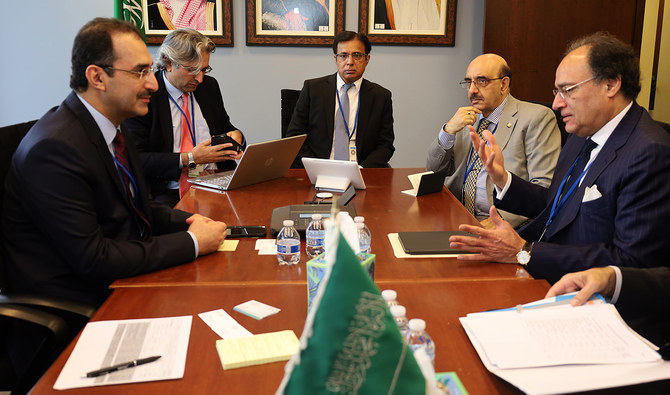
ISLAMABAD: Federal Minister for Finance Muhammad Aurangzeb met with Sultan Abdulrahman Al-Marshad, CEO Saudi Fund for Development (SFD), in Washington on Thursday and discussed investable projects, including a dam and a major national highway.
Aurangzeb is in Washington for IMF and World Bank spring meetings. As he launches negotiations for a new three-year multi-billion-dollar bailout deal from the IMF, Saudi Foreign Minister Prince Faisal bin Farhan Al Saud was in Islamabad earlier this week where he said Riyadh would be “moving ahead significantly” to invest in projects in the South Asian nation.
The Saudi official’s visit followed a meeting in Makkah between Prime Minister Shehbaz Sharif and Saudi Crown Prince Mohammed bin Salman in which the Kingdom had pledged to expedite $5 billion in investments.
“Briefed him [SFD CEO] about his recent visit to Saudi Arabia and that of Saudi delegation to Pakistan during this week,” the finance ministry said about the meeting between the Pakistani finance minister and the Saudi official in Washington.
“Expressed satisfaction with the progress of ongoing projects. Discussed the funding of Diamer Bhasha dam and N-25 from Karachi to Chaman. Informed that Pakistan would pitch bankable and investable projects to Saudi investors.”
Diamer-Bhasha Dam is a concrete-filled gravity dam, in the preliminary stages of construction, on the River Indus between Kohistan district in Khyber Pakhtunkhwa and Diamer district in Gilgit Baltistan. Upon completion, the dam dam would produce 4800 megawatts of electricity through hydro-power generation, store an extra 10.5 cubic kilometers of water for Pakistan that would be used for irrigation and drinking, extend the life of Tarbela Dam located downstream by 35 years, and control flood damage by the River Indus downstream during high floods.
The N-25 or National Highway 25 is an 813 km national highway in Pakistan which extends along from Karachi, Pakistan’s commercial hub, in Sindh province to the Chaman border via Quetta in the Balochistan province of Pakistan.
During the Saudi FM’s visit this week, investments in the Pakistani sectors of mining and minerals, agriculture, energy, information technology and infrastructure development were discussed. Speaking to journalists on Thursday, Foreign Minister Ishaq Dar said Pakistan had pitched an “epic menu” of investment projects worth $30 billion to Riyadh during Prince Faisal’s visit.
Pakistan and Saudi Arabia enjoy strong trade, defense and cultural ties. The Kingdom is home to over 2.7 million Pakistani expatriates and the top source of remittances to the cash-strapped South Asian country.


![]()

Pakistani finance minister, Saudi Fund for Development discuss funding for dam, highway
Short Url
https://arab.news/2x8ts
Pakistani finance minister, Saudi Fund for Development discuss funding for dam, highway
- Aurangzeb is in Washington for IMF and World Bank spring meetings
- Saudi FM was recently in Pakistan to discuss investment projects


Latest updates


© 2026 SAUDI RESEARCH & PUBLISHING COMPANY, All Rights Reserved And subject to Terms of Use Agreement.