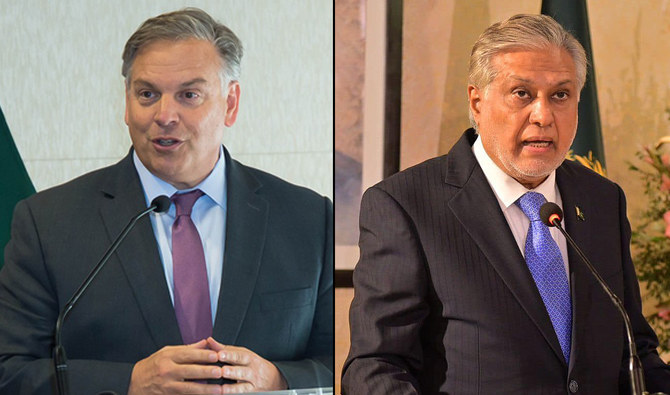
KARACHI: US Ambassador Donald Blome met Pakistani Foreign Minister Ishaq Dar on Thursday and said the South Asian nation’s prosperity and security remained a ‘top priority’ for Washington.
Blome’s comments come amid a spike in militant attacks in Pakistan and while its finance chief is in discussions with the International Monetary Fund in Washington on a potential follow-up program to its nine-month, $3 billion stand-by arrangement.
“US Ambassador Donald Blome met today with Foreign Minister Ishaq Dar to discuss recent events in the region,” Acting US Mission Spokesperson Thomas Montgomery said.
“Ambassador Blome conveyed the United States’ commitment to working with the government and people of Pakistan, underscoring that prosperity and security for Pakistan remains a top priority for the United States.”
Pakistan went to the polls on February 8 in a vote marred by a mobile Internet shutdown on election day, arrests and violence in its build-up and unusually delayed results, leading to accusations that the vote was rigged.
However, the US has repeatedly said it will work with the new government of Prime Minister Shehbaz Sharif, though it has expressed concerns about reported election irregularities and urged a probe.
Although defense and key foreign policy decisions are largely influenced by Pakistan’s powerful military, Sharif will have to juggle relations with the US and China.
Islamabad has close economic ties to both the nations, which has put it in a tricky position as the two countries have embarked upon a costly trade war.
“From our perspective it has to be an and-and discussion,” finance minister Muhammad Aurangzeb said in an interview this week when asked how the Sharif government plans to conduct its trading relationships with the world’s two largest economies.
“US is our largest trading partner, and it has always supported us, always helped us in terms of the investments,” he said. “So that is always going to be a very, very critical relationship for Pakistan.”
“On the other side, a lot of investment, especially in infrastructure, came through CPEC,” he said, referring to the roughly 1,860-mile-long China-Pakistan Economic Corridor designed to give China access to the Arabian Sea.
Aurangzeb said there was a “very good opportunity” for Pakistan to play a similar role in the trade war as countries like Vietnam, which has been able to dramatically boost its exports to the US following the imposition of tariffs on some Chinese goods.
“We have already a few examples of that already working,” he said. “But what we need to do is to really scale it up.”
Militancy has also spiked in recent months, creating a major challenge for the new government, with religiously motivated groups like the Pakistani Taliban as well as ethnic separatists showing an enhanced ability to hit high-value targets.
In an attack last month that has so far been unclaimed, a suicide bomber rammed a vehicle into a convoy of Chinese engineers working on a hydropower project at Dasu in the northwestern Khyber Pakhtunkhwa province, killing five Chinese nationals and their Pakistani driver.
The Mar. 26 assault was the third major attack in little over a week on China’s interests in the South Asian nation, where Beijing has invested more than $65 billion in infrastructure projects as part of its wider Belt and Road initiative.


![]()

US says Pakistan’s prosperity and security remains a ‘top priority’
Short Url
https://arab.news/wy84p
US says Pakistan’s prosperity and security remains a ‘top priority’
- Blome’s comments come amid a spike in militant attacks in Pakistan
- Pakistani finance chief has launched negotiations for a new IMF bailout
Latest updates


© 2026 SAUDI RESEARCH & PUBLISHING COMPANY, All Rights Reserved And subject to Terms of Use Agreement.