

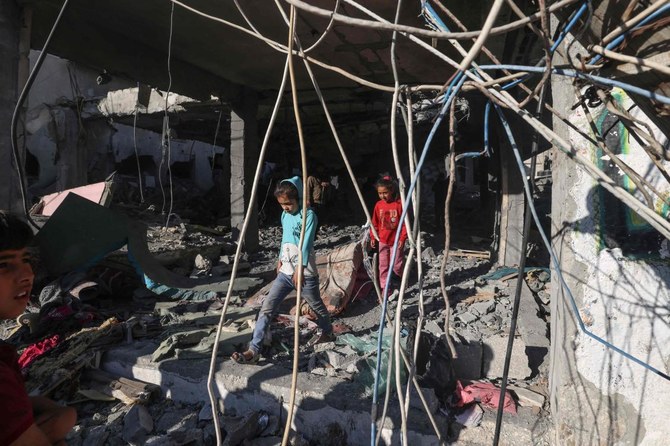
GENEVA: The United Nations appealed on Wednesday for $2.8 billion in funding to assist more than three million people in Gaza and the West Bank until the end of the year, to help ease food shortages and prevent looming famine in Gaza.
A flash appeal published by the UN Office for the Coordination of Humanitarian Affairs (OCHA) said that sum was needed to help 3.1 million people and “reduce human suffering and prevent further loss of life.”
A major chunk of funding — $782.1 million — will be destined for food aid for 2.2 million people in Gaza and 400,000 people in the West Bank, the appeal said.
More than six months of war have created critical food shortages among Gaza’s Palestinians that in some areas now exceed famine levels, according to the United Nations.
A senior UN aid official said on Tuesday that the United Nations was struggling to prevent famine in the Gaza Strip and while there had been some improvement in coordination with Israel, aid deliveries in the enclave still faced obstacles.
Israel aims to wipe out Hamas in Gaza after a deadly Oct. 7 attack on Israel by the Palestinian militant group, in which it killed some 1,200 people and took more than 250 people hostage, according to Israeli tallies.
Gaza health authorities say Israel has killed more than 33,000 people since, in its assault on the enclave.
UN appeals for $2.8 billion for Gaza, West Bank aid
https://arab.news/pb2e6
UN appeals for $2.8 billion for Gaza, West Bank aid
- $782.1 million will be destined for food aid for 2.2 million people in Gaza
Syrian government vows to protect Kurds in Aleppo, accuses SDF of planting explosives
- Kurdish-led group targeting neighborhoods with mortars, machine guns, Ministry of Defense says
- Army declares Ashrafieh, Sheikh Maqsoud ‘closed military zone’ after hundreds of civilians evacuated
LONDON: The Syrian government on Wednesday affirmed its commitment to protect all citizens, including Kurds, as armed tensions in Aleppo between the Syrian army and the Kurdish-led Syrian Democratic Forces continued for a fourth day.
The Ministry of Defense accused the SDF of planting explosives on roads and setting booby traps in the Sheikh Maqsoud and Ashrafieh neighborhoods, and bombarding them with mortar shells and heavy machine gun fire.
The army designated the two neighborhoods a “closed military zone” after the Syrian Arab Red Crescent evacuated 850 civilians from the area.
The government said in a statement that the SDF played no role in the city’s security and military affairs.
“This confirms that the exclusive responsibility for maintaining security and protecting residents falls upon the Syrian state and its legitimate institutions, in accordance with the constitution and applicable laws,” it said.
Protecting all citizens, including Kurds, was a non-negotiable responsibility upheld without discrimination based on ethnicity or affiliation, it said.
It also rejected any portrayal of its security measures as targeting a specific community, according to the Syrian Arab News Agency.
“The authorities concerned stress that those displaced from areas of tension are exclusively civilians, all of them Kurdish citizens who left their neighborhoods out of fear of escalation,” the statement said.
“They sought refuge in areas under the control of the state and its official institutions, which clearly demonstrates the trust of Kurdish citizens in the Syrian state and its ability to provide them with protection and security and refutes claims alleging that they face threats or targeted actions.”
The government called for the withdrawal of armed groups from Aleppo.
At least three civilians and a Syrian soldier have been killed and dozens more injured in Aleppo since Tuesday. Authorities have accused the SDF of targeting medical and educational facilities.
The escalation in violence has dealt a blow to an agreement between the two sides that was meant to be implemented by the end of last year.
The Syrian government reached an agreement with the SDF in March that included plans to integrate the group’s military, territory and natural resources, including oil fields, into the new government in Damascus.


