

Pakistan Eid tourism surged by over 360 percent amid easing inflation — provincial data

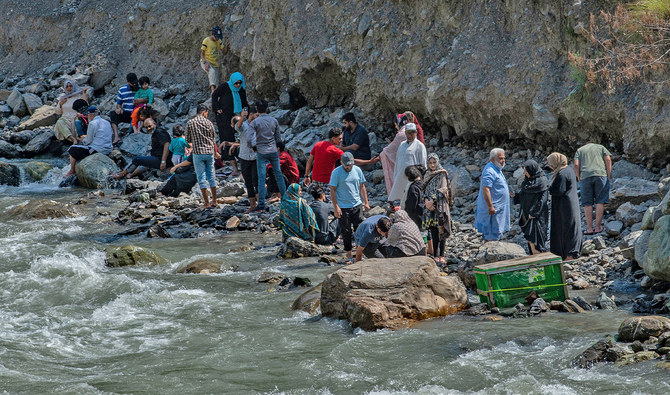
Visitors gather on a riverside in Naran valley, in Mansehra District of Khyber Pakhtunkhwa province on June 28, 2021. (AFP/File)
Short Url
Updated 15 April 2024
Follow

Pakistan Eid tourism surged by over 360 percent amid easing inflation — provincial data

  • Inflation in Pakistan fell to 20.7 percent in March, the country’s lowest in 23 months, data showed
  • Khyber Pakhtunkhwa’s Galiyat area saw highest number of tourists, 237,500, from April 10-14 last week

ISLAMABAD: Eid tourism in Pakistan’s northwestern Khyber Pakhtunkhwa (KP) province surged by over 360 percent this year, with over 580,000 tourists visiting the area’s scenic spots during the five-day holidays last week, data released by the provincial tourism authority on Monday showed, as inflation eases in the economically troubled country. 

Poor weather conditions and soaring inflation led to a staggering 74 percent decline in the number of tourists that visited KP last year during the Eid holidays, as per official figures, when over 125,000 tourists visited the province. The northwestern province is home to many picturesque locations and scenic spots such as Swat Valley, Malam Jabba, Abbottabad, Kaghan, and Shogran that Pakistanis from all over the country visit during the Eid holidays. 

As per figures shared by the Khyber Pakhtunkhwa Integrated Tourism Development Project (KITE), a provincial initiative by the provincial government to develop tourism in KP, 583,452 tourists in total visited the province from April 10-14. 

“Khyber Pakhtunkhwa’s tourist spots remained tourists’ first priority during Eid holidays,” the KP Culture and Tourism Authority said in a statement. “During the five days [April 10-14], over 583,000 tourists visited the tourist spots of Khyber Pakhtunkhwa.”

According to a breakdown shared by KITE, Galiyat saw the highest number of visitors with over 237,500 visiting the area during the five days while 151,900 visited Malam Jabba. As many as 92,470 tourists visited Kumrat Valley while 77,372 toured Naran and Kaghan areas, the data showed. 

Pakistan’s inflation last year peaked at 36.4 percent during April 2023 while food inflation surged to 49.1 percent. The South Asian country’s inflation outpaced price gains even in Sri Lanka as its currency depreciated and Pakistan hiked fuel and energy prices to comply with the International Monetary Fund (IMF). 

In March 2024, however, Pakistan’s inflation rate measured by the Consumer Price Index (CPI) fell to 20.7 percent, its lowest in 23 months. However, the country continues to face significant financial challenges, with dwindling foreign exchange reserves and a weak national currency.


Sindh assembly passes resolution rejecting move to separate Karachi

Updated 21 February 2026
Follow

Sindh assembly passes resolution rejecting move to separate Karachi

  • Chief Minister Shah cites constitutional safeguards against altering provincial boundaries
  • Calls to separate Karachi intensified amid governance concerns after a mall fire last month

ISLAMABAD: The provincial assembly of Pakistan’s southern Sindh province on Saturday passed a resolution rejecting any move to separate Karachi, declaring its territorial integrity “non-negotiable” amid political calls to carve the city out as a separate administrative unit.

The resolution comes after fresh demands by the Muttahida Qaumi Movement (MQM) and other voices to grant Karachi provincial or federal status following governance challenges highlighted by the deadly Gul Plaza fire earlier this year that killed 80 people.

Karachi, Pakistan’s largest and most densely populated city, is the country’s main commercial hub and contributes a significant share to the national economy.

Chief Minister Syed Murad Ali Shah tabled the resolution in the assembly, condemning what he described as “divisive statements” about breaking up Sindh or detaching Karachi.

“The province that played a foundational role in the creation of Pakistan cannot allow the fragmentation of its own historic homeland,” Shah told lawmakers, adding that any attempt to divide Sindh or separate Karachi was contrary to the constitution and democratic norms.

Citing Article 239 of Pakistan’s 1973 Constitution, which requires the consent of not less than two-thirds of a provincial assembly to alter provincial boundaries, Shah said any such move could not proceed without the assembly’s approval.

“If any such move is attempted, it is this Assembly — by a two-thirds majority — that will decide,” he said.

The resolution reaffirmed that Karachi would “forever remain” an integral part of Sindh and directed the provincial government to forward the motion to the president, prime minister and parliamentary leadership for record.

Shah said the resolution was not aimed at anyone but referred to the shifting stance of MQM in the debate while warning that opposing the resolution would amount to supporting the division of Sindh.

The party has been a major political force in Karachi with a significant vote bank in the city and has frequently criticized Shah’s provincial administration over its governance of Pakistan’s largest metropolis.

Taha Ahmed Khan, a senior MQM leader, acknowledged that his party had “presented its demand openly on television channels with clear and logical arguments” to separate Karachi from Sindh.

“It is a purely constitutional debate,” he told Arab News by phone. “We are aware that the Pakistan Peoples Party, which rules the province, holds a two-thirds majority and that a new province cannot be created at this stage. But that does not mean new provinces can never be formed.”

Calls to alter Karachi’s status have periodically surfaced amid longstanding complaints over governance, infrastructure and administrative control in the megacity, though no formal proposal to redraw provincial boundaries has been introduced at the federal level.