Israeli airstrikes, artillery reach deep into Bekaa Valley as tensions soar

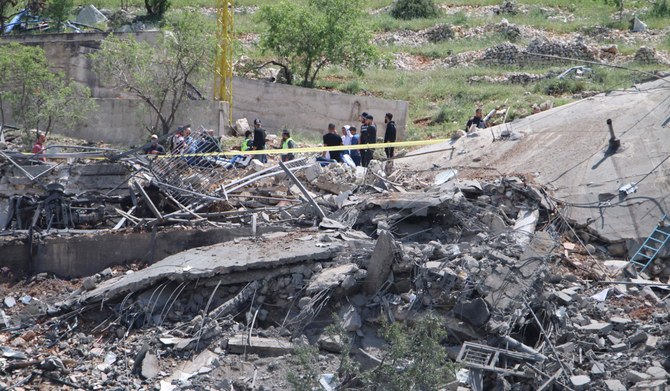
People gather around a destroyed building targeted by Israeli air strikes on the village of Nabi Sheet in the Baablbek district in Lebanon's eastern Bekaa Valley on April 14, 2024, as tensions in the region soared after Iran directly attacked Israel. (AFP)
Short Url
Updated 14 April 2024
Follow

Israeli airstrikes, artillery reach deep into Bekaa Valley as tensions soar

  • Hezbollah modifies its tactics in south Lebanon amidst the backdrop of Iranian attack on Israel

BEIRUT: Israeli forces on Sunday struck a Hezbollah site in Lebanon’s east near the Syrian border as tensions soared following Iran’s direct attack on Israel.

Shelling heavily targeted Lebanese border villages and the Bekaa Valley on Saturday night, as the Israeli military carried out raids on Khiam, Kfarkila, and Odaisseh.

Artillery shelling also targeted Houla, Wadi Saluki, the vicinity of Deir Mimas, and areas along the Litani River.

The raid on Khiam resulted in the death of one person, and many civilians were injured in other villages.

BACKGROUND

Hezbollah has exchanged near-daily cross-border fire with Israel since the Palestinian group attacked southern Israel on October 7, triggering war in the Gaza Strip.

A missile exploded near a Lebanese Army intelligence office in the Jdeidet Marjayoun village.

The missile caused significant material damage to the facility and nearby houses, but miraculously, nobody was injured.

On Sunday morning, Israeli warplanes targeted the park in Jabal Safi adjacent to Jbaa and the outskirts of a village in Iqlim Al-Tuffah.

A sonic boom caused by missile fire damaged several houses, shops, and schools in Jbaa, while Israeli planes also targeted areas deep inside central Bekaa, specifically a three-floor building between the Saraain and Nabi Chit villages. Additionally, military aircraft were seen flying over Baalbek and its surroundings.

The Israeli military said that it struck “an important weapon manufacturing site for Hezbollah in Nabi Chit.”

Hezbollah’s own attacks were limited to Israeli military outposts repeatedly targeted since the outbreak of hostilities, including the air and missile defense headquarters at the Kaylaa outpost in the Golan Heights, which Hezbollah targeted with dozens of Katyusha missiles.

Following the Iranian attack on Israel overnight, Hezbollah’s supporters rallied in Beirut’s southern suburbs, holding the party’s banner and chanting slogans in support of Tehran.

News that the majority of the Iranian drones and missiles were intercepted before reaching Israeli airspace, however, prompted criticism of the attack online.

Beirut's Rafic Hariri International Airport closed for six hours after news of the impending attack broke on Saturday evening.

Lebanese people flocked to gas stations to fill their tanks in case escalating tensions affected supplies in the coming days.

The representative of the country’s fuel distributors, Fadi Abu Shaqra, said that “fuel is secured, and the quantities are sufficient for (the next several) days.”

He said gasoline and diesel were available, and there was no need for the public to worry about shortages.

Caretaker Public Works and Transportation Minister Ali Hamia said the airport will gradually return to work as normal.

“Closing the airport was a precautionary measure. It took into account the safety and security of people arriving and departing,” Hamia said.

“At 7 a.m., we suspended the closure decision. The airspace was opened, and work will gradually return to its normal course.”

Middle East Airlines said it had rescheduled a number of flights and announced the successful departure of flights to London and Dubai.


US shoots down Iranian drone approaching aircraft carrier, official says

Updated 2 sec ago
Follow

US shoots down Iranian drone approaching aircraft carrier, official says

  • Iranian Shahed-139 drone shot down by F-35 jet
  • Iranian boats harass US-flagged tanker in Strait of Hormuz, US military says
The US military on Tuesday shot down an Iranian drone that “aggressively” approached the Abraham Lincoln aircraft carrier in the Arabian Sea, the US military said, in an incident first reported by Reuters. The incident came as diplomats sought to arrange nuclear talks between Iran and the United States, and US President Donald Trump warned that with US warships heading toward Iran, “bad things” would probably happen if a deal could not be reached.
Oil futures prices rose more than $1 per ‌barrel after news ‌the drone was shot down.
The Iranian Shahed-139 drone ‌was ⁠flying toward ‌the carrier “with unclear intent” and was shot down by an F-35 US fighter jet, the US military said.
“An F-35C fighter jet from Abraham Lincoln shot down the Iranian drone in self-defense and to protect the aircraft carrier and personnel on board,” said Navy Captain Tim Hawkins, a spokesperson at the US military’s Central Command.
Iran’s UN mission declined to comment.
Iran’s Tasnim news agency said connection had been ⁠lost with a drone in international waters, but the reason was unknown.
No American service members were ‌harmed during the incident and no US equipment was ‍damaged, he added.
The Lincoln carrier strike ‍group is the most visible part of a US military buildup in ‍the Middle East following a violent crackdown against anti-government demonstrations last month, the deadliest domestic unrest in Iran since its 1979 revolution.
Trump, who stopped short of carrying out threats to intervene during the crackdown, has since demanded Tehran make nuclear concessions and sent a flotilla to its coast. He said last week Iran was “seriously talking,” while Tehran’s top security official, Ali Larijani, said arrangements for negotiations ⁠were under way.
Iranian boats harass US-flagged tanker
In a separate incident on Tuesday in the Strait of Hormuz, just hours after the drone shootdown, Iran’s Islamic Revolutionary Guard Corps forces harassed a US-flagged, US-crewed merchant vessel, according to the US military.
“Two IRGC boats and an Iranian MoHajjer drone approached M/V Stena Imperative at high speeds and threatened to board and seize the tanker,” Hawkins said.
Maritime risk management group Vanguard said the Iranian boats ordered the tanker to stop its engine and prepare to be boarded. Instead, the tanker sped up and continued its voyage.
Hawkins said a US Navy warship, the McFaul, was operating in the area ‌and escorted the Stena Imperative.
“The situation de-escalated as a result, and the US-flagged tanker is proceeding safely,” Hawkins added.