

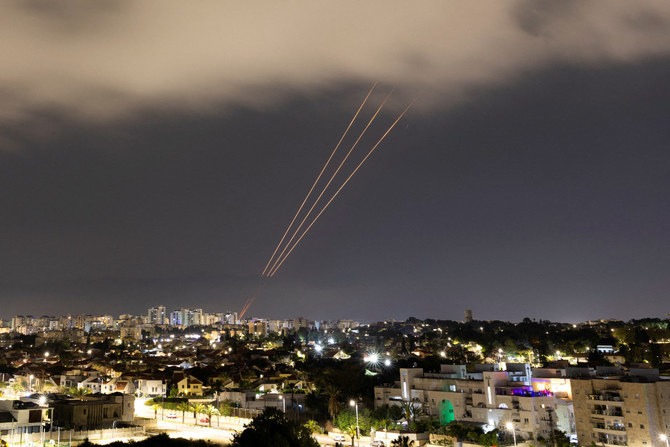

JERUSALEM/DUBAI: Iran launched a swarm of explosive drones and fired missiles at Israel late on Saturday in its first ever direct attack on Israeli territory, risking a major escalation as the United States pledged “ironclad” backing for Israel.
Sirens wailed and journalists in Israel said they heard distant heavy thuds and bangs from what local media called aerial interceptions of explosive drones. The ambulance service said there was no immediate word of casualties.
Israel’s military said more than 100 drones were launched from Iran, with security sources in Iraq and Jordan reporting dozens seen flying overhead and US officials saying the US military had shot some down.
Israel’s Channel 12 TV cited an unnamed Israeli official as saying there would be a “significant response” to the attack.
Iran’s state news agency cited a source saying its military had also launched a wave of ballistic missiles. Israel’s military also said missiles were fired, but there was no immediate report of these striking in Israel.
Iran has vowed retaliation for what it called an Israeli strike on its Damascus consulate on April 1 that killed seven Guards officers including two senior commanders and said its strike was a punishment for “Israeli crimes.” Israel has neither confirmed nor denied responsibility for the consulate attack.
“Should the Israeli regime make another mistake, Iran’s response will be considerably more severe,” the Iranian mission to the United Nations said, warning the US to “stay away.” However, it also said Iran now “deemed the matter concluded.”
US President Joe Biden, who on Friday had warned Iran against an attack, cut short a visit to his home state of Delaware to meet national security advisers in the White House Situation Room, an official said. He pledged to stand with Israel.
The Gaza war between Israel and Hamas, now in its seventh month, has driven up tensions in the region, spreading to fronts with Lebanon and Syria and drawing long-range fire at Israeli targets from as far away as Yemen and Iraq.
British maritime security company Ambrey said in a statement that drones were also reportedly launched against Israel by Yemen’s Iran-aligned Houthi group.
Those clashes now threaten to morph into a direct open conflict pitting Iran and its regional allies against Israel and its main supporter the United States, with regional power Egypt urging “utmost restraint.”
US and British warplanes were involved in shooting down some Israel-bound drones over the Iraq-Syria border area, Channel 12 reported. Three US officials said the US military had shot down drone aircraft without saying how many.
Escalation
“This is a severe and dangerous escalation. Our defensive and offensive capabilities are at the highest level of readiness ahead of this large-scale attack from Iran,” said Israel’s military spokesperson Rear Admiral Daniel Hagari.
Israeli Prime Minister Benjamin Netanyahu, whose official jet took off shortly after the attack began, convened the war cabinet at a military headquarters in Tel Aviv, his office said.
Israel’s military said sirens would sound in any threatened areas and that its defenses were poised to deal with the drones, which it said were “explosive.”
“We are used to having around 20 seconds to get to shelters when missiles come in. Here, the warning comes hours ahead of time. It naturally raises the anxiety level among the Israeli public,” said Nir Dvori, a Channel 12 TV correspondent on social media.
Israel’s military told residents of the Israeli-occupied Golan Heights to stay close to bomb shelters, putting the area on standby for possible impact from drone strikes.
Israel and Lebanon said they were closing their airspace on Saturday night. Jordan, which lies between Iran and Israel, had readied air defenses to intercept any drone or missile that violated its territory, two regional security sources said.
Residents in several Jordanian cities said they heard heavy aerial activity.
Syria, an ally of Iran, said it was putting its ground-to-air defense systems around the capital and major bases on high alert, army sources there said.
Condemnation
The European Union, Britain, France, Mexico, Czechia, Denmark, Norway and the Netherlands all condemned Iran’s attack.
Israel has been bracing for an Iranian response to the Damascus consulate strike since last week, when Iran’s Supreme Leader Ayatollah Ali Khamenei said Israel “must be punished and shall be” for an operation he called equivalent to one on Iranian soil.
Biden said on Friday that his only message to Iran was “Don’t,” but added that “we are devoted to the defense of Israel.”
Iran’s main ally in the region, the Lebanese Shiite group Hezbollah that has been exchanging fire with Israel since the Gaza war began on Oct. 7, said early on Sunday it had fired rockets at an Israeli base.
Earlier on Saturday, Iran’s state-run IRNA news agency reported that a Guards helicopter had boarded and taken into Iranian waters the Portuguese-flagged MSC Aries.
MSC, which operates the Aries, confirmed Iran had seized the ship and said it was working “with the relevant authorities” for its safe return and the wellbeing of its 25 crew.
MSC leases the Aries from Gortal Shipping, an affiliate of Zodiac Maritime, Zodiac said in a statement, adding that MSC is responsible for all the vessel’s activities. Zodiac is partly owned by Israeli businessman Eyal Ofer.
Israeli Foreign Minister Israel Katz accused Iran of piracy.
'IRGC seize commercial ship'
For days, Iranian officials including Supreme Leader Ayatollah Ali Khamenei have threatened to “slap” Israel for its Syria strike.
Iran has largely avoided directly attacking Israel, despite its targeted killings of nuclear scientists and sabotage campaigns on Iran’s atomic sites. Iran has targeted Israeli or Jewish-linked sites through proxy forces.
Israel’s war on Hamas in the Gaza Strip has inflamed decade-old tensions in the Middle East, and any new attack threatens to escalate that conflict into a wider regional war.
Flight-tracking data showed the airspace over Jordan empty, while few flights continued on their north-south routes over Iraq. A sole Middle East Airlines flight from Dubai to Beirut remained airborne over Syria.
Lebanon’s state-run National News Agency reported heavy Israeli airstrikes and shelling on multiple locations in south Lebanon following the launch of drones from Iran. The Iran-backed Lebanese militant group Hezbollah has been clashing with Israeli forces in the border area for more than six months.
Earlier Saturday, commandos from Iran’s paramilitary Revolutionary Guard rappelled from a helicopter onto an Israeli-affiliated container ship near the Strait of Hormuz and seized the vessel.
Iran’s state-run IRNA said a special forces unit of the Guard’s navy carried out the attack on the Portuguese-flagged MSC Aries, a container ship associated with London-based Zodiac Maritime.
Zodiac Maritime is part of Israeli billionaire Eyal Ofer’s Zodiac Group. Zodiac declined to comment and referred questions to MSC. Geneva-based MSC acknowledged the seizure and said 25 crew members were on the ship.
“We are working closely with the relevant authorities to ensure their wellbeing, and safe return of the vessel,” MSC said.
White House National Security Council spokesperson Adrienne Watson said the crew was made up of Indian, Filipino, Pakistani, Russian and Estonian nationals and urged Iran to release them and the vessel.
IRNA said the Guard would take the vessel into Iranian territorial waters.
A Middle East defense official, who spoke on condition of anonymity to discuss intelligence matters, provided video of the attack to The Associated Press in which Iranian commandos are seen rappelling onto a stack of containers on the vessel’s deck.
The video corresponded with known details of the MSC Aries. The commandos rappelled from what appeared to be a Soviet-era Mil Mi-17 helicopter, which both the Guard and the Iranian-backed Houthis in Yemen have used before to raid ships.
Israeli Foreign Minister Israel Katz called on nations to list the Guard as a terrorist organization. Iran “is a criminal regime that supports Hamas’ crimes and is now conducting a pirate operation in violation of international law,” Katz said.
The US, Israel’s main backer, has stood by the country despite growing concerns over Israel’s war on Gaza killing more than 33,600 Palestinians and wounding over 76,200 more. Israel’s war began after Hamas’ Oct. 7 attack on Israel that killed 1,200 people and saw some 250 others taken hostage.
The Pentagon said Saturday that Defense Secretary Lloyd Austin spoke with his Israeli counterpart “to discuss urgent regional threats ... and made clear that Israel could count on full US support to defend Israel against any attacks by Iran and its regional proxies.” National security adviser Jake Sullivan also spoke with his counterpart to reinforce Washington’s “ironclad commitment to the security of Israel.”


