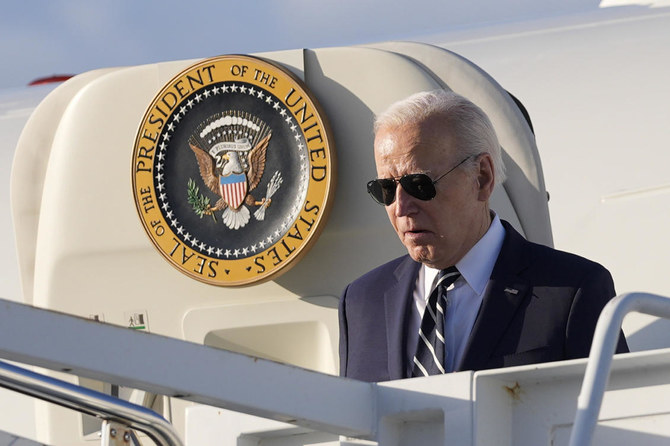
Biden is cutting short a beach weekend to meet with his national security team amid Mideast tensions

President Joe Biden is cutting short a weekend stay at his Delaware beach house and returning to the White House on Saturday to meet with his national security team and monitor the situation in the Middle East.(AP)
Short Url
Updated 13 April 2024
Follow

Biden is cutting short a beach weekend to meet with his national security team amid Mideast tensions

  • Soon after the White House announced the change of plans, the Pentagon reported that Defense Secretary Lloyd Austin had spoken with his Israeli counterpart
  • Amid the Israel-Hamas war, tensions have escalated since a suspected Israeli strike this month on an Iranian consular building in Syria

DELAWARE, USA: President Joe Biden is cutting short a weekend stay at his Delaware beach house and returning to the White House on Saturday to meet with his national security team and monitor the situation in the Middle East.
Soon after the White House announced the change of plans, the Pentagon reported that Defense Secretary Lloyd Austin had spoken with his Israeli counterpart “to discuss urgent regional threats ... and made clear that Israel could count on full US support to defend Israel against any attacks by Iran and its regional proxies.
Amid the Israel-Hamas war, tensions have escalated since a suspected Israeli strike this month on an Iranian consular building in Syria killed 12 people, including senior Iranian generals. Israel is bracing for a possible Iranian attack, raising concerns about the United States being pulled into deeper regional conflict.
Biden on Friday said the United States was “devoted” to defending Israel and that “Iran will not succeed.”
Asked by reporters what his message was for Iran, the president’s only reply was: “Don’t.”
He ignored a question about what would trigger a direct US military response, and when asked how imminent an Iranian attack on Israel was, Biden said he did not want to get into secure information, “but my expectation is sooner than later.”
During the Israel-Hamas war in Gaza, there have been near-daily exchanges of fire between Israeli forces and the Iran-backed Hezbollah militant group along the Israel-Lebanon border. US officials have recorded more than 150 attacks by Iran-backed militias in Iraq and Syria on US forces at bases in those countries since war started on Oct. 7.
One attack in late January killed three US service members in Jordan. In retaliation, the US launched a massive air assault, hitting more than 85 targets at seven locations in Iraq and Syria.
Meantime, on Saturday, commandos from Iran’s paramilitary Revolutionary Guard rappelled from a helicopter onto an Israeli-affiliated container ship near the Strait of Hormuz and seized the vessel.
National Security Council spokesperson Adrienne Watson said the US strongly condemned the seizure and urged Iran to release the ship and crew immediately.
“We will work with our partners to hold Iran to account for its actions,” she said.
Also Saturday, the Israeli-occupied West Bank also saw some of the worst violence since Hamas’ attack on Israel.


Families mourn those killed in a Congo mine landslide as some survivors prepare to return

Updated 03 February 2026
Follow

Families mourn those killed in a Congo mine landslide as some survivors prepare to return

GOMA, Congo: After a landslide last week killed at least 200 people in eastern Congo at a rebel-controlled coltan mine, families of the deceased and survivors are mourning their lost loved ones, and some survivors prepared to head back to the reopened mines.
On Wednesday, following heavy rains in eastern Congo, a network of hand-dug tunnels at the Rubaya mining complex collapsed, killing at least 200 artisanal miners and trapping an unknown number who remain missing. The mine, located around 25 miles (40 kilometers) to the west of the regional capital of Goma, has been under the control of Rwandan-backed M23 rebels since early 2024 and employs thousands of miners who work largely by hand.
Family members grieve
In the Mugunga neighborhood in Goma, the family of Bosco Nguvumali Kalabosh, 39, mourned his death Monday.
Since last Thursday, relatives, neighbors and loved ones have been gathering at the family home, sitting around a photograph of him placed up against a wall.
“He was supposed to return to Goma on Thursday,” said his older brother, Thimothée Kalabosh Nzanga.
Kalabosh had been a miner for more than 10 years. He owned his own mines on the site and came from a family where artisanal mining — mining for minerals using basic hand tools — had been passed down from generation to generation. He leaves behind a widow and four children, the eldest of whom is 5 years old.
Survivors head back to Rubaya
For survivors trickling back into town, the pressure to return to the mines is clear — despite the constant danger.
Tumaini Munguiko, a survivor of the collapse, came to offer his condolences to Kalabosh’s family. “Seeing our peers die is very painful. But despite the pain, we are forced to return to the mines to survive,” he said.
Munguiko calmly explained that he had already experienced several similar disasters. “It has almost become normal. We accept it because it is our means of survival. I was saved this time, but I lost five friends and my older brother.”
According to him, landslides are common in Rubaya, especially during the rainy season. “When it rains, the clay soils become unstable. Some take shelter, others perish, others survive, and others watch from afar,” he said.
Miners dig long tunnels, often parallel to one another, with limited support and no safe evacuation route in case of a collapse.
A former miner at the site told The Associated Press that there have been repeated landslides because the tunnels are dug by hand, poorly constructed and not maintained.
“People dig everywhere, without control or safety measures. In a single pit, there can be as many as 500 miners, and because the tunnels run parallel, one collapse can affect many pits at once,” former miner Clovis Mafare said.
“The diggers don’t have insurance,” said Mafare. Of potential compensation for families, he said: “It’s a whole legal process, and it’s very long. They might receive some money for the funerals, but that small amount isn’t compensation.”
Kalabosh’s family has not received compensation for their loss.
However, both Munguiko and Nzanga say they will return to the mines soon despite the risks.
“I have no choice. Our whole life is there,” said Munguiko.
Rare earth minerals
The Rubaya mines have been at the center of the recent fighting in eastern Congo, changing hands between the Congolese government and rebel groups. For over a year now, the site has been controlled by the M23 rebels.
The mines produce coltan — short for columbite-tantalite — an ore from which the metals tantalum and niobium are extracted. Both are considered critical raw materials by the United States, the European Union, China and Japan. Tantalum is used in mobile phones, computers and automotive electronics, as well as in aircraft engines, missile components and GPS systems. Niobium is used in pipelines, rockets and jet engines.
The mines at Rubaya are massive and attract people from across the region. Artisanal miners and workers have been flocking there for years, drawn to the site to earn a steady income in a region plagued by poverty and chronic insecurity. A disaster like this affects people across eastern Congo and the grief has spread to regional hubs like Goma.
For the last two weeks, Rubaya has been virtually cut off from the world. The mining town has no mobile network or Internet connection. Poor infrastructure, coupled with persistent conflict, means cellular service and electricity are unreliable. To communicate with the outside world, residents must pay around 5,000 Congolese francs — just over $2 — for 30 minutes of connection via a private Starlink system.
Congo’s government, in a statement on X, expressed solidarity with the victims’ families and accused the rebels of illegally and unsafely exploiting the region’s natural resources while blaming Rwanda. An M23 spokesperson accused the government of politicizing the tragedy and listed other collapses at government-controlled mines.