

Indonesia denies reports of recognizing Israel, vows to stay at forefront defending Palestine

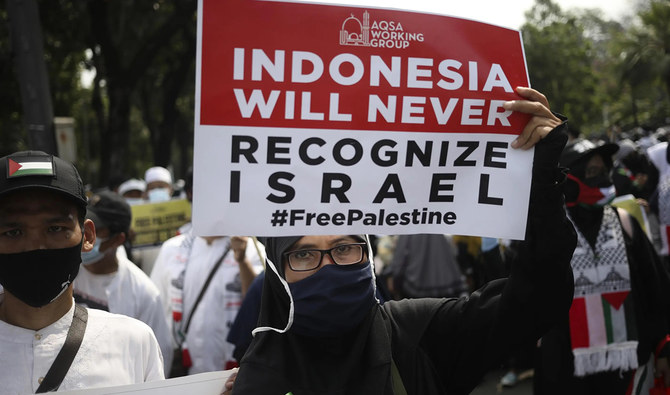
An Indonesian woman holds up a poster during a rally against Israel’s attacks on Gaza, outside the US embassy in Jakarta on May 21, 2021. (AP/File)
Short Url
Updated 12 April 2024
Follow

Indonesia denies reports of recognizing Israel, vows to stay at forefront defending Palestine

  • Establishing ties with Israel would mean ‘political suicide’ for Indonesian leadership
  • Israeli media reports claim Indonesia has started OECD-brokered talks with Tel Aviv

JAKARTA: Jakarta has denied plans to establish diplomatic ties with Tel Aviv, following viral Israeli media reports claiming it was part of a deal to smooth Indonesia’s entry into the Organization for Economic Cooperation.

Indonesia is the first Southeast Asian nation to apply for the membership of the 38-nation forum. Accession talks began in February but, according to local Israeli media, were objected to by Tel Aviv over the lack of diplomatic ties with Jakarta.

Countries need unanimous approval from all OECD members, including Israel, to join the bloc.

Citing anonymous sources, the Israeli media reports claimed that Indonesia had started OECD-brokered talks with Israel, which in exchange for recognition would give its nod for the world’s most populous Muslim-majority nation to join the group.

The Indonesian Ministry of Foreign Affairs debunked the claims.

“There are no plans to open diplomatic ties with Israel, especially in the wake of Israel’s atrocities in Gaza. Indonesia’s stance has not changed, and we remain consistent in supporting Palestine’s independence within the framework of the two-state solution,” Lalu Muhamad Iqbal, the ministry’s spokesperson, told reporters Thursday evening.

“Indonesia will always be consistent and at the forefront of defending the rights of the Palestinian people.”

One of the staunchest supporters of Palestine, the Indonesian government has repeatedly called for an end to Israeli occupation of Palestinian territories and for a two-state solution based on pre-1967 borders.

Since the beginning of Israel’s deadly invasion of Gaza in October, it has also been vocal on the international stage, demanding a stop to military support and weapons sales to Tel Aviv.

In January, Indonesian Foreign Minister Retno Marsudi called on the UN Security Council to make no exceptions in upholding international law and to bring Israel to accountability over mass killing and atrocities.

Israeli ground and air attacks have in the past six months killed at least 33,400 Palestinian citizens — nearly half of them children. Over 70,000 have been injured, mutilated and disabled by the strikes, while thousands of others remain missing under the rubble.

The Israeli military has also levelled large parts of Gaza, destroyed most of its civilian and medical infrastructure, and blocked water, food and aid supplies to the territory, bringing its more than 2 million inhabitants to the verge of famine.

Since the beginning of the onslaught, mass public protests in support of Palestine have been regular in Indonesia, where the people see Palestinian independence as mandated by their own constitution, which calls for the abolition of colonialism.

“If the government takes the opposite step by recognizing the state of Israel and tolerating colonialism and oppression, that will cause political suicide, given that such a thing would lead to political delegitimization and loss of public trust,” Dr. Airlangga Pribadi Kusman, political science lecturer at Airlangga University in Surabaya, told Arab News.

“The current and future Indonesian government should continue its policy of supporting Palestinian independence as has been the commitment of previous governments.”


Morocco's cereals harvest expected to double after wet winter

Updated 13 sec ago
Follow

Morocco's cereals harvest expected to double after wet winter

RABAT: Moroccan grains traders and millers ‌expect Morocco to double its cereals harvest this season after abundant winter rains, with limited impact from floods in the northwestern plains of the North African country, which is ​a major grains importer.
Industry leaders plan to add domestic wheat to strategic reserves this year "without compromising imports", said Moulay Abdelkader Alaoui, head of the federation of industrial millers FNM, who expects a domestic harvest of 6 million metric tons.
"We expect a good cereals harvest this year of 8 to 9 million tons, including around 5 million tons of soft wheat," Omar Yacoubi, head of Morocco's wheat trading federation FNCL, told Reuters. The previous harvest was ‌4.4 million ‌tons, including 2.4 million tons of soft wheat.
Morocco traditionally ​cancels ‌its ⁠wheat ​import subsidy ⁠and reinstates customs duties to protect the local harvest.
But this year importers, millers and traders have asked the government to extend the subsidy window to June 1, instead of May 1, to compensate for costs incurred due to bad weather.
Rainfall this winter was 34% above the 30-year average and triple the previous year's levels, while dam filling rates improved to 70% from about 25%, ⁠agriculture ministry data shows, while the total grain-planted area rose ‌to 3.7 million hectares, from 2.6 million the ‌year before.
Flooding in the fertile northwestern plains, ​which destroyed 110,000 hectares, had a "localised" ‌impact, Yacoubi said, with wheat losses to be offset by higher yields ‌in larger plains.
DELAYED SHIPPING
Large swells and storms since mid-December have disrupted port operations at Casablanca and Jorf Lasfar, which handle 80% of Morocco's wheat imports.
Shipping delays have weighed heavily on importers, even as international wheat prices remain below the subsidy eligibility threshold, Yacoubi ‌said, adding that as of this week, 70 ships carrying 1 million tons of wheat were queued outside ⁠ports, leading to low ⁠stock levels.
Moroccan importers are paying about $20,000 per day for ships waiting offshore, pushing them to request an extension of the government subsidy programme.
Traditionally, only half of Morocco's harvest reaches industrial mills because small farmers retain wheat for their own use, but Alaoui said this year's plentiful rainfall should improve crop quality and encourage more collection.
French exporters expect to supply about two-thirds of Morocco's soft wheat import needs, or 3.5 million tons.
From June 2025 to January 2026, Morocco imported 7 million tons of grains, up 12% year-on-year, including 3.2 million tons of soft wheat.
During the same period, France topped Morocco's soft ​wheat suppliers with 2.26 million tons, ​followed by Argentina with 233,144 tons, Russia with 227,070 tons, Germany with 120,084 tons and the U.S. with 94,688 tons.