

Mali’s junta bans the media from reporting on political activities in a deepening crackdown

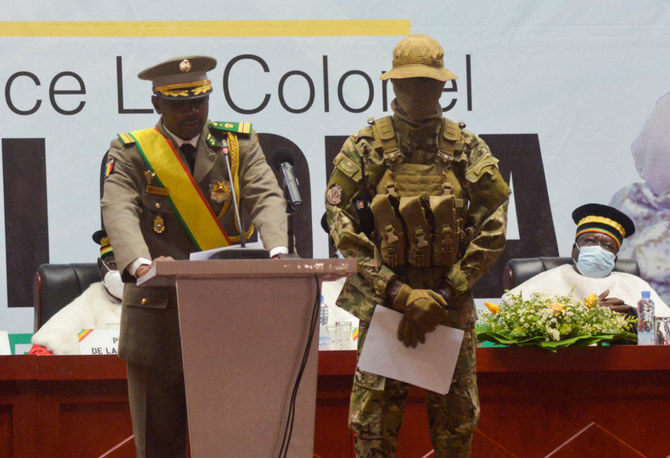
Colonel Assimi Goita, leader of two military coups and new interim president, speaks during his inauguration ceremony in Bamako, Mali, on June 7, 2021. (REUTERS/File Photo)
Short Url
Updated 12 April 2024
Follow

Mali’s junta bans the media from reporting on political activities in a deepening crackdown

  • Maison de le Press, an umbrella organization of journalists in Mali, said it rejects the order and called on media to continue with their work
  • Col. Assimi Goita, who took charge after a second coup in 2021, has failed in his promised to return the country to democracy in early 2024

BAMAKO, Mali: In a deepening crackdown, Mali’s ruling junta on Thursday banned the media from reporting on activities of political parties and associations, a day after suspending all political activities in the country until further notice.

The order, issued by Mali’s high authority for communication, was distributed on social media. The notice said it applied to all forms of the media, including television, radio, online and print newspapers.
Mali has experienced two coups since 2020, leading a wave of political instability that has swept across West and Central Africa in recent years. Along with its political troubles, the country is also in the grip of a worsening insurgency by militants linked to Al-Qaeda and the Daesh group.
The scope of the ban — or how it would be applied in practice — was not immediately clear. It was also not known if journalists would still be allowed to report on issues such as the economy, which are closely tied to politics and who would monitor their work.
The umbrella organization that represents journalists in Mali responded with an unusually stern rebuttal.
The group, known as Maison de le Press, or Press House, said it rejects the order and called on journalists to continue to report on politics in Mali. It also urged them to “stand tall, remain unified and to mobilize to defend the right of citizens to have access to information.”
Mali’s national commission for human rights also expressed regret and profound concern over the decision in a statement published late Thursday. It warned the junta the decision could prove harmful.
“Instead of calming the social climate, these restrictions on fundamental rights and freedoms could potentially stir up trouble and tension, which the country does not need,” it said.
The clampdown on the media followed a similar action on Wednesday, when the junta ordered the suspension of all activities by political parties until further notice, citing a a need to preserve public order. The news was broadcast on state television as the population was celebrating Eid Al-Fitr, the holiday marking the end of the holy month of Ramadan during which observant Muslims fast from dawn till dusk.
Analysts said the move was likely a backlash against political figures, civil society and students who have expressed frustration with the junta’s failure to return the country to democratic rule as promised.
“Recent weeks saw mounting pressure by political parties and figures,” Rida Lyammouri of the Policy Center for the New South, a Morocco-based think tank, told The Associated Press. “For the first time, the public and politicians have publicly criticized junta leaders and accused them of a lack of seriousness.”
Col. Assimi Goita, who took charge after a second coup in 2021, promised to return the country to democracy in early 2024. But in September, the junta canceled elections scheduled for February 2024 indefinitely, citing the need for further technical preparations.
The junta has vowed to end the insurgency that emerged in 2012 after deposing the elected government. It cut military ties with France amid growing frustration with the lack of progress after a decade of assistance, and turned to Russian contractors, mercenaries from the Wagner group, for security support instead. But analysts say the violence has only grown worse.
The United States said it was “deeply concerned” by the ban on political activities. “Freedom of expression and freedom of association are critical to an open society,” State Department spokesman Matthew Miller told reporters in Washington.


Disinformation the new enemy in disaster zones, says Red Cross

Updated 05 March 2026
Follow

Disinformation the new enemy in disaster zones, says Red Cross

  • “Harmful information and dehumanizing narratives” undermines humanitarian aid and putting lives of aid workers at risk
  • Between 2020 and 2024, disasters affected nearly 700 million people, displaced over 105 million, and killed more than 270,000 — doubling the number in need of humanitarian aid

GENEVA: The rise of disinformation is undermining humanitarian aid and putting lives at risk, while disasters are affecting ever more people, the Red Cross warned Thursday.
“Between 2020 and 2024, disasters affected nearly 700 million people, caused more than 105 million displacements, and claimed over 270,000 lives,” the International Federation of Red Cross and Red Crescent Societies said.
The number of people needing humanitarian assistance more than doubled in the same timeframe, the IFRC said in its World Disasters Report 2026.
But the world’s largest humanitarian network said that “harmful information and dehumanizing narratives” were increasingly undermining trust, putting the lives of aid workers at risk.
“In polarized and politically-charged contexts, humanitarian principles such as neutrality and impartiality are increasingly misunderstood, misrepresented or deliberately attacked online,” it said.
The IFRC has more than 17 million volunteers across more than 191 countries.
“In every crisis I have witnessed, information is as essential as food, water and shelter,” said the Geneva-based federation’s secretary general Jagan Chapagain.
“But when information is false, misleading or deliberately manipulated, it can deepen fear, obstruct humanitarian access and cost lives.”
He said harmful information was not a new phenomenon, but it was now moving “with unprecedented speed and reach.”
Chapagain said digital platforms were proving “fertile ground for lies.”
The IFRC report said the challenge nowadays was no longer about the availability of information but its reliability, noting that the production and spread of disinformation was easily amplified by artificial intelligence.

- ‘Life and death’ -

The report cited numerous recent examples of harmful information hampering crisis response.
During the 2024 floods in Valencia, false narratives online accused the Spanish Red Cross of diverting aid to migrants, which in turn fueled “xenophobic attacks on volunteers,” the IFRC said.
In South Sudan, rumors that humanitarian agencies were distributing poisoned food “caused people to avoid life-saving aid” and led to threats against Red Cross staff.
In Lebanon, false claims that volunteers were spreading Covid-19, favoring certain groups with aid and providing unsafe cholera vaccines eroded trust and endangered vulnerable communities, the IFRC said.
And in Bangladesh, during political unrest, volunteers faced “widespread accusations of inaction and political alignment,” leading to harassment and reputational damage, it added.
Similar events were registered by the IFRC in Sudan, Myanmar, Peru, the United States, New Zealand, Canada, Kenya and Bulgaria.
The report underlined that around 94 percent of disasters were handled by national authorities and local communities, without international interventions.
“However, while volunteers, local leaders and community media are often the most trusted messengers, they operate in increasingly hostile and polarized information environments,” the IFRC said.
The federation called on governments, tech firms, humanitarian agencies and local actors to recognize that reliable information “is a matter of life and death.”
“Without trust, people are less likely to prepare, seek help or follow life-saving guidance; with it, communities act together, absorb shocks and recover more effectively,” said Chapagain.
The organization urged technology platforms to prioritize authoritative information from trusted sources in crisis contexts, and transparently moderate harmful content.
And it said humanitarian agencies needed to make preparing to deal with disinformation “a core function” of their operations, with trained teams and analytics.