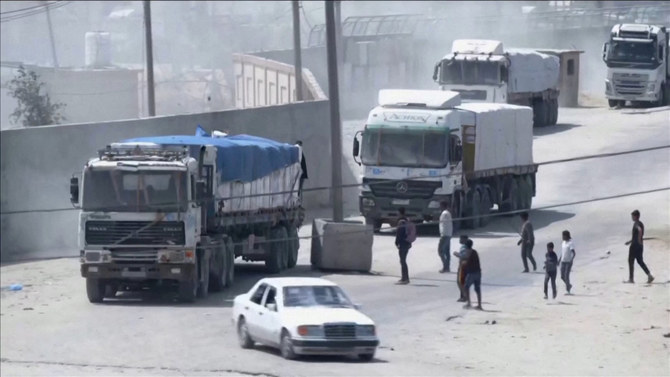

JERUSALEM: Under heavy US pressure, Israel has promised to ramp up aid to Gaza dramatically, saying last week it would open another cargo crossing and surge more trucks than ever before into the besieged enclave.
But days later, there are few signs of those promises materializing and international officials say starvation is widespread in hard-hit northern Gaza.
Samantha Power, administrator of the US Agency for International Development, said this week she accepted “credible” reports that famine is now occurring in the area and urged Israel to take further steps to expedite humanitarian aid shipments.
Power’s remarks echoed those of US President Joe Biden, who said on Wednesday that Israeli efforts to increase aid were “not enough.”
While Israel says it has dramatically increased the number of aid trucks entering the territory, UN workers report only a slight uptick — possibly because they count trucks differently.
Here’s what we know about the aid entering Gaza, and why discrepancies in reporting persist:
HOW MUCH AID IS ENTERING GAZA?
Israel says that since Sunday it has transported an average of 400 trucks a day into Gaza and that aid is now piling up on the Palestinian side of the Kerem Shalom crossing, one of two major crossings into the territory.
But Juliette Touma, communications director for the UN agency for Palestinian refugees, known as UNRWA, said that while aid workers have noticed a slight increase in the amount of aid entering Gaza, it’s nothing close to the surge Israel is claiming.
On Monday, UNRWA says 223 trucks of aid passed. On Tuesday, that number hit 246. On Wednesday, it was down to 141.
Meanwhile, only trickles of aid are reaching northern Gaza.
WHAT HAS ISRAEL PROMISED?
After Biden said last week that future American support for the war in Gaza depends on Israel doing more to protect civilians and aid workers, Israeli Prime Minister Benjamin Netanyahu promised a series of steps. Biden spoke out after an Israeli airstrike killed seven aid workers delivering food to the strip.
Netanyahu pledged to immediately re-open Israel’s Erez crossing into northern Gaza — a pedestrian crossing destroyed by Hamas militants when they stormed into southern Israel on Oct. 7. Netanyahu also said he would allow Israel’s port in Ashdod to process aid shipments and increase Jordanian aid packages through another land crossing.
But Israeli officials this week dropped the plan to open Erez. Instead, they say a new crossing will be built, though it is unclear when it will open. The Ashdod port, meanwhile, is not yet accepting aid shipments and Gaza aid groups report no significant increase in trucks received at their warehouses.
Before the latest Israel-Hamas war, some 500 trucks carrying food, fuel and other supplies entered Gaza daily. That was supplemented by fish and produce farmed within the territory.
Even that was barely enough in a crowded territory whose economy has been battered by a 17-year blockade imposed by Israel and Egypt. The blockade, meant to keep Hamas from arming, restricted the flow of goods in and out of Gaza and contributed to widespread poverty and unemployment.
Scott Anderson, the acting director of UNRWA in Gaza, said the low levels of aid since the war started have compounded an existing, pre-war nutrition deficit in the territory.
“You have to remember, this was not a nutrition-rich environment before the war. The resilience was not there,” said Anderson.
WHY IS THERE A DISCREPANCY BETWEEN THE UN AND ISRAEL’S NUMBERS?
Israel and the UN count trucks arriving in Gaza differently.
Israel counts every truck it inspects and allows to pass into Gaza, according to Shimon Freedman, a spokesperson for COGAT, the Israeli defense body in charge of Palestinian civilian affairs.
At the Kerem Shalom crossing, once the trucks pass into Gaza, the pallets of aid they are carrying are deposited in a 1-kilometer-long (a half-mile) zone for Palestinian drivers to pick up.
UNRWA only counts the trucks, driven by a Palestinian contractor, returning from that zone, Anderson said.
He also said that sometimes the trucks arriving from Israel are not fully loaded. Palestinian drivers on the Gaza side of the crossing load their trucks fully before passing through the gate — something that could further account for truck count differences.
WHAT IS SLOWING AID TRANSFER?
Getting from Israeli inspection, through the corridor and past the gate into Gaza takes time — and is made more arduous by the way Israel uses the Kerem Shalom crossing, Anderson said.
Since the war began, Israel has kept the crossing partially closed, Anderson said. Palestinian drivers must also wait for the incoming trucks to be unloaded — further narrowing the window of time allowed for pickup.
Aid inspected by Israel sometimes sits overnight, awaiting pickup. The UN says it stops all operations at 4:30 p.m. for safety purposes due to a breakdown in public order and airstrikes at night. UNRWA says they used to use local Palestinian police to escort aid convoys, but many refused to continue serving after airstrikes killed at least eight police officers in Rafah. Israel says armed Hamas militants have tried to siphon off aid.
COGAT denied allegations that they restrict the crossing’s hours or limit movement of trucks to pick up aid and blamed the UN for the backup, saying the agency does not have enough workers to move aid to warehouses for timely distribution.
WHAT HAPPENS MOVING FORWARD?
Israeli Defense Minister Yoav Gallant said Wednesday night that increasing aid efforts is a top priority.
“We plan to flood Gaza with aid and we are expecting to reach 500 trucks per day,” said Gallant. He did not specify a time frame for reaching that goal.
But even if Israel meets its goal, slowdowns at the crossings and convoy safety concerns may continue to hamper distribution. The UN has called for a return to prewar procedures — with additional terminals open and a significant amount of commercial goods, in addition to humanitarian aid, able to pass through.
“Gaza has become very quickly dependent on relief handouts,” Touma said. “The market has been forced to shut. This is not sustainable.”

keywords