Russia, Germany and UK urge restraint as Iranian threat puts Middle East on edge

1 / 3
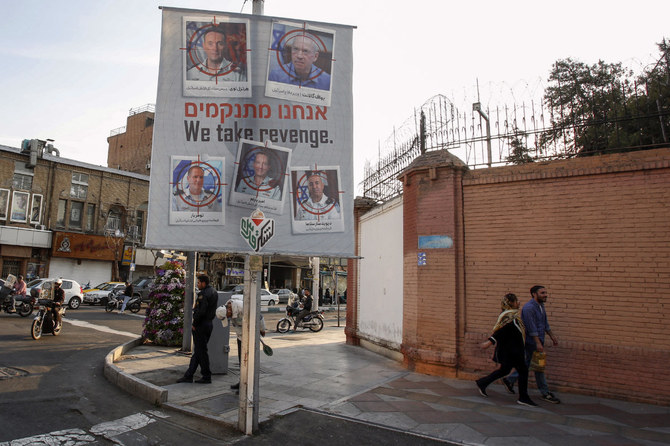
A banner displaying pictures of Israeli army officials with their faces encircled by a red crosshair icon, hang in Tehran on April 2, 2024 following an Israeli strike in Damascus that demolished the consular annex of Iran's embassy, killing at least 13 people, including two Iranian Revolutionary Guards generals and five personnel from the force. (AFP)
2 / 3
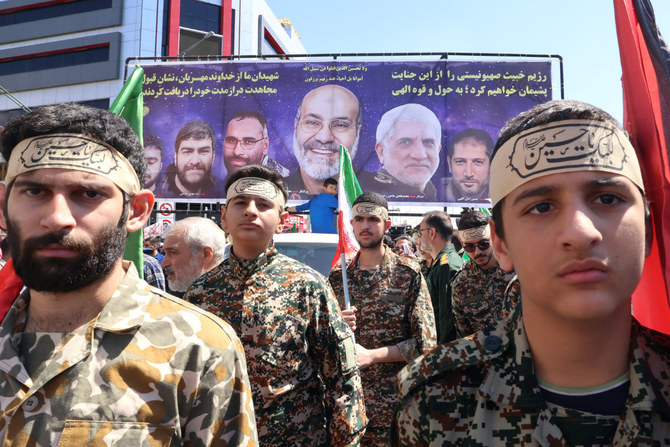
Iranians attend the funeral of seven Revolutionary Guard Corps members killed in a strike on the country's consular annex in Damascus, which Tehran blamed on Israel, on April 5, 2024, during their funeral procession in Tehran. Iran has threatened to retaliate against Israel, putting the Middle East region on edge as Israel warned that it will strike back. (AFP/File)
3 / 3
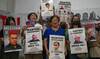
(L to R) Kremlin spokesman Dmitry Peskov, British foreign minister David Cameron and German Foreign Minister Annalena Baerbock. (Agencies)
Short Url
Updated 12 April 2024
Follow

Russia, Germany and UK urge restraint as Iranian threat puts Middle East on edge

  • “Iran should instead work to de-escalate and prevent further attacks,” said Cameron
  • Israeli Defense Minister Yoav Gallant told US Secretary of Defense Lloyd Austin that Israel would respond directly to any attack by Iran

MOSCOW: Russia, Germany and Britain on Thursday urged countries in the Middle East to show restraint and Israel said it was preparing to “meet all its security needs” in a region on edge over an Iranian threat to strike Israel.

The German airline Lufthansa, one of only two Western carriers flying to Tehran, extended a suspension of its flights to the Iranian capital and Russia warned against travel to the Middle East.
Iran has vowed revenge for the April 1 airstrike on its embassy compound in Damascus that killed a top Iranian general and six other Iranian military officers, ratcheting up tension in a region already strained by the Gaza war.
Israel has not claimed responsibility for the attack, but Iranian Supreme Leader Ayatollah Ali Khamenei said on Wednesday Israel “must be punished and it shall be,” saying it was tantamount to an attack on Iranian soil.
The “imperative for Iran to punish this rogue regime” might have been avoided had the UN Security Council condemned the strike and brought the perpetrators to justice, Tehran’s mission to the United Nations said on Thursday.
Prime Minister Benjamin Netanyahu said Israel was keeping up its war in Gaza but making security preparations elsewhere.
“Whoever harms us, we will harm them. We are prepared to meet all of the security needs of the State of Israel, both defensively and offensively,” he said in comments released following a visit to an air force base.
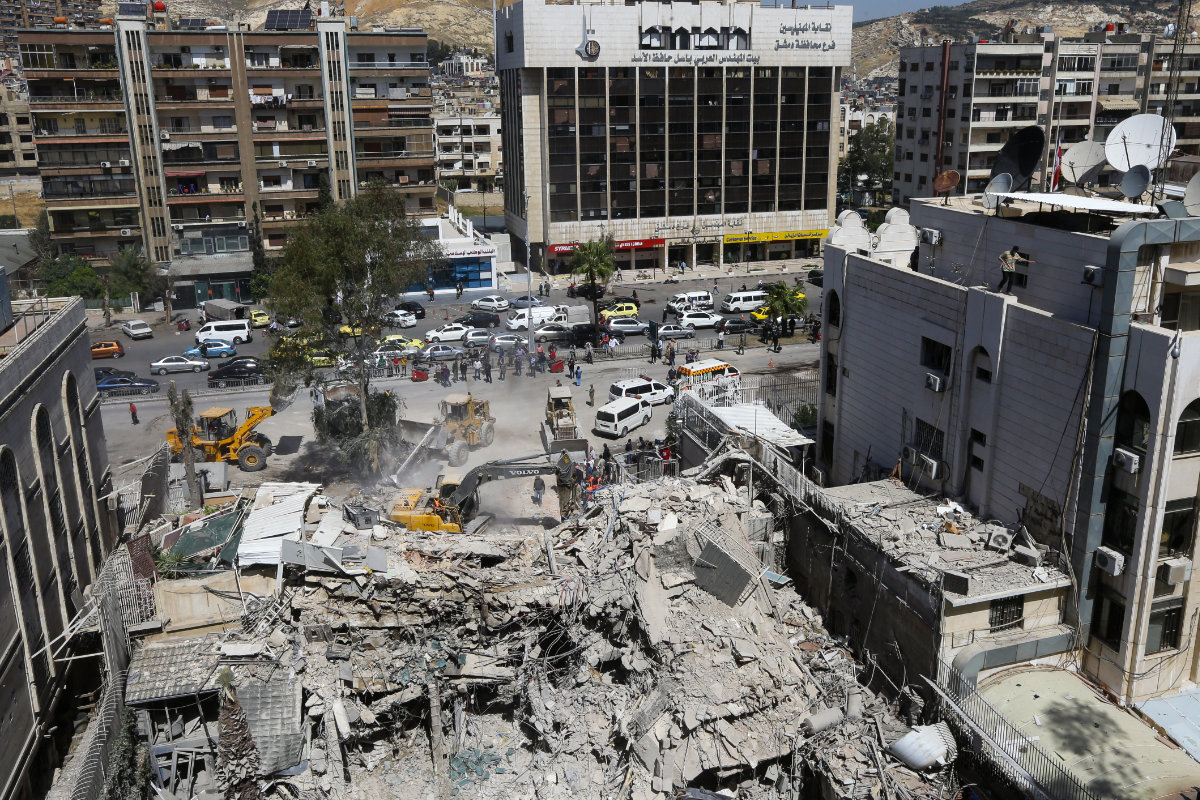


A view of the consular annex of Iran's embassy in Damascus, Syria, that was demolished by an Israeli airstrike on April 1, 2024, killing at least 13 people, including two Iranian Revolutionary Guards generals and five personnel from the force. (AP)

Iran has signalled to Washington that it will respond to Israel’s attack in a way that aims to avoid major escalation and it will not act hastily, Iranian sources said.
Israeli Defense Minister Yoav Gallant told US Secretary of Defense Lloyd Austin that Israel would respond directly to any attack by Iran, Gallant’s office said.
Conflict has spread across the Middle East since the eruption of the Gaza war, with Iran-backed groups declaring support for the Palestinians waging attacks from Lebanon, Yemen and Iraq. Tehran has avoided direct confrontation with Israel or the United States, while declaring support for its allies.
German Foreign Minister Annalena Baerbock called on her Iranian counterpart Hossein Amirabdollahian to urge “maximum restraint” to avoid further escalation.
Russia’s foreign ministry told citizens they should not travel to the Middle East, especially to Israel, Lebanon and the Palestinian territories.
“Right now it’s very important for everyone to maintain restraint so as not to lead to a complete destabilization of the situation in the region, which doesn’t exactly shine with stability and predictability,” Kremlin spokesman Dmitry Peskov told a news briefing.

‘Potential for miscalculation’
British foreign minister David Cameron said on Thursday he had made clear to Amirabdollahian that Iran should not draw the Middle East into a wider conflict.
“I am deeply concerned about the potential for miscalculation leading to further violence,” Cameron said on X.


US State Department spokesperson Matthew Miller said Secretary of State Antony Blinken called counterparts including the Turkish, Chinese and Saudi foreign ministers “to make clear that escalation is not in anyone’s interest and that countries should urge Iran not to escalate.”
US President Joe Biden said on Wednesday Iran was threatening to launch a “significant attack in Israel,” and that he had told Netanyahu that “our commitment to Israel security against these threats from Iran and its proxies is iron-clad.”
The US expects an attack by Iran against Israel but one that would not be big enough to draw Washington into war, a US official said late on Thursday.
Iran is the third-largest oil producer in the OPEC group and oil prices stayed near six-month highs on Thursday.
Late on Wednesday, an Iranian news agency published an Arabic report on the X platform saying the air space over Tehran had been closed for military drills, but then removed the report and denied it had issued such news.
Lufthansa said it would probably not fly to Tehran before April 13. Austrian Airlines said it was still planning to fly on Thursday but was adjusting timings to avoid crew having to disembark for an overnight layover.
Iranian air space is also a key overflight route for Emirates’ and Qatar Airways’ flights to Europe and North America.
Emirates, Qatar Airways, Turkish Airlines, Aeroflot and Air Arabia, among the airlines that fly to Tehran, did not immediately respond to requests for comment.

Battleground: Jerusalem
The biblical battle for the Holy City

Enter


keywords

UN nuclear watchdog says it’s unable to verify whether Iran has suspended all uranium enrichment

Updated 58 min 22 sec ago
Follow

UN nuclear watchdog says it’s unable to verify whether Iran has suspended all uranium enrichment

VIENNA: Iran has not allowed the United Nations nuclear watchdog to access nuclear facilities affected by the 12-day war in June, according to a confidential report by the watchdog circulated to member states and seen Friday by The Associated Press.
The report from the International Atomic Energy Agency stressed that therefore it “cannot verify whether Iran has suspended all enrichment-related activities,” or the “size of Iran’s uranium stockpile at the affected nuclear facilities.”
The IAEA report on Friday warned that due to the continued lack of access to any of Iran’s four declared enrichment facilities, the agency “cannot provide any information on the current size, composition or whereabouts of the stockpile of enriched uranium in Iran.”
The report stressed that the “loss of continuity of knowledge over all previously declared nuclear material at affected facilities in Iran needs to be addressed with the utmost urgency.”
Iran long has insisted its program is peaceful, but the IAEA and Western nations say Tehran had an organized nuclear weapons program up until 2003.
Highly enriched material should be verified regularly
According to the IAEA, Iran maintains a stockpile of 440.9 kilograms (972 pounds) of uranium enriched up to 60 percent purity — a short, technical step away from weapons-grade levels of 90 percent.
That stockpile could allow Iran to build as many as 10 nuclear bombs, should it decide to weaponize its program, IAEA director general Rafael Grossi warned in a recent interview with the AP. He added that it doesn’t mean that Iran has such a weapon.
Such highly enriched nuclear material should normally be verified every month, according to the IAEA’s guidelines.
The IAEA also reported that it had observed, through the analysis of commercially available satellite imagery, “regular vehicular activity around the entrance to the tunnel complex at Isfahan.”
The facility in Isfahan, some 350 kilometers (215 miles) southeast of Tehran, was mainly known for producing the uranium gas that is fed into centrifuges to be spun and purified.
Israel has struck buildings at the Isfahan nuclear site, among them a uranium conversion facility. The US also struck Isfahan with missiles during the war last June.
The IAEA also reported that through the analysis of commercially available satellite imagery, it has observed “activities being conducted at some of the affected nuclear facilities, including the enrichment facilities at Natanz and Fordow,” but it added that “without access to these facilities it is not possible for the Agency to confirm the nature and the purpose of the activities.”
The confidential IAEA report also said Friday that Iran did provide access to IAEA inspectors “to each of the unaffected nuclear facilities at least once since the military attacks of June 2025, with the exception of Karun Nuclear Power Plan, which is in the early stages of construction and does not contain nuclear material.”
IAEA joined Geneva talks between Iran and US
The IAEA reported on Friday that Grossi attended negotiations between the US and Iran on Feb. 17 and Feb. 26 in Geneva at which he “provided advice on issues relevant to the verification of Iran’s nuclear program.” The report said that those negotiations are “ongoing.”
The Trump administration has held three rounds of nuclear talks this year with Iran under Omani mediation. Thursday’s round of talks in Geneva ended without a deal, leaving the danger of another Mideast war on the table as the US has gathered a massive fleet of aircraft and warships in the region.
Oman’s Foreign Minister Badr Al-Busaidi said technical talks involving lower-level representatives would continue next week in Vienna, the home of the IAEA. The agency is likely to be critical in any deal.
The US is seeking a deal to limit Iran’s nuclear program and ensure it does not develop nuclear weapons.
Iran says it is not pursuing weapons and has so far resisted demands that it halt uranium enrichment on its soil or hand over its stockpile of highly enriched uranium.
Similar talks last year between the US and Iran about Iran’s nuclear program broke down after Israel launched what became a 12-day war on Iran, that included the US bombing Iranian nuclear sites.
Before the June war, Iran had been enriching uranium up to 60 percent purity.