

Russia puts more Kremlin critics on a wanted list as its crackdown on dissent reaches new levels

1 / 2
This photo posted on social media shows Russian women's rights activist Darya Serenko in Moscow in February 2022. Serenko left her homeland as the Russian government intensified its crackdown against critics. (X: @Bayanov74)
2 / 2
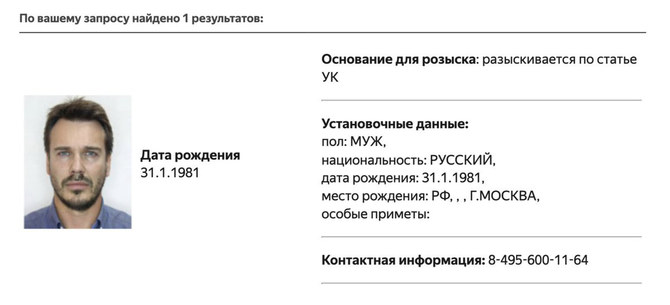
A screenshot of a post on Telegram and shared by the independent Russian news outlet Mediazona showing a wanted notice against Russian journalist Mikhail Zygar by the Kremlin. (X: @mediazona_en)
Short Url
Updated 11 April 2024
Follow

Russia puts more Kremlin critics on a wanted list as its crackdown on dissent reaches new levels

  • The Kremlin’s crackdown against opposition activists, independent journalists and government critics has intensified during Russia's invasion of Ukraine in February 2022

TALLINN, Estonia: Russian authorities have put more Kremlin critics on a wanted list as its crackdown against dissent reaches unprecedented levels since Moscow sent troops into Ukraine more than two years ago.

Independent Russian news outlet Mediazona reported Tuesday that it found women’s rights activist Darya Serenko and prominent journalist and author Mikhail Zygar in the Interior Ministry’s database of individuals wanted on criminal charges. The entries don’t specify the charges or when they were added to the list.
Both Serenko and Zygar have long left Russia.
The Kremlin’s crackdown against opposition activists, independent journalists and government critics has intensified during the war. Hundreds have faced criminal charges over protests and remarks condemning the war in Ukraine, and thousands have been fined or briefly jailed.

Serenko, a longtime activist and author, co-founded the Feminist Anti-War Resistance group shortly after Russia invaded Ukraine in February 2022 and moved to Georgia during the crackdown. Both she and the group were designated as “foreign agents,” a label that comes with additional government scrutiny.
Zygar, an author and a founding editor in chief of Russia’s independent TV channel Dozhd, also left Russia after the invasion and was declared a “foreign agent.” Unconfirmed Russian media reports earlier this year said Zygar could be facing charges of spreading false information about the army over a social media post about Russian atrocities in Bucha, a suburb near Kyiv occupied for several weeks by Moscow’s forces.


Spreading false information about the army is a criminal offense punishable by up to 15 years in prison under a law Moscow adopted days after announcing what the Kremlin insists on calling a “special military operation” in Ukraine.
The law has been widely used against those who publicly criticize the war or the Kremlin, including those who left Russia. Many have been tried and convicted in absentia.
On Wednesday, Russia’s Investigative Committee announced charging another women’s rights activist Zalina Marshenkulova with “justifying terrorism.” Marshenkulova, who also lives abroad, was charged in absentia over unspecified social media posts, according to a statement by the Committee’s branch in Moscow. The charge carries punishment of up to seven years in prison.
Marshenkulova said in a Telegram post that she was “not surprised” and described charges against her “surreal” and “arbitrariness.”


US backs Japan in dispute with China over radar incident

Updated 5 sec ago
Follow

US backs Japan in dispute with China over radar incident

  • US criticizes China for radar targeting Japanese aircraft
  • Incident follows Japan PM’s remarks on potential Chinese attack on Taiwan

WASHINGTON/TOKYO: The United States has for the first time criticized China for aiming radars at Japanese military aircraft during a training exercise last week, incidents that the Asian neighbors have given differing accounts of amid escalating tensions.
The run-in near Japan’s Okinawa islands comes after Japanese Prime Minister Sanae Takaichi triggered a dispute with Beijing last month with her remarks on how Tokyo might react to a hypothetical Chinese attack on Taiwan.
China claims democratically governed Taiwan and has not ruled out using force to take control of the island, which sits just over 100 km  from Japanese territory and is surrounded by sea lanes that Tokyo relies on.
“China’s actions are not conducive to regional peace and stability,” a State Department spokesperson said late Tuesday, referring to the radar incident.
“The US-Japan Alliance is stronger and more united than ever. Our commitment to our ally Japan is unwavering, and we are in close contact on this and other issues.”
China’s foreign ministry did not immediately respond to a request for comment.
Japan late on Tuesday scrambled jets to monitor Russian and Chinese air forces conducting joint patrols around the country.
MOST SERIOUS INCIDENT IN YEARS
The Chinese fighter jets aiming their radars at the Japanese planes on Saturday was the most serious run-in between the East Asian militaries in years.
Such moves are seen as a threatening step because it signals a potential attack and may force the targeted plane to take evasive action. Tokyo blasted the moves as “dangerous.”
Beijing, however, said that the Japanese aircraft had repeatedly approached and disrupted the Chinese navy as it was conducting previously announced carrier-based flight training east of the Miyako Strait.
Speaking to reporters in Taipei on Wednesday, Taiwan President Lai Ching-te said China’s drills were “very inappropriate behavior.”
“We also call upon China to demonstrate the responsibility befitting a major power. Peace is priceless; war has no winners. Peace must be fostered by all parties, and China shares this responsibility,” he said.
Relations between Asia’s two largest economies have soured sharply since Takaichi told parliament last month that a Chinese attack on Taiwan could amount to a “survival-threatening situation” and trigger a potential military response from Tokyo.
Beijing has demanded she retract the remarks, accused Tokyo of threatening it militarily and advised its citizens not to travel to Japan.
US Ambassador to Japan George Glass has publicly expressed support for Japan in several social media posts since the diplomatic dispute began, but President Donald Trump and other senior US officials have remained silent.
Trump, who plans to visit Beijing next year for trade talks, telephoned Takaichi last month, urging her not to escalate the dispute, people with knowledge of the matter told Reuters.