


Spain: Israel’s ‘disproportionate response’ in Gaza a global threat

1 / 4
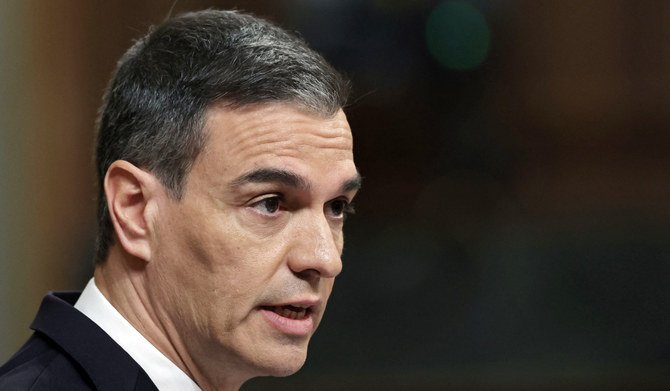
Prime Minister Pedro Sanchez addresses parliament at the Spanish lower house, Congress of Deputies, in Madrid on April 10, 2024. (AFP)
2 / 4
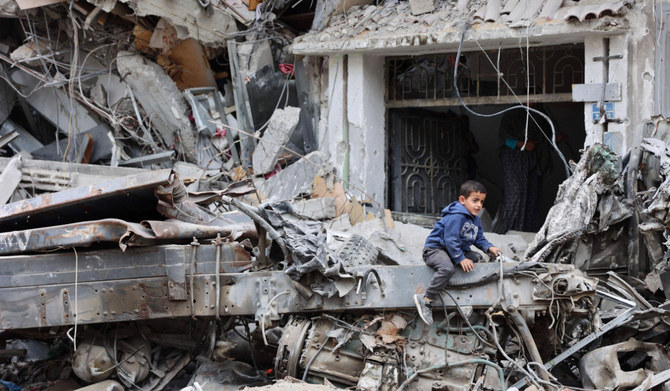
A Palestinian child plays on the ruins of a building destroyed by earlier Israeli bombardment in Gaza City on April 8, 2024, amid the ongoing conflict between Israel and the Palestinian Hamas militant group. (AFP)
3 / 4
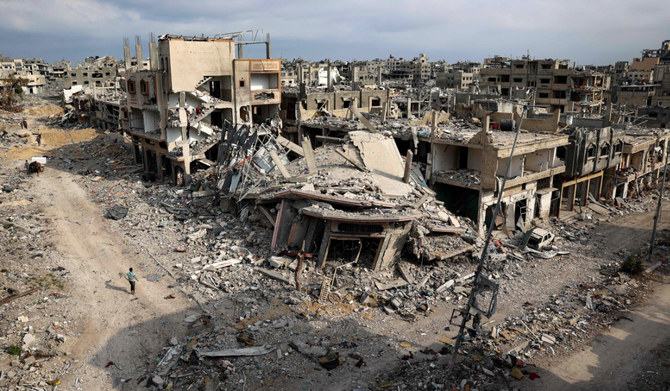
Palestinians walk past damaged buildings in Khan Yunis on April 8, 2024 after Israel pulled its ground forces out of the southern Gaza Strip, six months into the devastating war sparked by the October 7 attacks. (AFP)
4 / 4
A paramedic helps an injured boy out of an ambulance outside the Al-Aqsa Martyrs Hospital in Deir al-Balah, central Gaza Strip, on April 9, 2024, amid the ongoing conflict between Israel and the Palestinian Hamas militant group. (AFP)
Short Url
Updated 11 April 2024
Follow

Spain: Israel’s ‘disproportionate response’ in Gaza a global threat

  • PM Pedro Sanchez insists that recognition of Palestinian state is ‘in Europe’s geopolitical interests’

MADRID: Spanish Prime Minister Pedro Sanchez has warned that Israel’s “disproportionate response” in the Gaza war with Hamas risks “destabilizing the Middle East, and as a consequence, the entire world.”

Sanchez also insisted that the recognition of a Palestinian state, long resisted by Israel and its key allies, is “in Europe’s geopolitical interests.”
Sanchez had already raised the subject of statehood during a visit last week to the Middle East when he said Spain could recognize Palestine as a nation by the end of June.
“The international community cannot help the Palestinian state if it does not recognize its existence,” Sanchez told lawmakers on Wednesday.
Since the start of the war in Gaza more than six months ago, the socialist premier has pushed for Europe to accord such recognition.

BACKGROUND

Prime Minister Pedro Sanchez’s criticism of the Gaza war has raised tensions with Israel.

His criticism of the Gaze war has also raised tensions with Israel.
Speaking on Wednesday, Sanchez said Israel’s “absolutely disproportionate response” had “overturned decades of humanitarian law and threatened to destabilize the Middle East and, as a consequence, the whole world.”
In February, Sanchez and his Irish counterpart at the time, Leo Varadkar, asked the EU to “urgently” examine whether Israel was complying with its human rights obligations in Gaza as laid out in a key accord that links rights to trade ties.
And in November, Israel recalled its Madrid envoy for consultations after expressing fury over Sanchez’s “outrageous remarks” in a television interview, in which he expressed “serious doubts” over the legality of Israel’s actions in Gaza.
His remarks were denounced by Israeli Prime Minister Benjamin Netanyahu as “shameful,” though the Israeli Ambassador Rodica Radian-Gordon returned to Madrid in January.
Israel was also angered by statements in October and November by radical left-wing ministers in Sanchez’s coalition government calling for sanctions and an embargo on arms sales to Israel.
While visiting a Palestinian refugee camp in Jordan last week, Sanchez hit out at Israel over the drone strike on a humanitarian convoy that killed seven staff members of the NGO World Central Kitchen.
He demanded that Israel clarify “the circumstances of this brutal attack.”
Like most other global leaders, Sanchez has called for the implementation of the two-state solution but has also pressed for the world to recognize a Palestinian state, breaking with other Western powers who say this should come only as part of a negotiated peace with Israel.
Last week, Sanchez told reporters traveling with him on his Middle East tour that he hoped Spain would recognize Palestinian statehood by the end of June.
In late March, Sanchez signed a joint statement alongside his Irish, Maltese, and Slovenian counterparts on the sidelines of an EU summit announcing they were ready “to recognize Palestine” when “the circumstances are right” if that could help resolve the conflict.
Spanish government spokeswoman Pilar Alegria said on Tuesday that starting Thursday, Sanchez is due to visit Poland, Norway, and Ireland before welcoming Portugal’s leader to discuss the issue again.
In an opinion piece for Madrid’s Real Instituto Elcano think tank, former Israeli Ambassador Alon Liel said Spain’s move to recognize a Palestinian state could “ignite the momentum that might lead to overall European and UN recognition.”
If so, “Spain would become a meaningful player toward a new diplomatic momentum for the Israeli-Palestinian conflict,” wrote Liel, a former director-general of the Israeli Foreign Ministry.
In 2014, the Spanish parliament had called on the right-wing government at the time to recognize a Palestinian state, just a few weeks after Sweden became the first EU member in Western Europe to do so.
Sweden’s recognition mirrored earlier moves by six other European countries: Bulgaria, Cyprus, the Czech Republic, Hungary, Poland and Romania.

Battleground: Jerusalem
The biblical battle for the Holy City

Enter


keywords

Japan seizes Chinese fishing vessel, arrests captain

Updated 2 sec ago
Follow

Japan seizes Chinese fishing vessel, arrests captain

TOKYO: Japan seized a Chinese fishing boat and arrested its skipper, authorities said Friday, an incident that could deepen a spat between the Asian giants.
The episode on Thursday off southern Japan came three months after Prime Minister Sanae Takaichi suggested that Japan would intervene militarily if Beijing sought to take Taiwan by force.
China swiftly reacted to the seizure, the Japanese fisheries’ agency first since 2022 of a Chinese fishing boat, by urging Japan to protect the rights of Chinese crew.
“It is hoped Japan strictly respects the China-Japan fisheries agreement, fairly enforces the law and safeguards the safety and legitimate rights and interests of Chinese crew members,” foreign ministry spokesman Lin Jian told a news conference on Friday.
Japan’s fisheries agency said the vessel’s captain was ordered to stop for an inspection, but the boat “failed to comply and fled.”
“Consequently, the vessel’s captain was arrested on the same day,” the agency said in a statement.
The boat was inside Japan’s exclusive economic zone 89.4 nautical miles (166 kilometers) south-southwest of Meshima island in the Goto archipelago, Japan’s statement said — not a disputed area.
The captain was named as Chinese national Zheng Nianli, 47. The status of the other 10 people on board the vessel, named the Qiong Dong Yu, was unclear.
“To prevent illegal fishing operations by foreign vessels, we will continue to take firm action and engage in enforcement activities,” chief government spokesman Minoru Kihara said.
China has a number of territorial tussles with Japan, and there have been repeated incidents around the Senkaku Islands, known as the Diaoyu in China.
The 2010 arrest of another Chinese fishing boat captain off those islands in the East China Sea became a major diplomatic incident.

- Taiwan spat -

Japan and China have close economic ties but Takaichi’s comments about Taiwan have sent relations spiralling downwards again.
China has long insisted that Taiwan, occupied for decades by Japan until 1945, is its territory and has not ruled out force to achieve “reunification.”
Taiwanese President Lai Ching-te told AFP in an interview this week that other countries — including Japan — would be China’s next targets should Beijing seize the democratic island.
“The next countries under threat would be Japan, the Philippines, and others in the Indo-Pacific region, with repercussions eventually reaching the Americas and Europe,” Lai said.
After Takaichi’s comments, Beijing summoned Tokyo’s ambassador, warned Chinese citizens against visiting Japan and conducted joint air drills with Russia.
In December, J-15 jets from China’s Liaoning aircraft carrier twice locked radar on Japanese aircraft in international waters near Okinawa, according to Japan.
China also tightened controls on exports to Japan for items with potential military uses, fueling worries that Beijing may choke supplies of vital rare-earth minerals.
Japan’s last two pandas were even returned to China last month.

- Hawkish leader -

Takaichi, 64, was seen as a China hawk before becoming Japan’s first woman prime minister in October.
She won a landslide victory in snap elections on Sunday, putting her in a strong position for the next four years to stamp her mark on Japanese domestic and foreign policy.
Takaichi said Monday that under her leadership Japan — which hosts some 60,000 US military personnel — would bolster its defenses and “steadfastly protect” its territory.
She also said that she was “open to various dialogues with China.”
But China’s foreign ministry said “genuine dialogue should be built on respect for one another.”
“Proclaiming dialogue with one’s mouth while engaging in confrontation — no one will accept this kind of dialogue,” foreign ministry spokesman Lin Jian said Tuesday.
“If Japan truly wants to develop a strategic and mutually beneficial relationship with China, it’s very easy and clear: withdraw Takaichi’s erroneous remarks about Taiwan,” he said.