

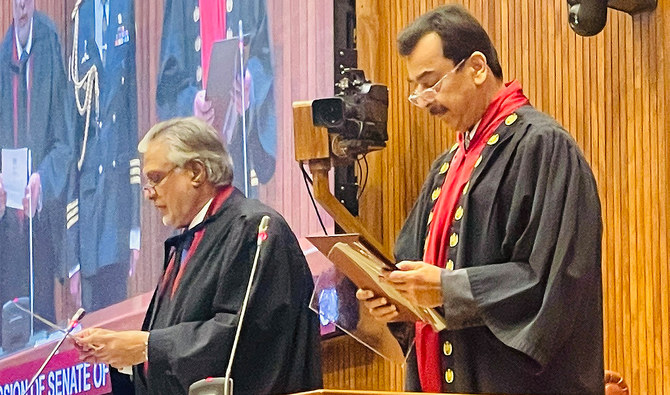
Pakistan’s ruling coalition clinches Senate top slots of chairman, deputy chairman

Pakistan's foreign minister Ishaq Dar (second from right) administers the oath to Senate Chairman, Yousaf Raza Gillani, in Islamabad, Pakistan on April 9, 2024. (@aishachaudhary/X)
Short Url
Updated 09 April 2024
Follow

Pakistan’s ruling coalition clinches Senate top slots of chairman, deputy chairman

  • Ex-premier Yousaf Raza Gillani, Syedal Khan Nasir elected Senate chairman, deputy chairman unopposed respectively
  • Senators affiliated with former prime minister Imran Khan boycotted proceedings of the election in protest

ISLAMABAD: Pakistan’s ruling coalition on Tuesday secured the top posts in the Senate after its candidates, former prime minister Yousaf Raza Gillani and Syedal Khan Nasir, were elected unopposed as chairman and deputy chairman of the house, respectively.

Pakistani senators are elected for a term of six years and are responsible to discuss laws, provide their technical input and vote on legislations like other public representatives. Half of these senators retire every three years and new ones are elected to replace them.

The ruling coalition, led by the Pakistan Muslim League-Nawaz (PML-N) and Pakistan Peoples Party (PPP), joined hands to have Gillani and Nasir elected to the coveted posts on Tuesday. The PPP had nominated Gillani to be the chairman while the PML-N wanted Nasir to hold the post of the deputy chairman.

Both candidates also received support from other political parties and independent candidates.

“It is a unique honor and privilege to be elected as chairman of this august house,” Gillani told the Senate after being sworn in. “I am thankful to Allah Almighty for having been given this opportunity.”

Gillani mentioned the crises the country had been facing, saying: “Pakistan faces an assault of those who seek to divide and polarize us, those who seek to incite hatred, those who seek to replace norms of civility and abuse democracy with demagoguery.”

He said that his party had rejected politics of hate and preferred politics of “reconciliation and of the welfare of people.”

The Senate elections were held earlier this month in Pakistan’s Sindh, Punjab and Balochistan provinces and in the federal capital of Islamabad. The Election Commission of Pakistan (ECP) delayed polls on eleven Senate seats in the northwestern Khyber Pakhtunkhwa (KP) province ruled by the former prime minister Iman Khan’s loyalists last Tuesday.

Pakistan’s election regulatory body had taken the decision in response to a plea by the opposition, which had called for a postponement after nearly two dozen provincial lawmakers on reserved seats were not administered oath despite a court order.

Members of Khan’s Pakistan Tehreek-e-Insaf (PTI) party boycotted the election on Tuesday, saying the exercise was unfair since the Senate was incomplete without the presence of legislators from KP.

At the outset of the proceedings, at least 41 newly elected senators took oath as members of the House amid protests by PTI lawmakers. The ruling coalition managed to bag 19 seats, increasing its tally of total seats to 59 out of 85 in the upper house of parliament.

PTI Senator Falak Naz termed the chairman and deputy chairman Senate’s elections as “unconstitutional,” adding that his party would challenge it in the Supreme Court.

“The Senate is incomplete as our Senators are yet to be elected from Khyber Pakhtunkhwa. Therefore, this election is totally illegal and unconstitutional,” she told Arab News.

“We will protest against this undemocratic process inside and outside the parliament,” she added.

Political analysts said the Senate election had become controversial after the ECP postponed the polls on the 11 seats from KP.

“This will lead to further political instability in the country. Therefore, better sense should prevail to overcome the political challenges through a meaningful dialogue,” Munizae Jahangir, a political analyst and TV talk-show host, told Arab News.

“Our policymakers should understand that economic stability cannot be achieved without political stability in the country. So, it’s high time these political differences are resolved to focus on inflation and other issues of public importance,” she added.


Pakistan says defense pact with Saudi Arabia elevated brotherly ties to ‘new heights’

Updated 25 February 2026
Follow

Pakistan says defense pact with Saudi Arabia elevated brotherly ties to ‘new heights’

  • Pakistan, Saudi Arabia signed strategic defense pact last year pledging aggression against one will be treated as attack on both
  • Deputy PM Ishaq Dar says enduring bonds with Islamic and Arab nations form vital pillar of Pakistan’s foreign policy 

ISLAMABAD: Deputy Prime Minister Ishaq Dar said on Wednesday that Pakistan’s defense pact with Saudi Arabia elevated its brotherly ties with the Kingdom to “new heights,” stressing that close ties with Arab and Islamic nations form a key pillar of Islamabad’s foreign policy. 

Pakistan and Saudi Arabia signed a Strategic Mutual Defense Agreement on Sept. 17 last year, pledging that aggression against one country would be treated as an attack on both, enhancing joint deterrence and formalizing decades of military and security cooperation.

Both nations agreed in October 2025 to launch an economic cooperation framework to strengthen trade and investment ties. 

“In the Middle East, our landmark Strategic Mutual Defense Agreement with Saudi Arabia has elevated our brotherly ties to new heights,” Dar said while speaking at the Pakistan Governance Forum 2026 event in Islamabad. 

The Pakistani deputy prime minister was speaking on the topic “Navigating International Relations Amidst Changing Geo-Politics.”

Dar noted that Pakistan has reinforced partnerships with other Middle Eastern nations such as the UAE, Qatar, Jordan, Oman, Egypt and Bahrain. He said these partnerships have yielded “concrete agreements” in investment, agriculture, infrastructure, and energy sectors. 

“Our enduring bonds with Islamic and Arab nations form a vital pillar of our foreign policy, and we will continue to expand our partnerships across Asia, Latin America, and Africa,” he said. 

Dar pointed out that the presidents of Kazakhstan, Uzbekistan and Kyrgyzstan have undertaken visits to Pakistan in recent months, reflecting Central Asian nations’ desire to boost cooperation with Islamabad.

On South Asia, the Pakistani deputy PM said Pakistan has successfully transformed its fraternal ties with Bangladesh into “a substantive partnership.”

“Similarly, the trilateral mechanism involving China, Pakistan, and Bangladesh has been launched with a view to expanding and deepening regional cooperation and synergy,” the Pakistani minister said. 

He said Islamabad has strengthened its “all-weather” partnership with China via the second phase of the multi-billion-dollar China-Pakistan Economic Corridor agreement and “unwavering support” from both sides for each other’s core interests. 

Dar said Pakistan had also reinvigorated its partnership with the US, advancing cooperation in trade, technology, investment, and regional stability. 

“This calibrated approach has enhanced our ability to navigate complexity with skill and confidence, ensuring that our national interests are served without compromising our core foreign policy principles,” he said.