

Pakistan, Saudi Arabia reaffirm commitment to expedite $5 billion investment package

1 / 2
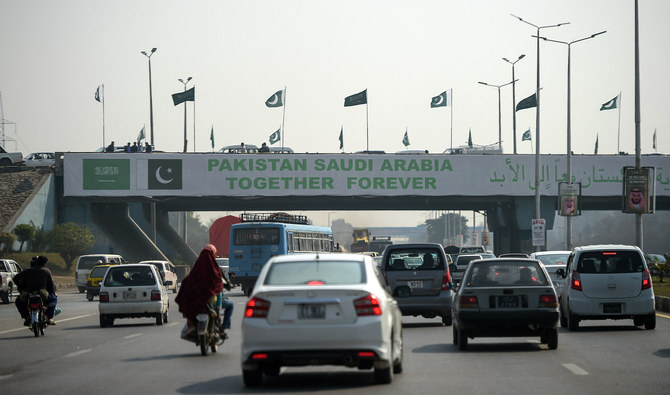
Pakistani commuters drive their vehicles under a banner welcoming Saudi Arabian Crown Prince Mohammed bin Salman displayed on a bridge, ahead of his arrival, in Islamabad on February 15, 2019. (AFP/File)
2 / 2
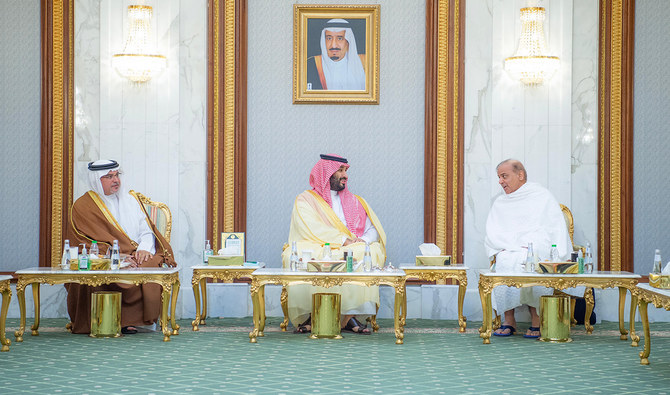
Saudi Crown Prince Mohammed bin Salman (center) meets Pakistan's Prime Minister Shehbaz Sharif (left) in his palace on the eve of 29th Ramadan, during the holy month of Ramadan, in the holy city of Makkah, Saudi Arabia, on April 7, 2024. (Saudi Press Agency)
Short Url
Updated 09 April 2024
Follow

Pakistan, Saudi Arabia reaffirm commitment to expedite $5 billion investment package

  • The development occurs at a meeting between PM Shehbaz Sharif, Crown Prince Mohammed bin Salman
  • Both sides stress the importance of a dialogue between Pakistan and India to ‘resolve outstanding issues’

ISLAMABAD: Pakistan and Saudi Arabia have reaffirmed their commitment to expedite an investment package worth $5 billion discussed previously, the Pakistan foreign office said on Monday, a day after Prime Minister Shehbaz Sharif met with Saudi Crown Prince Mohammed bin Salman.

The prime minister met the Saudi crown prince at the Al-Safa Palace in Makkah Al-Mukarramah on Sunday, according to a joint statement issued by the Pakistani foreign ministry.

During the meeting, the crown prince extended his congratulations to PM Sharif on assuming office, while the Pakistan PM, in turn, conveyed gratitude for the Kingdom’s steadfast support and hospitality.

“The discussions centered on fortifying the fraternal relations between the two brotherly nations and exploring avenues for enhanced collaboration across various sectors,” the joint statement read.

“Emphasis was placed on the Kingdom’s supportive role in Pakistan’s economy and the mutual desire to strengthen trade and investment ties. Both parties affirmed their commitment to expediting the first wave of investment package worth $ 5 billion which was discussed previously.”

Cash-strapped Pakistan desperately needs to shore up its current account deficit and signal to the International Monetary Fund (IMF) that it can continue to meet requirements for foreign financing that has been a key demand in previous bailout packages.

The prime minister invited the crown prince to undertake an official visit to Pakistan at the earliest convenience which was accepted by the Crown Prince Mohammed bin Salman, according to the statement.

Both leaders exchanged views on regional and global developments of mutual interest, including the worrying situation in Gaza.

“They urged for international efforts to halt Israeli military operations in Gaza, mitigate humanitarian impact and underscored the imperative for the international community to pressure Israel to cease hostilities, adhere to international law, and facilitate unhindered humanitarian aid access to Gaza,” it read.

“They discussed the need for advancing the peace process in accordance with relevant resolutions of the Security Council and the General Assembly as well as the Arab Peace Initiative aimed at finding a just and comprehensive solution, for the establishment of an independent Palestinian state with East Jerusalem as its capital.”

The two sides also stressed the importance of dialogue between Pakistan and India to “resolve the outstanding issues between the two countries, especially the Jammu and Kashmir dispute to ensure peace and stability in the region,” according to the joint statement.

The disputed Himalayan region of Kashmir is claimed in full, though ruled in part by both India and Pakistan since independence from Britain in 1947, with the neighbors having fought two of their three wars over it.

Sharif arrived in Saudi Arabia on a three-day official visit on Saturday, his first foreign trip as Pakistan’s chief executive since his election to the post last month. He was accompanied by his niece and Punjab chief minister, Maryam Nawaz Sharif, as well as the ministers of finance, foreign affairs, economic affairs, defense and information. The Pakistani premier and his delegation were also invited to an iftar by the Saudi crown prince.

Pakistan and Saudi Arabia enjoy strong trade, defense and cultural ties. The Kingdom is home to over 2.7 million Pakistani expatriates and serves as the top destination for remittances to the cash-strapped South Asian country.

Saudi Arabia has often come to cash-strapped Pakistan’s aid by regularly providing the South Asian country oil on deferred payment facilities and offering direct financial support to help stabilize its economy, shore up its foreign exchange reserves.


Pakistan’s OGDC ramps up unconventional gas plans

Updated 4 sec ago
Follow

Pakistan’s OGDC ramps up unconventional gas plans

  • Pakistan has long been viewed as having potential in tight and shale gas but commercial output has yet to be proved
  • OGDC says has tripled tight-gas study area to 4,500 square km after new seismic, reservoir analysis indicates potential

ISLAMABAD: Pakistan’s state-run Oil & Gas Development Company is planning a major expansion of unconventional gas developments from early next year, aiming to boost production and reduce reliance on imported liquefied natural gas.

Pakistan has long been viewed as having potential in both tight and shale gas, which are trapped in rock and can only be released with specialized drilling, but commercial output has yet to be proved.

Managing Director Ahmed Lak told Reuters that OGDC had tripled its tight-gas study area to 4,500 square kilometers (1,737 square miles) after new seismic and reservoir analysis indicated larger potential. Phase two of a technical evaluation will finish by end-January, followed by full development plans.

The renewed push comes after US President Donald Trump said Pakistan held “massive” oil reserves in July, a statement analysts said lacked credible geological evidence, but which prompted Islamabad to underscore that it is pursuing its own efforts to unlock unconventional resources.

“We started with 85 wells, but the footprint has expanded massively,” Lak said, adding that OGDC’s next five-year plan would look “drastically different.”

Early results point to a “significant” resource across parts of Sindh and Balochistan, where multiple reservoirs show tight-gas characteristics, he said.

SHALE PILOT RAMPS UP

OGDC is also fast-tracking its shale program, shifting from a single test well to a five- to six-well plan in 2026–27, with expected flows of 3–4 million standard cubic feet per day (mmcfd) per well.

If successful, the development could scale to hundreds or even more than 1,000 wells, Lak said.

He said shale alone could eventually add 600 mmcfd to 1 billion standard cubic feet per day of incremental supply, though partners would be needed if the pilot proves viable.

The company is open to partners “on a reciprocal basis,” potentially exchanging acreage abroad for participation in Pakistan, he said.

A 2015 US Energy Information Administration study estimated Pakistan had 9.1 billion barrels of technically recoverable shale oil, the largest such resource outside China and the United States.

A 2022 assessment found parts of the Indus Basin geologically comparable to North American shale plays, though analysts say commercial viability still hinges on better geomechanical data, expanded fracking capacity and water availability.

OGDC plans to begin drilling a deep-water offshore well in the Indus Basin, known as the Deepal prospect, in the fourth quarter of 2026, Lak said. In October, Turkiye’s TPAO with PPL and its consortium partners, including OGDC, were awarded a block for offshore exploration.

A combination of weak gas demand, rising solar uptake and a rigid LNG import schedule has created a surplus of gas that forced OGDC to curb output and pushed Pakistan to divert cargoes from Italy’s ENI and seek revised terms with Qatar.