

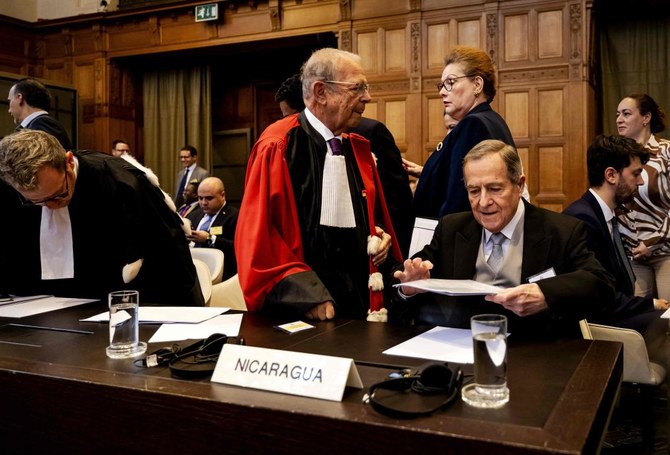

THE HAGUE, Netherlands: Nicaragua on Monday called on the United Nations’ top court to halt German military and other aid to Israel, arguing that Berlin’s support was enabling acts of genocide and breaches of international humanitarian law in the Israel-Hamas war in Gaza.
Opening Nicaragua’s case at the International Court of Justice, the country’s ambassador to the Netherlands, Carlos José Argüello Gómez, told the 16-judge panel that “Germany is failing to honor its own obligation to prevent genocide or to ensure respect of international humanitarian law.”
While the case brought by Nicaragua centers on Germany, it indirectly takes aim at Israel’s military campaign in Gaza following the deadly Oct. 7 attacks when Hamas-led militants stormed into southern Israel, killing some 1,200 people. More than 33,000 Palestinians have been killed in Gaza, according to the territory’s Health Ministry. Its toll doesn’t differentiate between civilians and combatants, but it has said women and children make up the majority of the dead.
Israel strongly denies that its assault amounts to genocidal acts, saying it is acting in self defense. Israeli legal adviser Tal Becker told judges at the court earlier this year that the country is fighting a “war it did not start and did not want.”
But Nicaragua rejected that defense, in a reference to Germany’s support for Israel.
“Surprisingly, Germany seems not to be able to differentiate between self-defense and genocide,” Argüello Gómez said.
Germany, whose lawyers will address the court Tuesday morning, rejects the case brought by Nicaragua.
“Germany has breached neither the Genocide Convention nor international humanitarian law, and we will set this out in detail before the International Court of Justice,” German Foreign Ministry spokesperson Sebastian Fischer told reporters in Berlin on Friday.
Nicaragua has asked the court to hand down preliminary orders known as provisional measures, including that Germany “immediately suspend its aid to Israel, in particular its military assistance including military equipment in so far as this aid may be used in the violation of the Genocide Convention” and international law.
It also wants the court to order Germany to resume funding to the United Nations aid agency in Gaza in addition to the aid Berlin is already providing.
“It is indeed a pathetic excuse to the Palestinian children, women and men in Gaza to provide humanitarian aid, including through airdrops, on the one hand, and to furnish the weapons and military equipment that are used to kill and annihilate them” and humanitarian workers, Nicaragua lawyer Daniel Müller told judges.
The court will likely take weeks to deliver its preliminary decision, and Nicaragua’s case will probably drag on for years.
Monday’s hearing at the world court came amid growing calls for allies to stop supplying arms to Israel as its six-month campaign continues to lay waste to Gaza.
On Friday, the UN’s top human rights body called on countries to stop selling or shipping weapons to Israel. The United States and Germany opposed the resolution.
Also, hundreds of British jurists, including three retired Supreme Court judges, have called on their government to suspend arms sales to Israel after three UK citizens were among seven aid workers from the charity World Central Kitchen killed in Israeli strikes. Israel said the attack on the aid workers was a mistake caused by “misidentification.”
Germany has for decades been a staunch supporter of Israel. Days after the Oct. 7 attack by Hamas, Chancellor Olaf Scholz explained why: “Our own history, our responsibility arising from the Holocaust, makes it a perpetual task for us to stand up for the security of the state of Israel,” he told lawmakers.
Berlin, however, has gradually shifted its tone as civilian casualties in Gaza have soared, becoming increasingly critical of the humanitarian situation in Gaza and speaking out against a ground offensive in Rafah.
Nicaragua’s government, which has historical links with Palestinian organizations dating back to their support for the 1979 Sandinista revolution, was itself accused earlier this year by UN-backed human rights experts of systematic human rights abuses “tantamount to crimes against humanity.” The government of President Daniel Ortega fiercely rejected the allegations.
In January, the ICJ imposed provisional measures ordering Israel to do all it can to prevent death, destruction and acts of genocide in Gaza. The orders came in a case filed by South Africa accusing Israel of breaching the Genocide Convention.
On March 28, the court ordered Israel to take measures to improve the humanitarian situation in Gaza, including opening more land crossings to allow food, water, fuel and other supplies into the war-ravaged enclave.

keywords


