

China provides Gwadar port warning system to mitigate effects of natural disasters

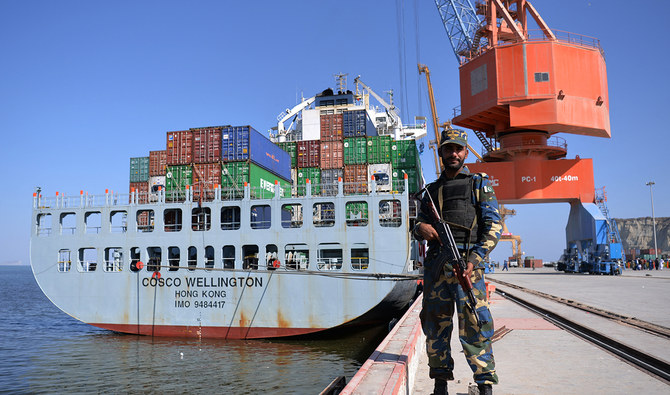
In this photograph taken on November 13, 2016, Pakistani Naval personnel stand guard near a ship carrying containers at the Gwadar port, some 700 kms west of Karachi, during the opening ceremony of a pilot trade programme between Pakistan and China. (AFP/File)
Short Url
Updated 07 April 2024
Follow

China provides Gwadar port warning system to mitigate effects of natural disasters

  • In March, torrential rains triggered urban floods in Gwadar and destroyed nearly 100 homes in the deep-sea port city 
  • China’s meteorological body helping Pakistani counterpart enhance its capacity to meet hydro-meteorological challenges 

ISLAMABAD: China has provided an early warning system to Pakistan’s Gwadar port to help it mitigate the effects of natural disasters such as floods and torrential rains, the state-run Radio Pakistan reported on Sunday. 

The development takes place a month after heavy rains battered Pakistan’s southwestern port city of Gwadar. Streets and neighborhoods in Gwadar as well as other districts in the Balochistan province remained inundated with floodwater for days.

The downpours destroyed nearly a hundred homes in the southwestern province and forced authorities to launch operations to rescue thousands of stranded people.

“China has provided equipment of early warning system to Gwadar port to help mitigate detrimental impacts of natural disasters like catastrophic flood and torrential rain,” Radio Pakistan said. 

China has invested heavily in southwestern Pakistan under the China-Pakistan Economic Corridor Project (CPEC), an energy and infrastructure road that Islamabad hopes would help revive its economy. The multi-billion-dollar corridor is part of President Xi Jinping’s Belt and Road Initiative (BRI). 

“The collaboration between China Meteorological Administration and PMD [Pakistan Meteorological Department] is a part of boosting China Pakistan Economic Corridor’s capacity for emergency management of major metrological disasters under the Belt and Road Initiative,” the report said. 

It said the Chinese meteorological department is helping its Pakistani counterpart enhance its institutional capabilities to meet emerging hydro-meteorological challenges.

Pakistan consistently ranks among one of the most adversely affected countries from the effects of climate change. 

Large swathes of Pakistan were submerged in 2022 due to extremely heavy monsoon rains and melting glaciers, a phenomenon linked to climate change that damaged crops and infrastructure and killed at least 1,700 people and affected over 30 million others.


Security forces kill four militants in Pakistan’s volatile southwest, military says

Updated 13 January 2026
Follow

Security forces kill four militants in Pakistan’s volatile southwest, military says

  • Balochistan, Pakistan’s largest province by land area bordering Iran and Afghanistan, has long been the site of a low-level insurgency
  • The Balochistan government has recently established a threat assessment center to strengthen early warning, prevent ‘terrorism’ incidents

ISLAMABAD: Pakistani security forces gunned down four militants in an intelligence-based operation in the southwestern Balochistan province, the military said on Tuesday.

The operation was conducted in Balochistan’s Kalat district on reports about the presence of militants, according to the Inter-Services Public Relations (ISPR), the Pakistani military’s media wing.

The “Indian-sponsored militants” were killed in an exchange of fire during the operation, while weapons and ammunition were also recovered from the deceased, who remained actively involved in numerous militant activities.

“Sanitization operations are being conducted to eliminate any other Indian-sponsored terrorist found in the area,” the ISPR said in a statement.

There was no immediate response from New Delhi to the statement.

Balochistan, Pakistan’s largest province by land area bordering Iran and Afghanistan, has long been the site of a low-level insurgency involving Baloch separatist groups, including the Balochistan Liberation Army (BLA) and the Balochistan Liberation Front (BLF).

Pakistan accuses India of supporting these separatist militant groups and describes them as “Fitna Al-Hindustan.” New Delhi denies the allegation.

The government in Balochistan has also established a state-of-the-art threat assessment center to strengthen early warning and prevention against “terrorism” incidents, a senior official said this week.

“Information that was once scattered is now shared and acted upon in time, allowing the state to move from reacting after incidents to preventing them before they occur,” Balochistan Additional Chief Secretary Hamza Shafqaat wrote on X.

The development follows a steep rise in militancy-related deaths in Pakistan in 2025. According to statistics released by the Pakistan Institute for Conflict and Security Studies (PICSS) last month, combat-related deaths in 2025 rose 73 percent to 3,387.

These included 2,115 militants, 664 security forces personnel, 580 civilians and 28 members of pro-government peace committees, the think tank said.