

Diaspora donations to the rescue as Pakistan economic crisis squeezes charities during Ramadan

Muslim devotees gather to break their fast during the Islamic holy month of Ramadan in Karachi on March 13, 2024. (AFP)
Short Url
Updated 05 April 2024
Follow

Diaspora donations to the rescue as Pakistan economic crisis squeezes charities during Ramadan

  • Leading charity organizations complain of decreased local donations, say expats now major source of sustenance 
  • World Bank report says 40.1% Pakistanis now living below poverty line due to rising inflation and unemployment

KARACHI: Officials at major Pakistani charities said this week they were receiving fewer local donations of alms during Ramadan amid rising poverty and inflation in the South Asian nation of 241 million people and were having to increasingly rely on contributions from Pakistanis living abroad.

Cash-strapped Pakistan’s $350 billion economy is in crisis with low growth, a weak currency and spiraling prices.

According to a World Bank report released this week, 40.1 percent Pakistanis now live below the poverty line, up from 39.9 percent in the last fiscal year. The report said about 10 million people were floating right above the poverty line and at risk of falling below it.

The economic crisis has changed the traditional dynamics of charity organizations in Pakistan, aid groups said, drying up many of their usual sources of support. Many people who once offered zakat — a pillar of faith requiring all Muslims to donate a portion of their wealth to charity — were now themselves seeking assistance from charities. 

Muslims must meet a certain threshold before they can qualify for zakat. The amount is usually 2.5 percent or 1/40 of an individual’s total savings and wealth.

“Unemployment has increased so much … that those who have been giving zakat, fitrana [charitable donations] and charity all their lives are now coming to us for ration,” Maulana Bashir Ahmed Farooqui, the founding chairman of the Saylani Welfare International Trust (SWIT), one of Pakistan’s largest charities, told Arab News in an interview this week.
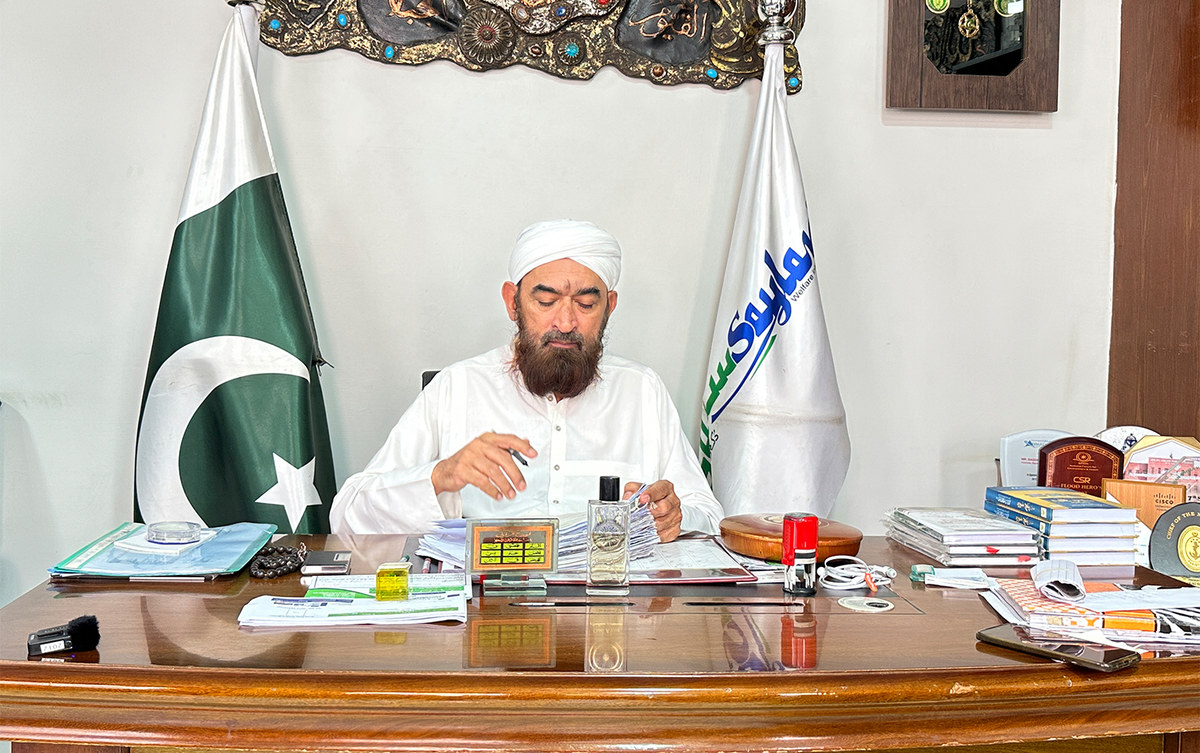


Maulana Bashir Ahmed Farooqui, the founding chairman of the Saylani Welfare International Trust (SWIT), gestures during an interview with Arab News in Karachi, Pakistan on April 4, 2024. (AN photo)

SWIT daily provides three meals a day to 200,000 people as well as other basic humanitarian aid services to 400,000. The charity spent Rs13 billion ($47 million) last year.

But Farooqi said local sources of funding were drying up, while the Pakistani diaspora, particularly expats in the UK, US, UAE and Saudi Arabia, was serving as a lifeline for communities wrestling with poverty, especially in the holy month of Ramadan. 

“A person whose salary was Rs50,000 would give us something everymonth, but now he is unable to survive even with Rs50,000 so what will he give us,” the SWIT chairman said. “Much of our funding is coming from mill owners, construction companies and then overseas Pakistanis. They have held our hand in a big way.”
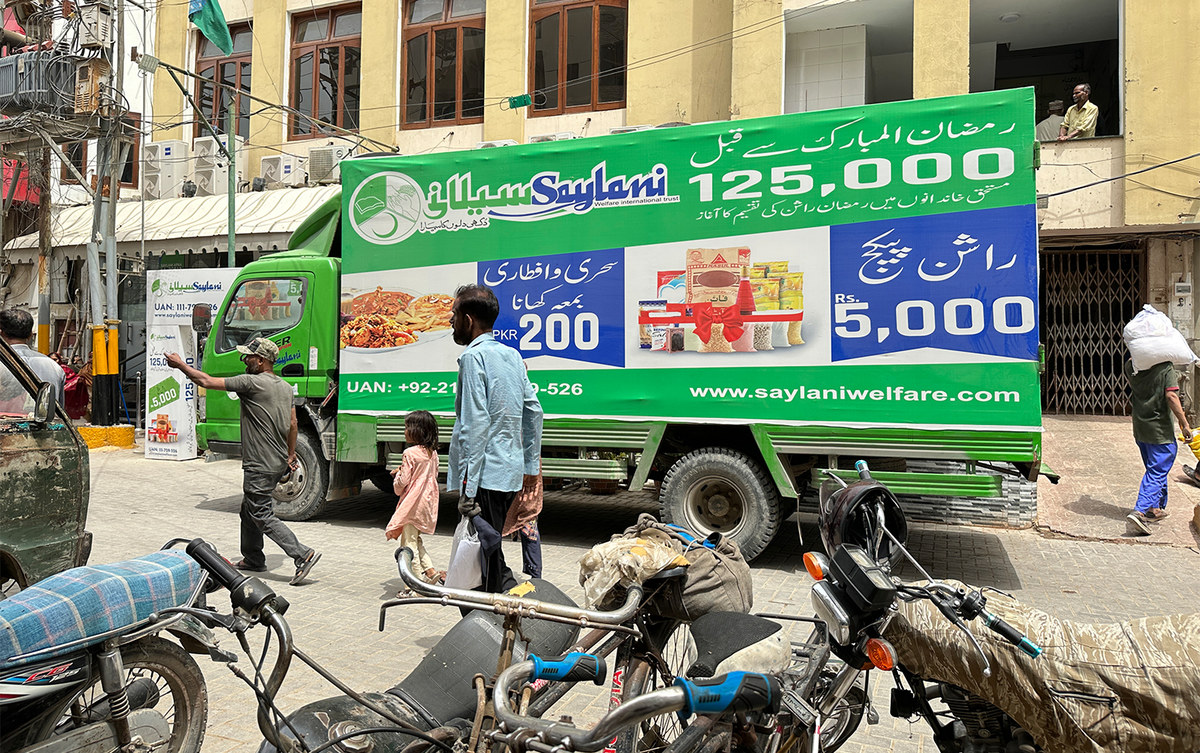


A Saylani food truck is parked on a road in Karachi, Pakistan on April 4, 2024. (AN photo)

Syed Waqas Jafri, the secretary general of AlKhidmat Foundation Pakistan, another large aid group, agreed with Farooqui that local donations had dried up.

“The people who are in low-income groups also used to do charity, but it has become difficult for them now,” he said. “In comparison, the middle and upper classes have been giving more.”

Saad Edhi, a spokesperson for the Edhi Foundation, said the inflow of donations was largely stagnant, but expenditures had doubled due to inflation.

“The flow of donation has not increased as compared to inflation and we are running operations through reserve funds,” he said.

But the Al Qadir Trust, another local charity organization that runs kitchens and clinics, said it had witnessed a rise in donations.

“We don’t have the overseas funding stream, so we rely on local sources,” Amir Madni, the organization’s general secretary, told Arab News. 

“As inflation has more than doubled, people are conscious of the needs of those suffering and they have increased their donations.”


Pakistan terms climate change, demographic pressures as ‘pressing existential risks’

Updated 4 sec ago
Follow

Pakistan terms climate change, demographic pressures as ‘pressing existential risks’

  • Pakistan has suffered frequent climate change-induced disasters, including floods this year that killed over 1,000
  • Pakistan finmin highlights stabilization measures at Doha Forum, discusses economic cooperation with Qatar 

ISLAMABAD: Pakistan’s Finance Minister Muhammad Aurangzeb on Saturday described climate change and demographic pressures as “pressing existential risks” facing the country, calling for urgent climate financing. 

The finance minister was speaking as a member of a high-level panel at the 23rd edition of the Doha Forum, which is being held from Dec. 6–7 in the Qatari capital. Aurangzeb was invited as a speaker on the discussion titled: ‘Global Trade Tensions: Economic Impact and Policy Responses in MENA.’

“He reaffirmed that while Pakistan remained vigilant in the face of geopolitical uncertainty, the more pressing existential risks were climate change and demographic pressures,” the Finance Division said. 

Pakistan has suffered repeated climate disasters in recent years, most notably the 2022 super-floods that submerged one-third of the country, displaced millions and caused an estimated $30 billion in losses. 

This year’s floods killed over 1,000 people and caused at least $2.9 billion in damages to agriculture and infrastructure. Scientists say Pakistan remains among the world’s most climate-vulnerable nations despite contributing less than 1 percent of global greenhouse-gas emissions.

Aurangzeb has previously said climate change and Pakistan’s fast-rising population are the only two factors that can hinder the South Asian country’s efforts to become a $3 trillion economy in the future. 

The finance minister noted that this year’s floods in Pakistan had shaved at least 0.5 percent off GDP growth, calling for urgent climate financing and investment in resilient infrastructure. 

When asked about Pakistan’s fiscal resilience and capability to absorb external shocks, Aurangzeb said Islamabad had rebuilt fiscal buffers. He pointed out that both the primary fiscal balance and current account had returned to surplus, supported significantly by strong remittance inflows of $18–20 billion annually from the Middle East and North Africa (MENA) and Gulf Cooperation Council (GCC) regions. 

Separately, Aurangzeb met his Qatari counterpart Ali Bin Ahmed Al Kuwari to discuss bilateral cooperation. 

“Both sides reaffirmed their commitment to strengthening economic ties, particularly by maximizing opportunities created through the newly concluded GCC–Pakistan Free Trade Agreement, expanding trade flows, and deepening energy cooperation, including long-term LNG collaboration,” the finance ministry said. 

The two also discussed collaboration on digital infrastructure, skills development and regulatory reform. They agreed to establish structured mechanisms to continue joint work in trade diversification, technology, climate resilience, and investment facilitation, the finance ministry said.