

Pakistan in major push to expand trade ties with Central Asian states

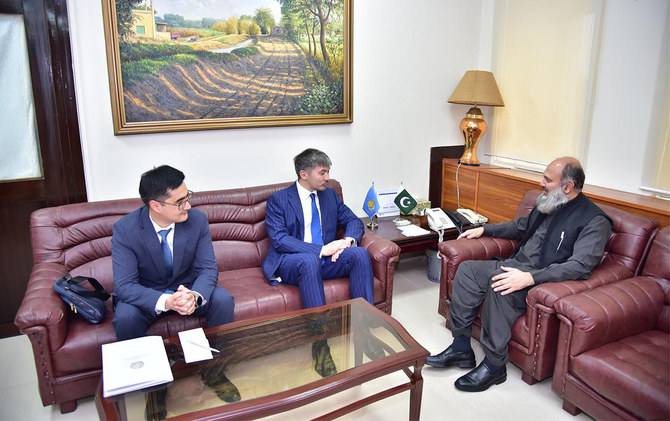
Pakistani Commerce Minister Jam Kamal Khan (left) meets Kazakhstan Ambassador Yerzhan Kistafin (second left) in Islamabad, Pakistan on April 5, 2024. (@jam_kamal/X)
Short Url
Updated 05 April 2024
Follow

Pakistan in major push to expand trade ties with Central Asian states

  • Pakistan seeks to leverage its geostrategic location to connect Central Asian states with the rest of the world
  • The country has invested in infrastructure projects like roads, railways and pipelines, eyeing economic connectivity

ISLAMABAD: Pakistan has been looking to strengthen its trade relations with Central Asian states, including Kazakhstan and Azerbaijan, the Pakistani state media reported on Friday, after Pakistani officials met envoys of two Central Asian republics in Islamabad.

In the first instance, Kazakhstan Ambassador Yerzhan Kistafin held a meeting with Pakistani Commerce Minister Jam Kamal Khan in Islamabad.

"The meeting focused on strategies to increase the trade volume between the two countries," the state-run Radio Pakistan broadcaster reported.

"Both the dignitaries deliberated on the establishment of road maps and improving connectivity to facilitate trade operations."

Separately, Pakistani Industries and Production Minister Rana Tanveer met with Azerbaijan's envoy in Islamabad.

"Development of the industries and agriculture is government's top priority," Tanveer was quoted as saying by Radio Pakistan. "He said practical steps are being taken to bolster exports."

During the meeting, the Azeri ambassador emphasized the need for working together in areas of mutual interest.

Earlier this week, Pakistan opened its trade gateway to Central Asia with first potato shipment to Tajikistan.

Pakistan has aimed to enhance its role as a pivotal trade and transit hub connecting the Central Asian republics with the rest of the world, leveraging its strategic geographical position.

The country has invested in infrastructure projects like roads, railways and pipelines while seeking greater economic connectivity under the China-Pakistan Economic Corridor (CPEC) initiative.


Three Afghan migrants die crossing into Iran as UN warns of new displacement toward Pakistan

Updated 9 sec ago
Follow

Three Afghan migrants die crossing into Iran as UN warns of new displacement toward Pakistan

  • UNHCR says 1.8 million Afghans were forced to return from Iran this year, straining Afghanistan’s resources
  • Rights groups warn forced refugee returns risk harm as Afghanistan faces food shortages and climate shocks

KABUL: Three Afghans died from exposure in freezing temperatures in the western province of Herat while trying to illegally enter Iran, a local army official said on Saturday.

“Three people who wanted to illegally cross the Iran-Afghanistan border have died because of the cold weather,” the Afghan army official told AFP on condition of anonymity.

He added that a shepherd was also found dead in the mountainous area of Kohsan from the cold.

The migrants were part of a group that attempted to cross into Iran on Wednesday and was stopped by Afghan border forces.

“Searches took place on Wednesday night, but the bodies were only found on Thursday,” the army official said.

More than 1.8 million Afghans were forced to return to Afghanistan by the Iranian authorities between January and the end of November 2025, according to the latest figures from the United Nations refugee agency (UNHCR), which said that the majority were “forced and coerced returns.”

“These mass returns in adverse circumstances have strained Afghanistan’s already overstretched resources and services” which leads to “risks of onward and new displacement, including return movements back into Pakistan and Iran and onward,” UNHCR posted on its site dedicated to Afghanistan’s situation.

This week, Amnesty International called on countries to stop forcibly returning people to Afghanistan, citing a “real risk of serious harm for returnees.”

Hit by two major earthquakes in recent months and highly vulnerable to climate change, Afghanistan faces multiple challenges.

It is subject to international sanctions particularly due to the exclusion of women from many jobs and public places, described by the UN as “gender apartheid.”

More than 17 million people in the country are facing acute food insecurity, the UN World Food Program said Tuesday.