

Unidentified gunmen kill another policeman in restive Pakistani district of North Waziristan

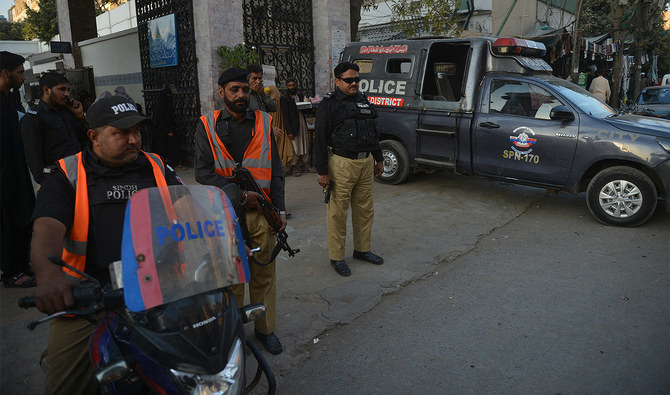
Policemen stand guard outside a mosque in Karachi, Pakistan on January 31, 2023. (AFP/File)
Short Url
Updated 05 April 2024
Follow

Unidentified gunmen kill another policeman in restive Pakistani district of North Waziristan

  • The killing came a day after a counterterrorism official and a cleric were shot dead in separate incidents
  • While no group has claimed responsibility for recent killings, suspicion is likely to fall on Pakistani Taliban

PESHAWAR: Unidentified gunmen on Thursday shot dead a policeman in the restive North Waziristan tribal district in Pakistan’s northwest, a police officer said, a day after the killing of a counterterrorism official and a religious leader in the volatile region.

The slain police official Tariq Khan was on leave in his hometown in Tapi, a rugged village on the outskirts of the district headquarters of Miran Shah, according to District Police Officer (DPO) Rohanzeb Khan.

“At around 5pm today, gunmen on motorbike opened fire, leaving police official dead on the spot,” he told Arab News, adding that body of the slain policeman had been shifted to hospital for medico-legal formalities.

A police team was dispatched to the spot immediately after the killing to collect evidence, according to Khan.

“We don’t have a final say because we’re investigating the case from different angles to know about the nature of the incident. However, as of yet, we are treating it as a case of target killing,” he added. 

On Tuesday, an official, who had been working with the provincial counterterrorism department (CTD), and a senior cleric affiliated with the Jamiat Ulema Islam (JUI) religious party were shot dead in two separate incidents of “targeted killings” in the same district, according to police.

The suspects, who were riding motorbikes, managed to get away from the scene.

While no group has claimed responsibility for the recent spate of killings, suspicion is likely to fall on the Pakistani Taliban, or the outlawed Tehreek-e-Taliban Pakistan (TTP), who have had a significant presence in North Waziristan and adjacent districts before being driven out as a result of successive military operations over the years.

The targeted killings come at a time of renewed militant violence in Pakistan’s northwestern and southwestern regions that border Afghanistan. The violence initially picked up after the TTP called off its fragile, months-long truce with the government in November 2022.

Last month, seven Pakistani soldiers, including two army officers, were killed in a militant attack in the same district, the Pakistani military said. The attack led the Pakistani military to carry out rare airstrikes against suspected TTP hideouts inside Afghanistan on March 18, killing eight people. The strikes prompted Afghan forces to fire heavy weapons at Pakistani soldiers along the border.

Last Wednesday, Afghan Deputy Interior Minister Mohammad Nabi Omari urged Pakistan and the banned TTP to resolve their disputes and start negotiations afresh. But Pakistan’s foreign office on Thursday rejected the Afghan minister’s suggestion, urging Kabul to take action against militant groups operating from its soil. 

Both Pakistan and Afghanistan have traded blame in recent months over who is responsible for a recent spate of militant attacks in Pakistan. Islamabad says the attacks are launched mostly by TTP members who operate from safe havens in Afghanistan. Kabul denies this and blames Islamabad for not being able to handle its own security challenges.


Bangladesh leader pushes for SAARC revival after meeting Indian, Pakistani dignitaries

Updated 5 sec ago
Follow

Bangladesh leader pushes for SAARC revival after meeting Indian, Pakistani dignitaries

  • Muhammad Yunus met Pakistan’s parliamentary speaker, Indian FM at Khaleda Zia’s funeral on Wednesday
  • SAARC has been dysfunctional since 2016, after India withdrew following a militant attack it blamed on Islamabad

ISLAMABAD: Bangladesh Chief Adviser Muhammad Younus this week pushed for reviving the South Asian Association for Regional Cooperation (SAARC) platform after meeting dignitaries from India, Pakistan and other parts of the region. 

SAARC has been effectively dysfunctional since 2016, when its planned Islamabad summit collapsed after India withdrew following a militant attack it blamed on Pakistan. Islamabad denied involvement, but New Delhi’s decision prompted Afghanistan, Bangladesh and Bhutan to pull out, leading to the indefinite postponement of the summit.

Younus met Pakistan’s National Assembly Speaker Ayaz Sadiq and Indian External Affairs Minister Subrahmanyam Jaishankar at former Bangladesh premier Khaleda Zia’s state funeral in Dhaka on Wednesday. The funeral also saw a handshake between the Indian and Pakistani representatives, the first high-level contact between officials of the two countries since their conflict in May. 

“During the meetings, Professor Yunus repeatedly emphasized the need to revive the South Asian Association for Regional Cooperation (SAARC),” Yunus’ account on social media platform X said.

“We witnessed a true SAARC spirit at the funeral yesterday,” the account quoted Yunus as saying. “SAARC is still alive. The SAARC spirit is still alive.”

The Bangladesh leader said apart from Jaishankar and Sadiq, representatives from South Asia who attended the funeral included Nepal’s Foreign Minister Bala Nanda Sharma, Sri Lanka’s Minister of Foreign Affairs, Employment and Tourism Vijitha Herath, and Maldives Minister of Higher Education and Labor Ali Haider Ahmed. 

Yunus said he tried to convene an informal gathering of SAARC leaders on the sidelines of the UN General Assembly in New York last year.

His statement to revive SAARC follows that of Pakistan’s Prime Minister Shehbaz Sharif, who earlier this month also called for reviving the South Asian platform. 

Sharif’s message last month came as the bloc marked the 40th anniversary of its founding charter. The Pakistani premier stressed the importance of deeper economic collaboration and collective responses to shared regional challenges such as poverty, climate-induced natural disasters, food and energy insecurity, and public-health vulnerabilities.