

‘Reckless’ Houthi Red Sea campaign harming Yemenis, Palestinians – US special envoy

US Special Envoy for Yemen Tim Lenderking said, on Wednesday, that the purpose of the strikes was to destroy the Houthis’ ability to attack ships. (Reuters)
Short Url
Updated 04 April 2024
Follow

‘Reckless’ Houthi Red Sea campaign harming Yemenis, Palestinians – US special envoy

  • Attacks on shipping hampering aid to Gaza, Timothy Lenderking tells briefing attended by Arab News
  • He praises Saudi efforts to mediate between Houthis, internationally recognized Yemeni government

LONDON: Continuing Houthi attacks on shipping in the Red Sea are “misplaced, reckless and indiscriminate,” the US special envoy for Yemen said on Wednesday during a briefing attended by Arab News.

Timothy Lenderking added that the Houthis’ activities are harming both ordinary Yemenis and Palestinians, who they claim to be acting in support of.

In a briefing from Muscat following a meeting with Omani Foreign Minister Sayyid Badr Al-Busaidi, and having spent the previous day in Riyadh, Lenderking said Houthi attacks are preventing aid from reaching Palestinians, as well as disrupting global trade.

He added that as well as international shipping entering the Suez Canal, traffic at the Yemeni port city of Hodeidah is also being affected, down 15 percent this year, hindering the flow of essential goods into the country.

Lenderking said ongoing military activity in the region is disrupting local industries, especially fishing, which is having an additional impact on the local economy and is having a detrimental effect on wildlife.

“The Houthis claim to be helping the Palestinians but are hurting them,” he added. “We all want Yemen to be a source of stability for the region.”

Houthi attacks “must stop so we can direct our attention back to the (Yemeni) peace process and to turn our attention to Palestine and the two-state solution,” he said, adding that “Houthi recklessness” is being facilitated by Iran, which is “sowing instability across the region” and “continues to enable these attacks, providing weapons and (is a) leading sponsor of terrorism.”

Lenderking said both the designation of the Houthis as a terrorist group and US strikes on their positions in Yemen are hampering their combat activities and fundraising, but insisted that the US, along with the likes of France and the UK, would prefer a diplomatic solution.

He said his meetings in Oman and Saudi Arabia are a demonstration of Washington’s “unshakeable” commitment to the Yemeni peace process, adding: “The US has been very clear that we seek de-escalation in the Red Sea, and that the Houthi attacks can’t continue.”

The Houthis “can still de-escalate and return to the peace process,” said Lenderking, who praised the Saudi role in mediating between the Houthis and the internationally recognized Yemeni government.

“I continue to meet with a broad range of officials and other Yemeni officials in Riyadh,” he said. “I think all of these consultations are extremely important in narrowing the differences that may exist between the conflicting parties.”

He added: “The fact that Saudi Arabia and the Houthis have been able to make progress, Saudi Arabia mediating between the Houthis and Yemeni government … gives us some hope that we can use this moment to get beyond … this nine-year civil war.”

Lenderking warned, though, that action would be required on the part of the Houthis to regain the trust of the international community.

“Unfortunately, these attacks against international shipping have undermined the credibility of the Houthis as a good-faith actor,” he said, calling on them to release the 25 crew members of the Galaxy Leader ship, abducted in November last year, which had “no connection with Israel.”

Lenderking added that the international community should not let the Gaza conflict stunt the peace process in Yemen. 

He defended America’s “longstanding commitment to Israel’s security,” but added: “That, of course, doesn’t mean rampant attacks on civilians, which the US has called out.”

First responders enter devastated Aleppo neighborhood after days of deadly fighting

Updated 10 sec ago
Follow

First responders enter devastated Aleppo neighborhood after days of deadly fighting

  • The US-backed SDF, which have played a key role in combating the Daesh group in large swaths of eastern Syria, are the largest force yet to be absorbed into Syria’s national army

ALEPPO, Syria: First responders on Sunday entered a contested neighborhood in Syria’ s northern city of Aleppo after days of deadly clashes between government forces and Kurdish-led forces. Syrian state media said the military was deployed in large numbers.
The clashes broke out Tuesday in the predominantly Kurdish neighborhoods of Sheikh Maqsoud, Achrafieh and Bani Zaid after the government and the Syrian Democratic Forces, the main Kurdish-led force in the country, failed to make progress on how to merge the SDF into the national army. Security forces captured Achrafieh and Bani Zaid.
The fighting between the two sides was the most intense since the fall of then-President Bashar Assad to insurgents in December 2024. At least 23 people were killed in five days of clashes and more than 140,000 were displaced amid shelling and drone strikes.
The US-backed SDF, which have played a key role in combating the Daesh group in large swaths of eastern Syria, are the largest force yet to be absorbed into Syria’s national army. Some of the factions that make up the army, however, were previously Turkish-backed insurgent groups that have a long history of clashing with Kurdish forces.
The Kurdish fighters have now evacuated from the Sheikh Maqsoud neighborhood to northeastern Syria, which is under the control of the SDF. However, they said in a statement they will continue to fight now that the wounded and civilians have been evacuated, in what they called a “partial ceasefire.”
The neighborhood appeared calm Sunday. The United Nations said it was trying to dispatch more convoys to the neighborhoods with food, fuel, blankets and other urgent supplies.
Government security forces brought journalists to tour the devastated area, showing them the damaged Khalid Al-Fajer Hospital and a military position belonging to the SDF’s security forces that government forces had targeted.
The SDF statement accused the government of targeting the hospital “dozens of times” before patients were evacuated. Damascus accused the Kurdish-led group of using the hospital and other civilian facilities as military positions.
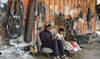
On one street, Syrian Red Crescent first responders spoke to a resident surrounded by charred cars and badly damaged residential buildings.
Some residents told The Associated Press that SDF forces did not allow their cars through checkpoints to leave.
“We lived a night of horror. I still cannot believe that I am right here standing on my own two feet,” said Ahmad Shaikho. “So far the situation has been calm. There hasn’t been any gunfire.”
Syrian Civil Defense first responders have been disarming improvised mines that they say were left by the Kurdish forces as booby traps.
Residents who fled are not being allowed back into the neighborhood until all the mines are cleared. Some were reminded of the displacement during Syria’s long civil war.
“I want to go back to my home, I beg you,” said Hoda Alnasiri.