



KARACHI: Sana Azeem, who comes from a third generation Gujarati-speaking family in Karachi, learnt traditional cooking from her mother, who taught her recipes passed down by her late grandmother.
Now, Gujarati recipes preserved over decades are always an integral part of Azeem’s iftar meal spreads in Ramadan, as they are for around three million Gujarati-speaking people settled in Karachi, most of whom migrated to the southern Pakistani port city after the partition of the Indian subcontinent in 1947 while many have lived there since the mid 1800s.
Karachi has thus been penetrated by the taste of Gujarati food for decades, with a few restaurants even exclusively serving Gujarati food.
“We grew up savoring these dishes in Ramadan,” Azeem, a 35-year-old teacher, told Arab News at her home as she prepared an iftar meal of Gujarati food last week.
Azeem’s father comes from a village called Gala in India’s Gujarat, while her mother hails from Bodhan in the Indian state of Telangana. Her paternal family moved to Pakistan after 1947 and her parents tied the knot in Pakistan.
Among the dishes Azeem loves to feed her family and friends in Ramadan are khandvi, a popular savoury snack made of gram flour and yogurt, batata vada, a mashed potato patty coated with chickpea flour, farmaas puri , which is a deep fried flatbread, and bhelpuri, a type of chaat made of puffed rice, vegetables and a tangy tamarind sauce.
The dishes are popular across Gujarati households in Pakistan during the month of Ramadan, Azeem said.
“There hasn’t been any variation [in the recipes] up till now. Most people follow [the same recipes] in Pakistan and abroad,” she said.
Khandvi is particularly popular during Ramadan but is made in Gujarati households the rest of the year also.
“It has a salty taste and a nice aroma when we serve it with tarka,” Azeem said, referring to a method of seasoning food with spices heated in oil or ghee.
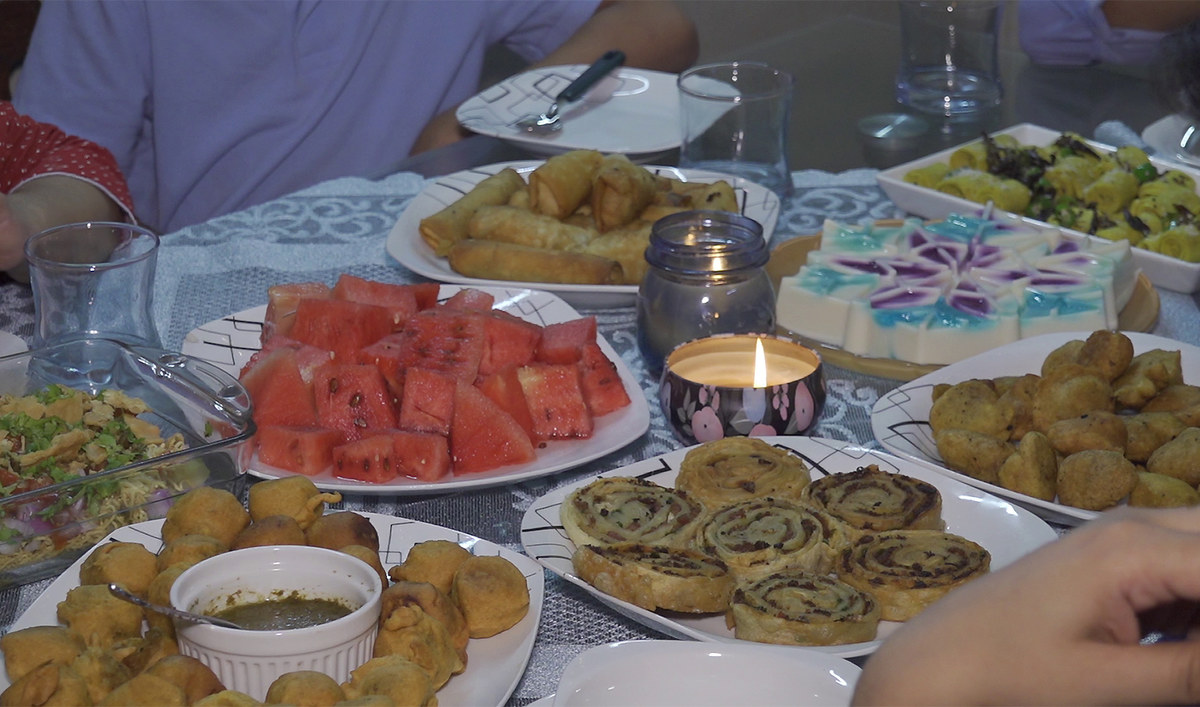
Sana Azeem (left) and her family (not pictured) break fast with Gujarati food during Ramadan in Karachi, Pakistan on March 30, 2024. (AN photo)
Batata vada, made with mashed potatoes and spices originating in Gujarat’s Surat city, was in Gujarati households the equivalent of pakoras, or fritters, a Ramadan staple in Pakistan, according to Azeem.
Farmaas puri, on the other hand, was a rather unique addition to the menu which originated from South Africa, but became a popular dish among Gujaratis in both India and Pakistan.
The puris are made by stacking together multiple layers of samosa sheets with minced meat, which are then rolled and kept overnight in the freezer to set the base. The dough is then cut into flat, round slices and deep-fried before serving.
“Gujarati families in Pakistan also make it,” Azeem said, adding that she learnt to make it from her in-laws family. “Its taste is similar to samosas so we also make it at times during Ramadan.”
Another popular dish, kopyanju, is an alternative for spring rolls for Gujaratis, with filings that include minced meat, split chickpea and boiled eggs.
Gujaratis also frequently make bHajjiya in Ramadan for its “nutritional value,” Azeem said.
“It has green gram beans, especially protein,” she said. “If I speak about my own family, we make it quite frequently other than Ramadan too as a snack with evening tea. During Ramadan, it gets the same importance as pakoras.”
Culture and food writer Ahmer Naqvi said Gujarati food was popular in Karachi as many Gujarati speakers, mostly merchants and businessmen, had settled in the city as far back as the 1850s when the British established a port.
“Since they are probably one of the oldest communities that migrated to Karachi, you see the presence of their cuisine and their food culture all over the city,” Naqvi said.
“There are many specific Gujarati delicacies that are still quite popular during some special occasions, for instance Ramadan. The influence of Gujarati cuisine on Karachi’s cuisine is unmistakable.”


